
 Nicole:
http://prntscr.com/nqy5xd
Nicole:
@Vocaloid
Nicole:
@Narad
 Narad:
Yes
Narad:
yes
Narad:
Yes
Narad:
Yes
Narad:
All ok
Narad:
All ok
Nicole:
@Narad can you please tell me what those answers were for those questions please?^
Nicole:
because it isnt there anymore
Narad:
Which one?
Nicole:
http://prntscr.com/nqycu6 http://prntscr.com/nqydq2 http://prntscr.com/nqyf07 http://prntscr.com/nqyf8g http://prntscr.com/nqyflv http://prntscr.com/nqygip http://prntscr.com/nqyhd0 http://prntscr.com/nqyhxn http://prntscr.com/nqyijr http://prntscr.com/nqyjb2
Nicole:
you answered them before I just dont see the answers anymore
Narad:
Thet have been removed
Narad:
1st one \[sinB= 0.88\] The angle is \ From my calculator, B=1.08
Narad:
2nd question \[tanB=0.34\] Therefore, the angle is \ From my calculator, B=0.33 rad
Narad:
3rd question \[cosA=0.23\] So, the angle is \[A=\cos ^{-1}(0.23)\] From my calculator, the angle is A=1.34 rads
Narad:
4th question sinB= 11/18 so, the angle is \ From my calculator, the angle is B= 37.67º
Narad:
5th question From the drawing \[sinA=2/4=1/2\] Therefore, the angle is \[A= \sin ^{-1}(0.5)\] From , the unit circle A=30º
Narad:
6th question From the given triangle, by applying Pythagoras theorem \[AB ^{2} = AC ^{2} +BC ^{2}\] AC=5 BC=4 Therefore \[AB ^{2}= 5^2+4^2 =25+16=41\] so, \[AB=\sqrt{41}=6.40\]
Narad:
7th question From the triangle XYZ, \[\tan50º = YZ/XZ\] but, XZ= 6.1 therefore, \[YZ=XZ*\tan50º\] \[YZ=6.1*\tan50º = 7.27\]
Narad:
8th question In the triangle ABC, we have \[tanA=BC/AC\] BC= 4 AC= 5 Therefore, \[tanA=4/5=0.8\] And the angle is \[A= \tan ^{-1}(0.8)= 38.66º\]
Narad:
9th question From the drawing \[\tan50º=x/50\] Therefore, \[x=50*\tan50º= 59.59\] The height of the building is \[H= 5+x=59.59+5=64.59 ft\]
Narad:
10th question The ladder makes an angle of 45º and is 7 ft from the wall Therefore, we have an isoceles triangle By the Pythagoras theorem, The length of the ladder is \[l=\sqrt{7^2+7^2} = 9.90m\] You can also use sin or cosine
Nicole:
@Narad
Narad:
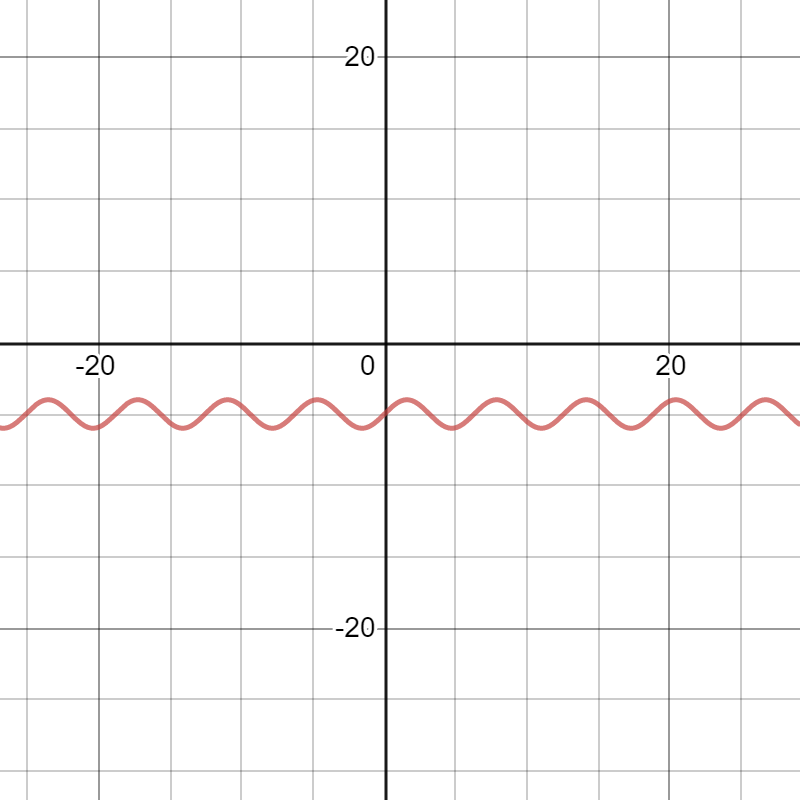
The function to be graphed is \[f(x)=\sin(x)-5\] When x=0, \[f(0)=\sin(0)-5=-5\] When \[x=\pi\], \[f(\pi)=\sin(\pi)-5=-5\] When \[x=\pi/2\], \[f(\pi/2)=\sin(\pi/2)-5=1-5=-4\] When \[x=-\pi/2\], \[f(-\pi/2)=\sin(-\pi/2)-5=-6\] The domain is \[=\mathbb{R} \] The range is\[y \in [-6,-4]\]
Nicole:
Okay but how would it look graphed?

 Nicole:
Hmm I cant see it?
Narad:
\[-1\le sinx \le 1\] \[-1-5\le sinx-5\le1-5\] \[-6\le f(x)\le-4\] This is the range
Nicole:
no im just asking like it says we also have to graph it so can you show me how?
Narad:
You calculate all the points by an incrementation of pi/2 x= -5pi, -4.5pi, -4.0pi, -3.5pi, -3.0pi, -2.5pi, -2.0pi, -1.5pi, -1.0pi,-0.5pi,0, 0.5pi, 1pi,1.5pi.2pi, 2.5pi. 3.0pi, 3.5pi,4.0pi, 4.5pi,5pi you calculate all the point y= f(x)=sin(x)-5 And you plot the curve
 Nicole:
but it says graph by radians?
Nicole:
@Narad ?
Narad:
The maximum are at (-7pi/2,-3pi/2, pi/2, 9pi/2) The minimum are at (-5pi/2, -pi/2,3pi/2,11pi/2)
Nicole:
@Vocaloid some input please
Nicole:
@Narad the next question is :http://prntscr.com/nr4ch4
Nicole:
domain and range? @Narad
 Narad:
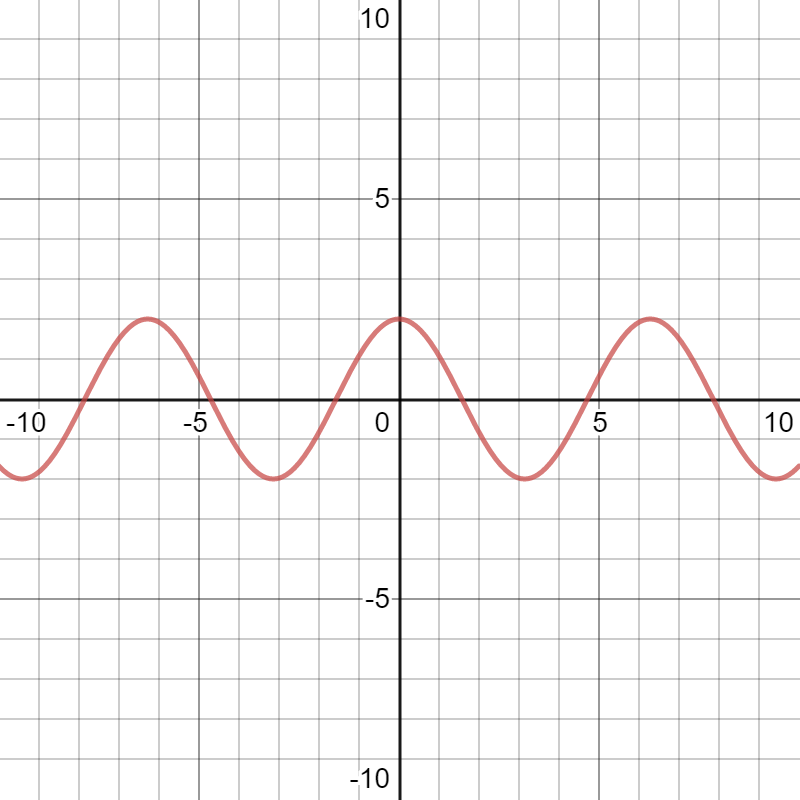
The graph is as the attachement. The domain is all real numbers \[-1\le cosx \le1\] \[-2\le 2cosx \le2\] The range is\[ y \in [-2, 2]\] The maxima are at (-4pi, -2pi, 0, 2pi, 4pi) The minima are at (-3pi, -pi, pi, 3pi)
Nicole:
@Narad
Join our real-time social learning platform and learn together with your friends!
 KBaby:
Verse 1 We left our names in the dust of the driveway Watched the old town shrink
KBaby:
Lyrics Generator Use AI to write the lyrics for a song. Suggested Genres: Pop Hip
KBaby:
Verse 1 We left our names in the dust of the driveway Watched the old town shrink
KBaby:
Lyrics Generator Use AI to write the lyrics for a song. Suggested Genres: Pop Hip
 aitexturegenerator:
How are you all handling AI-generated textures for 3D models and game assets without losing the hand-made feel? I've been doing a small stylized environment
aitexturegenerator:
How are you all handling AI-generated textures for 3D models and game assets without losing the hand-made feel? I've been doing a small stylized environment

 Demon25:
Woke up feeling like that girl and that dude well he still aint crap pluse the du
Demon25:
Woke up feeling like that girl and that dude well he still aint crap pluse the du
 playtsec:
how do I get rid of stress from teachers... I just feel like running out the classroom and leaving on my own.
playtsec:
how do I get rid of stress from teachers... I just feel like running out the classroom and leaving on my own.
 JohnnyLFowler0812:
What type of gamer would play something and then get off for a while. Why not sta
JohnnyLFowler0812:
Which is better? Metallica Rap Country R&B hiphop Medal Gospel Chill Which 3 opti
JohnnyLFowler0812:
What type of gamer would play something and then get off for a while. Why not sta
JohnnyLFowler0812:
Which is better? Metallica Rap Country R&B hiphop Medal Gospel Chill Which 3 opti