
 mhchen:
@jungkook22 Allow me to show you the beauty of math? What I'll go through eventually: 1. History 2. Music: Sound Frequencies and Instrument Architecture 3. Photography 4. Human Anatomy 5. Art 6. Flowers
 Gdeinward:
I would love to be shown the beauty of math o great one.
mhchen:
Unfortunately jungkook doesn't want to but sure I'll give you a ride Gdeinward. First of all. Solve for A and B using simple algebra: |dw:1568336832045:dw|
Gdeinward:
are the 2 equations correlated or are they separate?
Gdeinward:
ah I thought so, but I was confused for a sec
Gdeinward:
Ah it's a lat night. I'm having a bit of trouble
mhchen:
So A = 1 - B Then by substitution: \[\frac{B}{1-B} = \frac{1-B}{(1-B)+B}\] so \[ B = (1-B)^{2} \] Can you solve quadratics?
Gdeinward:
yes that is something I can do
Gdeinward:
B = (1-b)(1-b)
Gdeinward:
1-b2-b²
Gdeinward:
B = b² - b2 - 1 0 = b² -b3 - 1
Gdeinward:
the answer would be b = 3/2 - sqrt(13)/2 and b = 3/2 + sqrt(13)/2 right?
Gdeinward:
-0.302 and 0.302 right?
Gdeinward:
sorry 3.302 and -0.302
Gdeinward:
that solution is incorrect?
Gdeinward:
I followed the rules, that is classic polynomial form, im confused
Gdeinward:
Oh I see. Iwas trying to organize it better and I messed it up
Gdeinward:
-b^2-3b+1 = 0 is correct
Gdeinward:
its -3.302 and 0.302
Gdeinward:
Im so sorry. I feel like a dum dum
 JSVSL7:
\(\color{#0cbb34}{\text{Originally Posted by}}\) @Gdeinward Im so sorry. I feel like a dum dum \(\color{#0cbb34}{\text{End of Quote}}\) Gdein silly mistakes happen, -b * -b is simply b^2 not -b^2 so solve for b^2-3b+1
mhchen:
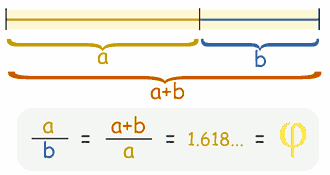
He's right. To save time, take a look at this. a/b = 1.618... What is b/a? Google this number and tell me what it is.
 JSVSL7:
WOW
JSVSL7:
It's pretty cool, it's the same number that forms the ratio in the fibonacci sequence, and the same ratio of our facial structuring
mhchen:
Exactly. Good understanding so far JSVSL7. The golden ratio is related to the best, most aesthetic position. Now then, tell me what happened on June 18, 618 AD (6/18/618)
JSVSL7:
Not sure what happened that year
mhchen:
Which Chinese dynasty was considered "China's Golden Age"?
JSVSL7:
Ah, you're referring to the Tang Dynasty?
mhchen:
And when did the Tang Dynasty begin
JSVSL7:
Same date
 xabippemeff:
X died that same day
JSVSL7:
I thought of that too ^
mhchen:
You can look more into what humanity was like during the Tang Dynasty. It was a semi-divine culture. Shen Yun is a Classical Chinese Dance show that revives the lost culture through dancing if you want to check them out: https://www.shenyunperformingarts.org/explore/view/article/e/5cYFXdEoCP4/tang-dynasty.html Anyways I'll leave that exploration for you. Let's go with 2. Music: An octave is 8 notes apart, or 13 counting the sharps/flats. (see how it relates to the fibonacci?) In music theory, what is a major chord made out of?
mhchen:
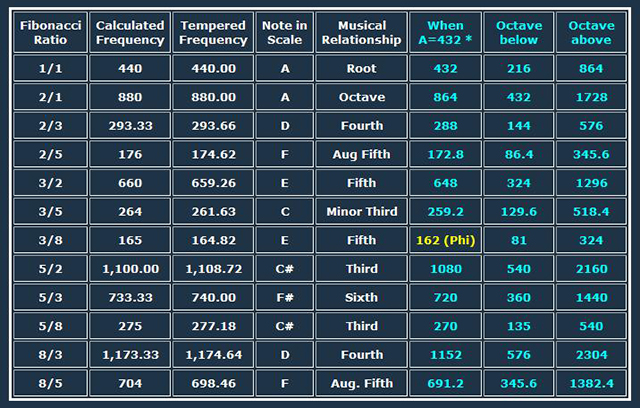
So a major chord is composed of a root (any note, for example, A). a major third, and a perfect fifth. (notice the resemblance to fibonnaci sequence) Let's take a look at their frequencies:
 mhchen:
If you have a piano, you can experiment playing chords (Root) - (Root+5) - (Root+8) , or (Root) - (Root+8) - (Root+13) if counting black keys For example: A-E-A C-G-C G#-D#-G# and compare them with any other chord with a slight change in notes. See how it sounds. Next up: Photography, someone tell me what the Rule of Thirds is used for.
 akshay:
Rule of third is used to show the focus of an object along those intersection lines? I took photography a while back
akshay:
But not to interrupt, The Taj Mahal's entrance also has its aesthetic designed with the golden ratio
JSVSL7:
Traditional Persian and Khorasan (afghanistan and some of pakistan) architecture also had a large significance of golden ratio
mhchen:
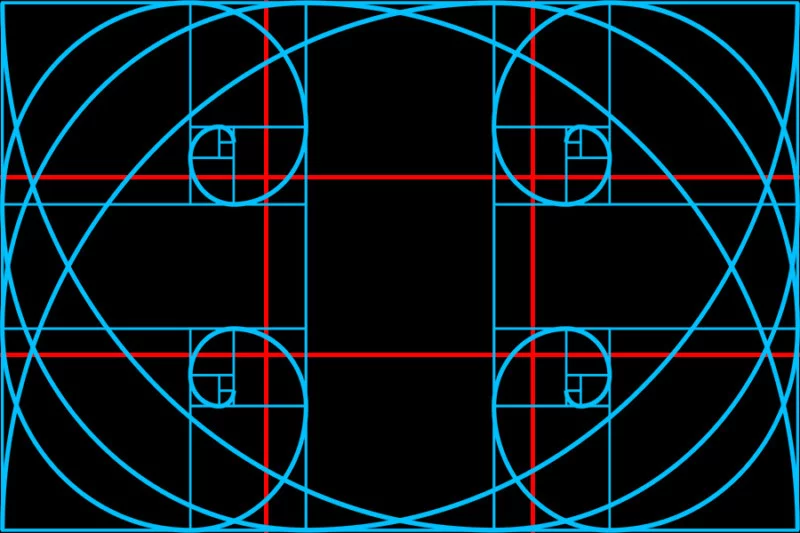
Very good, it is almost at the point where the golden spirals lie, but not quite: You can google examples yourselves. We can apply the same thing to things like Leonardo Da Vinci's Study of Human Proportions, proportions of musical instrument bodies, art, flowers, architecture (like you said) etc...
 akshay:
Cool thx
mhchen:
I'm tired xd. I'll stop here. I think these are enough to get you passionate about applying math to things.
akshay:
@jhonyy9 I'm sure he would like to see
akshay:
Thx I'm mindblown
Gdeinward:
Yeah thank you, sorry I couldn't stay to see it! That is very interesting.
jungkook22:
I am slightly scared now
Join our real-time social learning platform and learn together with your friends!
 KBaby:
Verse 1 We left our names in the dust of the driveway Watched the old town shrink
KBaby:
Lyrics Generator Use AI to write the lyrics for a song. Suggested Genres: Pop Hip
KBaby:
Verse 1 We left our names in the dust of the driveway Watched the old town shrink
KBaby:
Lyrics Generator Use AI to write the lyrics for a song. Suggested Genres: Pop Hip
 aitexturegenerator:
How are you all handling AI-generated textures for 3D models and game assets without losing the hand-made feel? I've been doing a small stylized environment
aitexturegenerator:
How are you all handling AI-generated textures for 3D models and game assets without losing the hand-made feel? I've been doing a small stylized environment

 Demon25:
Woke up feeling like that girl and that dude well he still aint crap pluse the du
Demon25:
Woke up feeling like that girl and that dude well he still aint crap pluse the du
 playtsec:
how do I get rid of stress from teachers... I just feel like running out the classroom and leaving on my own.
playtsec:
how do I get rid of stress from teachers... I just feel like running out the classroom and leaving on my own.
 JohnnyLFowler0812:
What type of gamer would play something and then get off for a while. Why not sta
JohnnyLFowler0812:
Which is better? Metallica Rap Country R&B hiphop Medal Gospel Chill Which 3 opti
JohnnyLFowler0812:
What type of gamer would play something and then get off for a while. Why not sta
JohnnyLFowler0812:
Which is better? Metallica Rap Country R&B hiphop Medal Gospel Chill Which 3 opti