
 Ballery1:
Math help plz
Ballery1:
Find the equation of the tangent line to the graph of \[F(x) = \frac{ 2x }{ x^2+3 }\] at \[(-1, \frac{ -1 }{ 2 })\]. Determine the point(s) on the graph where the tangent line is horizontal.
Ballery1:
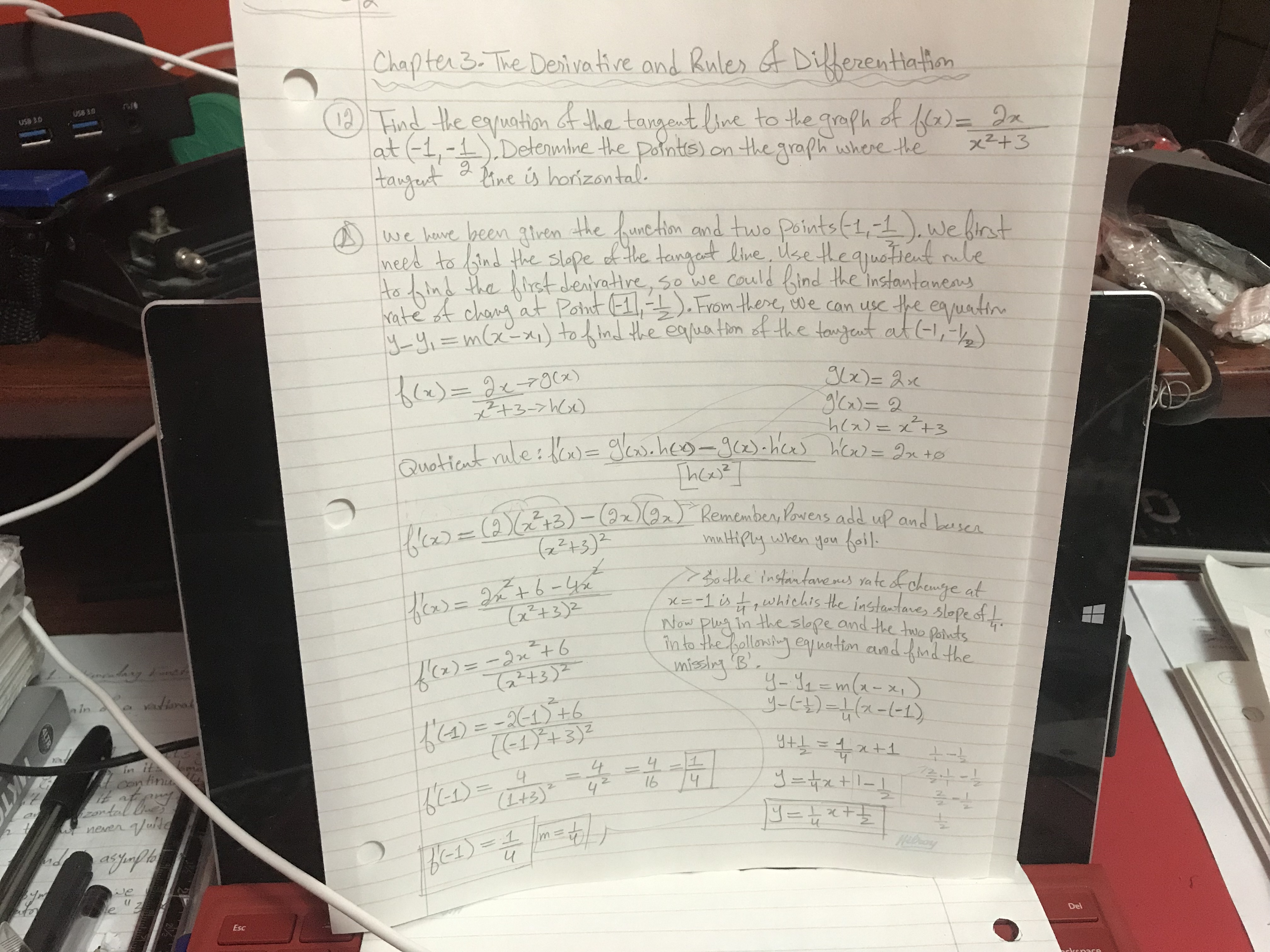
So i’ve Been given the function and two points. I need to first find the slope of the tangent. Once i have the slope and the points. I can use the equation \[y - y_1 = m( x - x_1)\]
Ballery1:
Nvm i figured it out lol
Ballery1:
I’ve found the equation of the tangent line. But i can’t do the next question by myself. @Narad The question is, Determine the point(s) on the graph where the tangent line is horizontal.
Ballery1:
Let me post my solution to the first part. One second.
 Ballery1:
Do i take the second derivative? Or maybe third?
Ballery1:
@Nnesha
 Hero:
Hero:
I would have done the entire write up on Mathcha
Hero:
Probably wouldn't have used as many words though
Hero:
Your tangent line is a bit off btw
Ballery1:
Omg i see it... i wrote 1/2 instead of 1/4 lol
Hero:
Correct
Hero:
When applying the point slope formula \(y - y_1 = m(x - x_1)\) you have to distribute the \(m\) after inserting the points \(y - y_1 = mx - mx_1\)
Ballery1:
I see :)
Hero:
Very good.
Ballery1:
So how do you determine the point(s) on the graph where the tangent line is horizontal?
Hero:
Sounds a second derivative level task.
Hero:
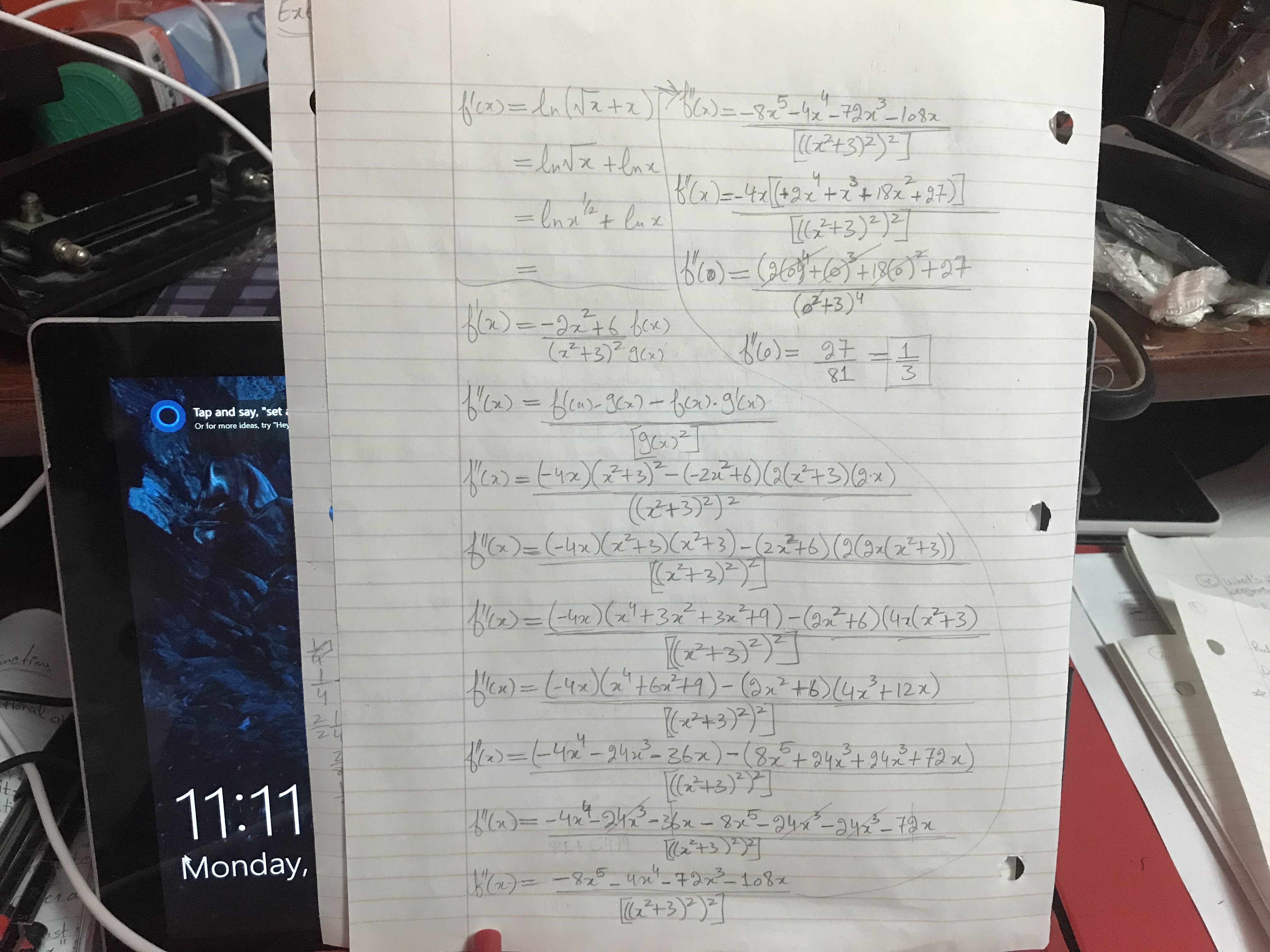
I think you're supposed to find the second derivative then set it to 0 and solve for x, but don't quote me on it. You're just finding the values for which the slope is zero.
Ballery1:
Yes
Ballery1:
Ok let me try.
 Ballery1:
the answer is... |dw:1569294798932:dw|
Hero:
Explain how you got the \(\sqrt{3}\)
Ballery1:
that’s the book answer. when i plugged in 0 in to the second derivative *as you told me* i got 1/3.
Ballery1:
my posted my solution up there
Hero:
That 1/3 is your f(x) value. You're supposed to use in place of f(x) for the original function then solve for x.
Hero:
Since f(x) is an odd function you're supposed to also try the the negative of the x you found to see if that is also produces a slope of zero.
Ballery1:
ok i’ll do that... let me finish this implicit notes first. i’ll post the answer here
Hero:
You're supposed to test them using f'(x)
Hero:
f'(x) = 0
Hero:
or rather test if f prime of (1/3) = 0
Hero:
When you set f(x) = 1/3 you're looking for the x coordinate of the point that the horizontal tangent line intercepts
Ballery1:
i see now.
Hero:
By the way you know that f(x) is odd because you can rewrite it as \(f(x) = \left(\dfrac{1}{x^2 + 3}\right)(2x)\)
Hero:
The first expression is even, the second expression is odd. Even times Odd = Odd
 Hero:
Hero:
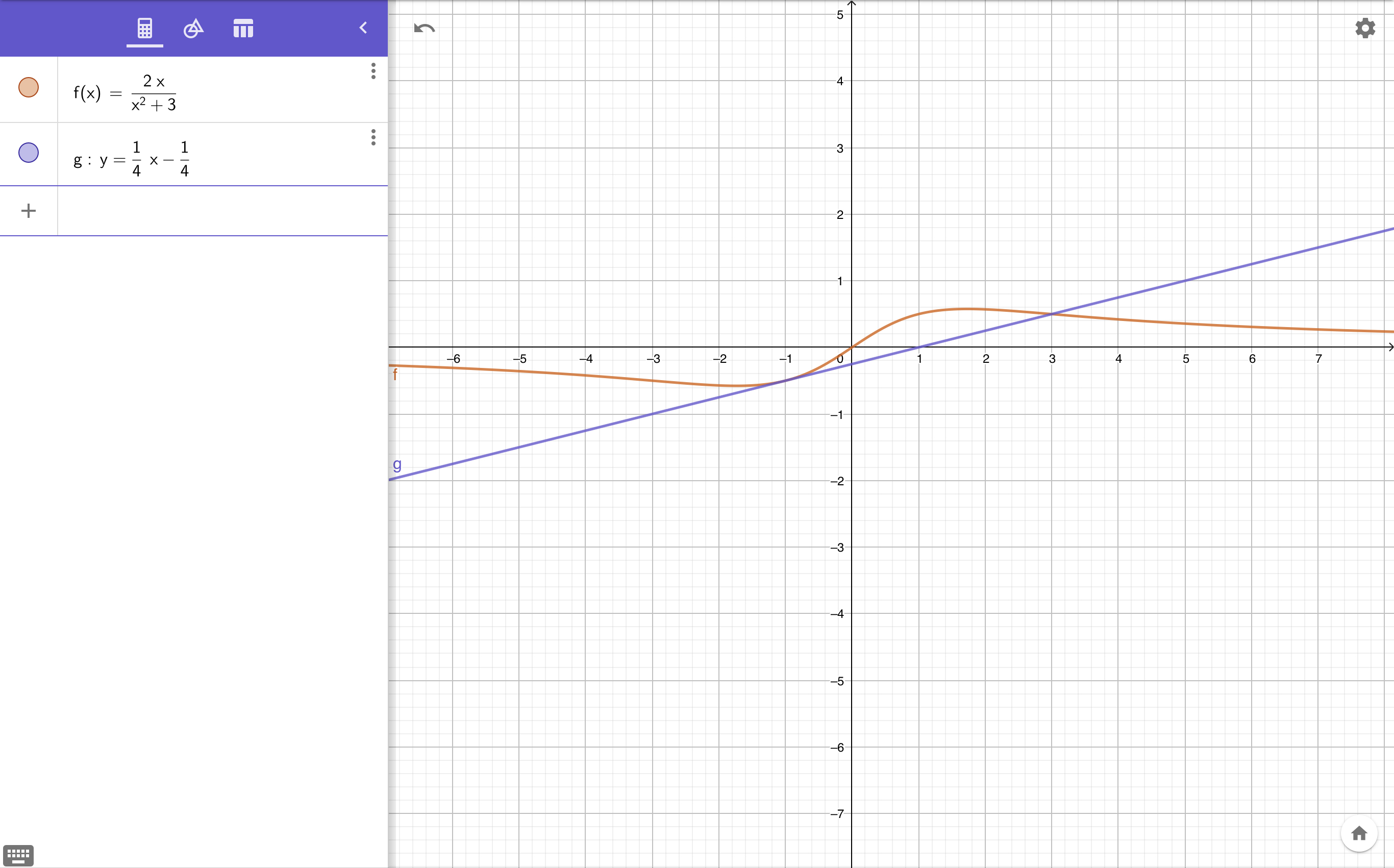
Is that the horizontal tangent line the second question is talking about?
Ballery1:
yes... the question asks, Determine the point(s) where the tangent line is horizontal
Ballery1:
we found the tangent line using the first derivative remember?
Hero:
Yes, you did. But the question question is talking about a different tangent line that is horizontal.
Ballery1:
tbh i don’t get the question.. i don’t see no horizontal line anywhere on the graph
Ballery1:
thats why lol
Hero:
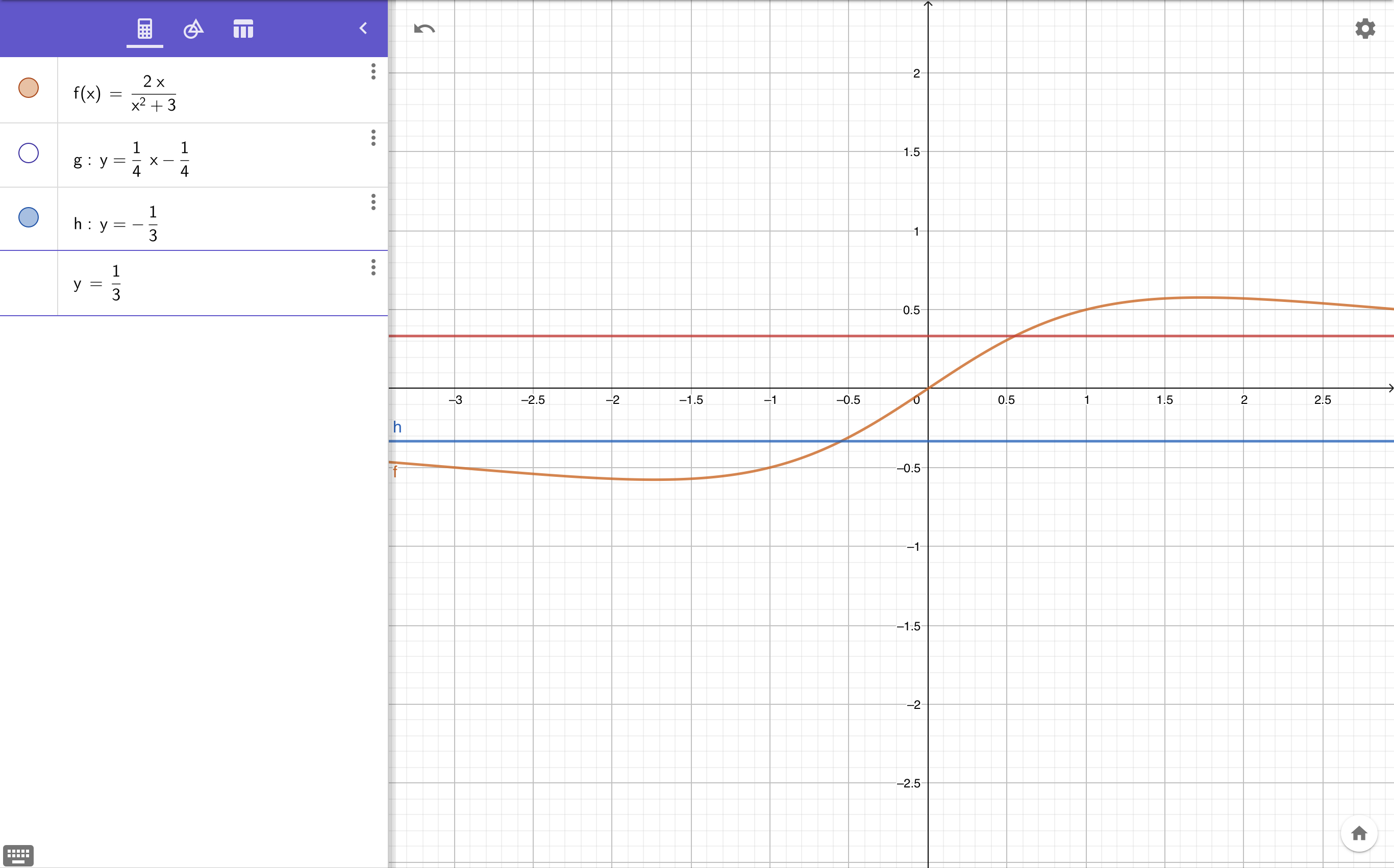
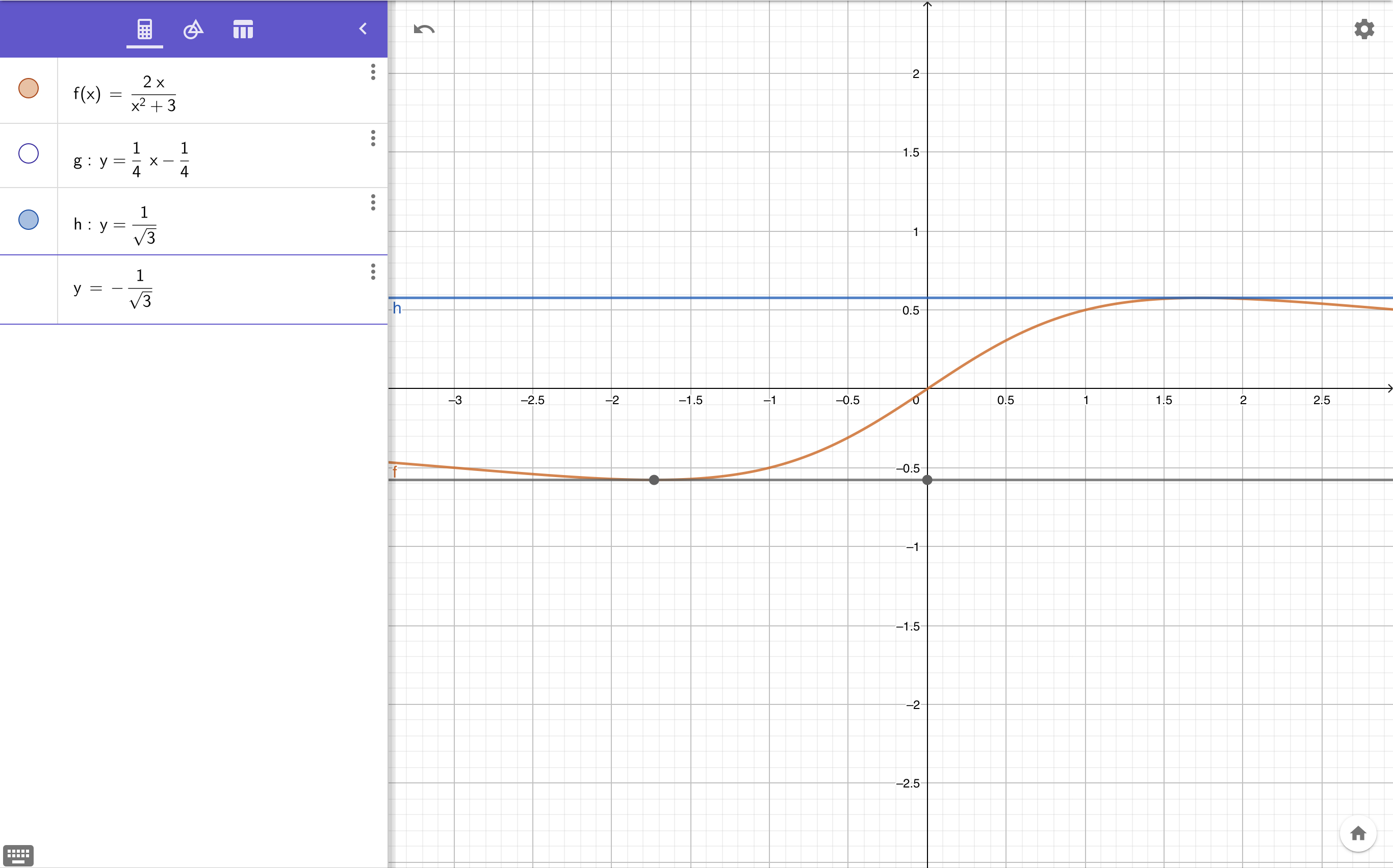
now tell me this. What happens if you graph y = 1/3 and y = -1/3
 Ballery1:
im not getting what you are trying to say
Hero:
Sorry, I meant 1/sqrt(3)
Hero:
y = 1/sqrt(3)
Hero:
I think you made a mistake in your calculation
 Hero:
Hero:
That's the horizontal tangent line
Hero:
Let's research how to find the correct values algebraically if you haven't already
Ballery1:
so i was suppose to get 1/sqrt(3), when i plugged in f”(0)??
Ballery1:
i have no clue. plz search with me lol
Hero:
Okay, I got it. That's my bad. We're supposed to set f prime x equal to zero and solve for x
Hero:
To find the y-values
Hero:
2nd derivative is for critical points. It's been a while for me
Hero:
So set the first derivative equal to zero then solve for x
Ballery1:
let me confrim once again this time... we’re suppose to find the first derivative equal to zero and solve for x right? lol
Ballery1:
ok, i’ll post the answer in a bit.. :)
Hero:
Yes
 Ballery1:
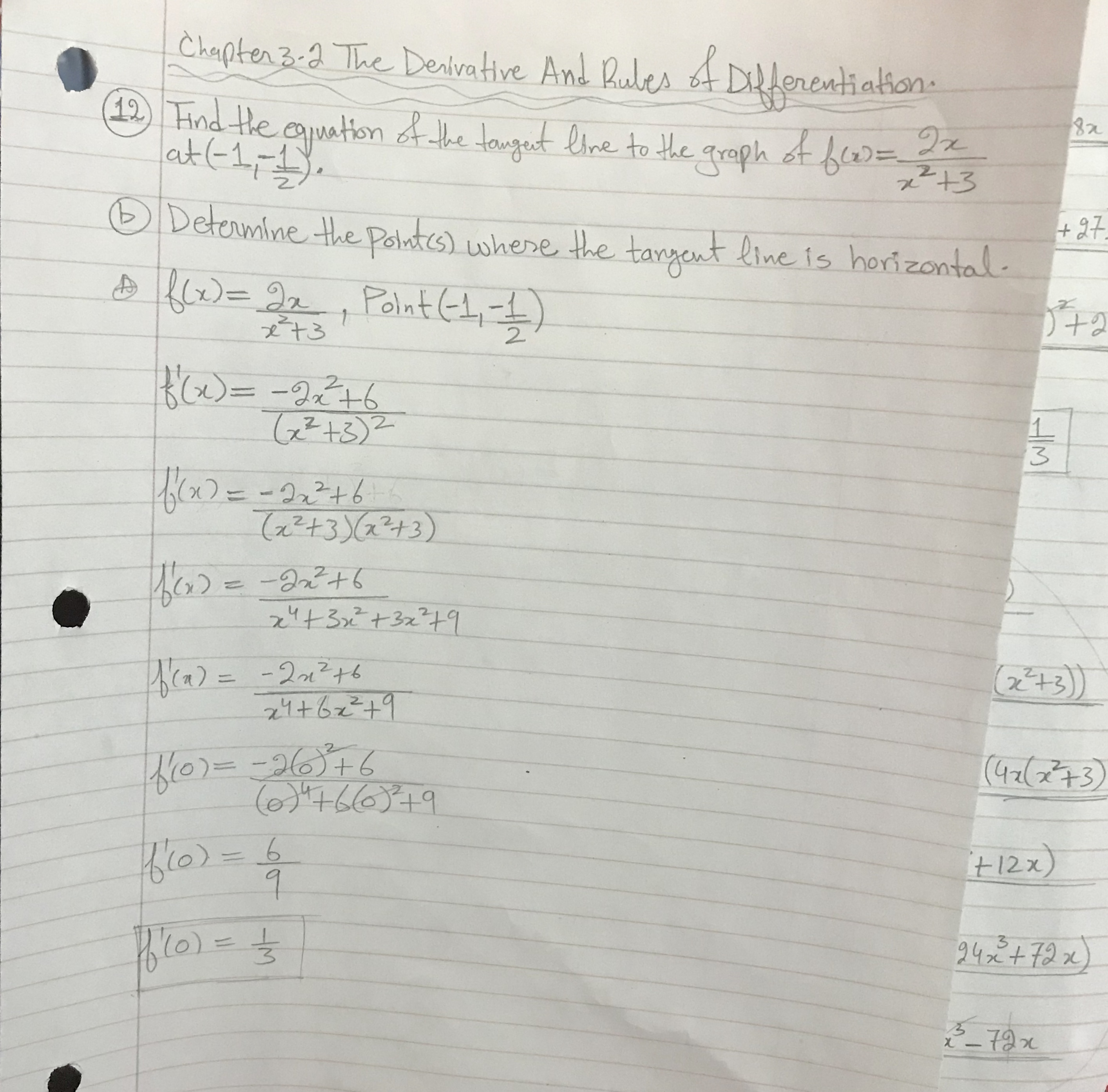
i’ve actually already tried that before but erased it lol
Hero:
That's not how you do it. You set the whole f(x) equal to zero. not just the x
Ballery1:
omg i see now /.-
Ballery1:
|dw:1569300671277:dw| plz work with me on this one
Ballery1:
|dw:1569300738958:dw|
Ballery1:
|dw:1569300779958:dw|
Ballery1:
so far so good?
Hero:
You shouldn't have done the multiplication
Ballery1:
yeah idk what am i doing :/
Hero:
You're supposed to multiply both sides of the equation by the denominator to get rid of it
Hero:
Then continue solving for x from there
Ballery1:
|dw:1569301186774:dw|
Hero:
Do you get it? Nope Start from here \(\dfrac{-2x^2+6}{(x^2 + 3)^2}=0\)
Hero:
You get ZERO on the other side of the equal sign because you set \(f(x)\) to ZERO remember?
Hero:
Anything times zero is zero
Hero:
So you should be left with \(-2x^2 + 6 = 0\)
Ballery1:
omg..
Hero:
And you continue solving for \(x\) from there
Ballery1:
i dont get it??? then how do i take the (x^2+3)^2 to the numerator ??
Ballery1:
omg.... /.-
Hero:
If you have \(\dfrac{x}{3} = 0\) How do you solve for \(x\) in this case? This is basic algebra
Ballery1:
i got it...
Ballery1:
yup... 0/3 which is just zero....i wasn’t expecting the whole denominator to cancel out like that..
Ballery1:
|dw:1569301984381:dw|
Ballery1:
|dw:1569302043611:dw|
Ballery1:
so how do we find the other .....aka negative x-value?
Hero:
You did not do that correctly. Here are the correct steps:
Ballery1:
uhgg /.- what did i do wrong now? lol
Ballery1:
oh u mean the + and - sign??
Hero:
|dw:1569302351340:dw|
Ballery1:
AAh i always forget to put that in...
Ballery1:
i mean to say their corresponding y values
Hero:
Now you input that in to f( _)
Hero:
and find the y
Hero:
\(f(\sqrt{3})\)
Ballery1:
wait, let me confirm this... do i plugin that into the first derivative or the original function?
Hero:
Original function.
Ballery1:
AAAh. thanks mate. brb :)
Hero:
Translate that comment you made in the chat to English
Ballery1:
here?
Hero:
Wherever, as long as I can see the translation
Ballery1:
k she asked me *aren’t you studying math a bit too much?* and i said *that poor dude hero’s stil helping me with a math problem.* and then i said *i love him*. that’s it.
Hero:
Ah okay, but next time, just say it in English.
Ballery1:
but english is overrated tho
Hero:
It is, but it's the only language I know
Ballery1:
icy.. i got chew bro.
Ballery1:
why am i not getting the right answer?!?!??!?!?!!?!
Hero:
I would like to see what you've done. You should get the right answer. Show your work like you've always done
Hero:
Hurry up because I'm going in a minute
Ballery1:
yes sir. let me draw my frustrating
Ballery1:
|dw:1569304231784:dw|
Hero:
Okay, so is that simplified completely?
Ballery1:
|dw:1569304368974:dw|
Ballery1:
is this it?
Hero:
Multiply top and bottom by \(\sqrt{3}\) then simplify again
Ballery1:
|dw:1569304480763:dw|
Hero:
You multiplied top and botttom by square root three, but for got to "simplify again"
Hero:
Cancel what is common to top and bottom
Ballery1:
isnt sqrt(3)* sqrt(3) = 3?
Hero:
It is but you have a three in the numerator AND denominator. Do you know what to do with that?
Ballery1:
omg that... ofc
Ballery1:
|dw:1569304644685:dw|
Hero:
Finally
Ballery1:
this is the type of tedious math i dont like
Ballery1:
and the other one plz one sec
Hero:
It's only tedious when you're first starting off.
Hero:
It gets easier the more you do it if you don't forget certain concepts
Ballery1:
|dw:1569304693569:dw|
Hero:
You get the same value. Except its negative. You don't really need my help with the other one.
Hero:
You got it. All you have to do is just graph the points to verify and you're done.
Ballery1:
|dw:1569304753283:dw|
Ballery1:
|dw:1569304887109:dw|
Ballery1:
|dw:1569304924649:dw|
Hero:
You confused yourself
Hero:
The negative is just -1 it doesn't suddenly get moved to a negative exponent
Ballery1:
ooooooo
Ballery1:
|dw:1569305051128:dw|
Hero:
smh
Hero:
You keep expanding when you need to be simplifying
Ballery1:
|dw:1569305169000:dw|
Hero:
There was no need to expand
Hero:
Rule of exponents \((ab)^2 = a^2b^2\) In this case \(a = -1\) and \(b = \sqrt{3}\)
Ballery1:
|dw:1569305258188:dw|
Ballery1:
but -1^2 is just 1 tho
Ballery1:
|dw:1569305386317:dw|
Hero:
But don't confuse yourself \((-1)^2 = 1\) Only when the negative is in parentheses does it become positive
Hero:
Which in this case it is in parentheses but there will be cases when the negative is not within paraentheses
Ballery1:
|dw:1569305420655:dw|
Ballery1:
|dw:1569305531071:dw|
Ballery1:
are we done or are we done ?
Ballery1:
thank you soooooooooooooooo much hero! you’re trully a living hero for me. :)
Hero:
Yep it is done when you graph the points to verify them.
Join our real-time social learning platform and learn together with your friends!
 Demon25:
For a hoco proposal with a cheerleader and football player, what else should be a
Demon25:
For a hoco proposal with a cheerleader and football player, what else should be a

 Breathless:
TOC: "MGF any confirmation on the commander? we require confirmation as soon as[radio static].
Breathless:
TOC: "MGF any confirmation on the commander? we require confirmation as soon as[radio static].
 EdwinJsHispanic:
I wrote something that I don't know if I want it as a poem or song, Please let me know on yours thoughts about it, I'm still doing this! "Broken promises an
EdwinJsHispanic:
I wrote something that I don't know if I want it as a poem or song, Please let me know on yours thoughts about it, I'm still doing this! "Broken promises an
 thehearken:
hi um I don't know if this is the right section for this, but can someone go over my poem and tell me if its good enough to give my English professor for a
thehearken:
hi um I don't know if this is the right section for this, but can someone go over my poem and tell me if its good enough to give my English professor for a
 heartlessprophet:
Aye what's 19z%u00f74p=9u03c0 my teacher thinking of impossible questions for us
heartlessprophet:
Aye what's 19z%u00f74p=9u03c0 my teacher thinking of impossible questions for us
 kippppp:
does anyone have any good tips for writing stories? i'm trying to write a dnd campaign but i'm not that great of a writer yet.
kippppp:
does anyone have any good tips for writing stories? i'm trying to write a dnd campaign but i'm not that great of a writer yet.
 GRIZZLEY19:
Y'all let me know what y'all think about this beat I made I took me like a hour maybe rate it 0/10 https://drive.
GRIZZLEY19:
Y'all let me know what y'all think about this beat I made I took me like a hour maybe rate it 0/10 https://drive.
 Ultrilliam:
Welcome to the 10th Anniversary Update! (Part 2) Sorry this one passed the date a
Ultrilliam:
Welcome to the 10th Anniversary Update! (Part 2) Sorry this one passed the date a
 Twaylor:
was walking downtown and my adhd brain wanted to make some (rock?) lyrics: There'
Twaylor:
was walking downtown and my adhd brain wanted to make some (rock?) lyrics: There'