
 RorydaSavage:
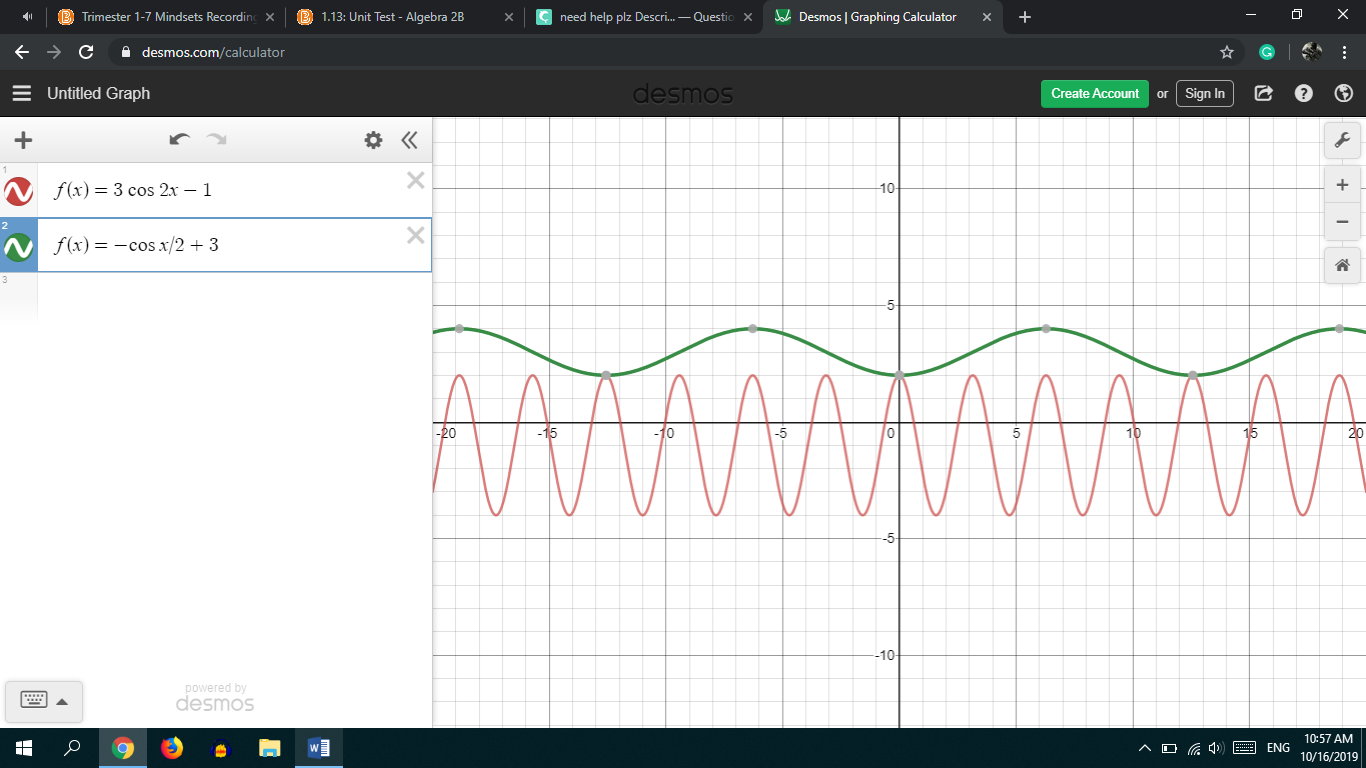
need help plz Describe the transition between f(x)=3cos2x-1 and f(x)=-cos x/2+3
 RorydaSavage:
the graph for the equations
 dude:
dude:
Okay we'll start from the left side to the right General equation \(acos(bx-c)+d\) \(3cos2x-1\) \(-cos~\frac{x}{2}+3\) Do you know what the a value controls?
RorydaSavage:
the value controls the size of the cos equation
dude:
Yes sort of It controls its vertical stretch and shrink if a > 1, then its a stretch If 0<a<1, then its a shrink If a<0, then it was reflected across the x-axis
RorydaSavage:
ok so i just say that it reflected across the x-axis b/c its describing the translation
dude:
Right and you also did a scale factor of 1/3 to the first equation to get to the second \((3cos2x-1)\color{red}{\times \frac13}=>(cos2x-1)\color{red}{\times -1}=>-cos2x-1\) Okay, now lets look at the b value \(acos(bx-c)+d\) Do you know what it controls?
RorydaSavage:
it controls the hight and length basically?
dude:
Sort of again In trig it works more as a change in the period of the function (Visually, its stretch or shrink) So the b value tells you about its period (How long it takes for the equation to return to its same place) If b>1 its period is smaller (The 'waves' are more closer to each other) If 0<b<1 the period increases (The 'waves' are further from each other) If b<0 there is a reflection across the y=axis
dude:
Am going to also add to my original statements about the a value a indicates the amplitude (The length of the wave) [Again the larger the value, the larger the wave height]
 Hero:
Hero:
If the general equation is \(f(x) = a \cos(bx-c) + d\) is the general equation of the cosine function, then we should first clarify which values are \(c\) and which are \(d\), otherwise we might confuse the functions and get different graphs other than what we intended like this: https://www.geogebra.org/classic/unjeannc
RorydaSavage:
i'm pretty sure its like Hero said with the equation
Join our real-time social learning platform and learn together with your friends!
 KBaby:
Verse 1 We left our names in the dust of the driveway Watched the old town shrink
KBaby:
Lyrics Generator Use AI to write the lyrics for a song. Suggested Genres: Pop Hip
KBaby:
Verse 1 We left our names in the dust of the driveway Watched the old town shrink
KBaby:
Lyrics Generator Use AI to write the lyrics for a song. Suggested Genres: Pop Hip
 aitexturegenerator:
How are you all handling AI-generated textures for 3D models and game assets without losing the hand-made feel? I've been doing a small stylized environment
aitexturegenerator:
How are you all handling AI-generated textures for 3D models and game assets without losing the hand-made feel? I've been doing a small stylized environment

 Demon25:
Woke up feeling like that girl and that dude well he still aint crap pluse the du
Demon25:
Woke up feeling like that girl and that dude well he still aint crap pluse the du
 playtsec:
how do I get rid of stress from teachers... I just feel like running out the classroom and leaving on my own.
playtsec:
how do I get rid of stress from teachers... I just feel like running out the classroom and leaving on my own.
 JohnnyLFowler0812:
What type of gamer would play something and then get off for a while. Why not sta
JohnnyLFowler0812:
Which is better? Metallica Rap Country R&B hiphop Medal Gospel Chill Which 3 opti
JohnnyLFowler0812:
What type of gamer would play something and then get off for a while. Why not sta
JohnnyLFowler0812:
Which is better? Metallica Rap Country R&B hiphop Medal Gospel Chill Which 3 opti