
 xXMarcelieXx:
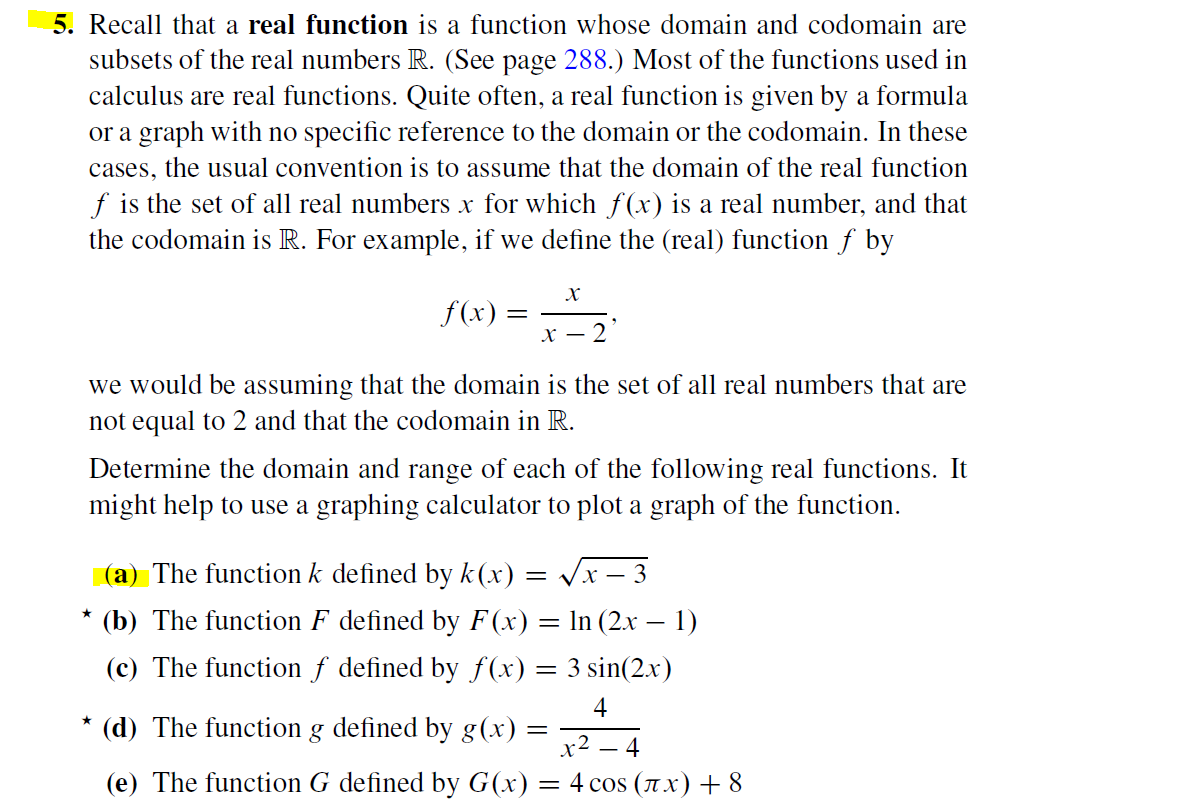
how do you find the range for this function? is there a way you can do it without graphing it ?
 mhchen:
You can find the minimum and maximum of it by taking the derivative and setting where the derivative is 0.
 xXMarcelieXx:
part a
xXMarcelieXx:
can you show me how to do it
mhchen:
Well, I don't see where the question is.
xXMarcelieXx:
i posted above
 imqwerty:
do you know what a square root is?
 myeyeshurt:
The range of the function can be considered after determining the domain as this function is monotonic
myeyeshurt:
The domain is [3, infinity) and so the corresponding range is [k(3), k(infinity))=[0, infinity)
mhchen:
wow I'm blind, didn't even see that image
 mhchen:
\(range(f) = \left\{ y \in [0,\infty) | y=f(x) \forall x \in [3,\infty)\right\}\) something like this I guess
xXMarcelieXx:
how would you do part a -c for the range ?
mhchen:
So we just did part (a) Part (b) is ln(2x-1) Its graph looks like this: |dw:1573357524196:dw| Doesn't the range look like all real numbers? Any number can be written as ln(2x-1) Here's a graph of sin(x): |dw:1573357610415:dw| It goes from -1 to 1 right? Now 3sin(x) would make it bigger 3 times.
Join our real-time social learning platform and learn together with your friends!
 KBaby:
Verse 1 We left our names in the dust of the driveway Watched the old town shrink
KBaby:
Lyrics Generator Use AI to write the lyrics for a song. Suggested Genres: Pop Hip
KBaby:
Verse 1 We left our names in the dust of the driveway Watched the old town shrink
KBaby:
Lyrics Generator Use AI to write the lyrics for a song. Suggested Genres: Pop Hip
 aitexturegenerator:
How are you all handling AI-generated textures for 3D models and game assets without losing the hand-made feel? I've been doing a small stylized environment
aitexturegenerator:
How are you all handling AI-generated textures for 3D models and game assets without losing the hand-made feel? I've been doing a small stylized environment

 Demon25:
Woke up feeling like that girl and that dude well he still aint crap pluse the du
Demon25:
Woke up feeling like that girl and that dude well he still aint crap pluse the du
 playtsec:
how do I get rid of stress from teachers... I just feel like running out the classroom and leaving on my own.
playtsec:
how do I get rid of stress from teachers... I just feel like running out the classroom and leaving on my own.
 JohnnyLFowler0812:
What type of gamer would play something and then get off for a while. Why not sta
JohnnyLFowler0812:
Which is better? Metallica Rap Country R&B hiphop Medal Gospel Chill Which 3 opti
JohnnyLFowler0812:
What type of gamer would play something and then get off for a while. Why not sta
JohnnyLFowler0812:
Which is better? Metallica Rap Country R&B hiphop Medal Gospel Chill Which 3 opti