
 NonportritV2:
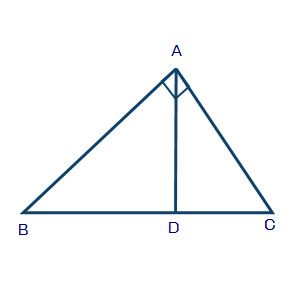
Seth is using the figure shown below to prove Pythagorean Theorem using triangle similarity. In the given triangle ABC, angle A is 90° and segment AD is perpendicular to segment BC. The figure shows triangle ABC with right angle at A and segment AD. Point D is on side BC. Part A: Identify a pair of similar triangles. (2 points) Part B: Explain how you know the triangles from Part A are similar. (4 points) Part C: If DB = 9 and DC = 4, find the length of segment DA. Show your work. (4 points)
 jhonyy9:
please correct it ia think there no segment AD perpendicular to segment BC this AD wan being AB yes ?
NonportritV2:
There is a segment AD.
jhonyy9:
|dw:1580150793675:dw|
jhonyy9:
where ?
 jhonyy9:
and segment AD is perpendicular to segment BC. how is possibly this ?
NonportritV2:
They both have two lines that meet at the same angle
jhonyy9:
may be AD perpendicular on DC and not on BC
jhonyy9:
check this please
 NonportritV2:
sorry wrong image
jhonyy9:
so than what will be correct ?
jhonyy9:
the second posted image ?
NonportritV2:
the second image is the image for this question the first one was for another question
jhonyy9:
ok so Part A: Identify a pair of similar triangles. (2 points) Part B: Explain how you know the triangles from Part A are similar. (4 points) Part C: If DB = 9 and DC = 4, find the length of segment DA. Show your work. (4 points)
jhonyy9:
step by step please - i m here to help you and explain
jhonyy9:
A . triangle ADB similar triangle ADC ?
NonportritV2:
i would say so they look perpendicular
jhonyy9:
do you wan saying angle D_1 congruent angle D_2 bc. AD perpendicular BC ?
jhonyy9:
and again what can you see there ? side AD what is for these triangles ?
jhonyy9:
AD not is common side ?
NonportritV2:
Answer: Part A; Triangle ABD is similar to Triangle ACD Step-by-step explanation: Part B; The triangle is given such that angle A is 90° If point D is on line BC, then it touches angle A. However line AD is perpendicular to line BC,which means it splits the angle at A into two equal halves. Hence, you now have two right angled triangles, on the one hand, triangle ABD and on the other hand, triangle ACD. The first one has angle D measuring 90° and line AB as the hypotenuse. The second one also has angle D measuring 90° with it's hypotenuse at line AC. Part C; From the dimensions given in the question, triangle ABD has side BD measuring 9 while the other two sides are not given. But angle D is given as 90° (perpendicular line from angle A in the original triangle). Also, angle A has been split in two which makes angle A in triangle ABD to measure 45° Therefore triangle ABD is a right angled triangle with the other two sides measuring 45° each. [180° = (90°+45°+45°)] We can solve for the unknown side by applying trigonometrical ratios. We have line DB given as 9 units and the angle facing it (angle A) is 45°. Line AD is unknown and is also facing angle B which is 45° We shall apply the ratio of tangent of angle since we have the opposite to angle B (unknown) and the adjacent to angle B (9 units) Tan 45° = opposite/adjacent Tan 45° = DA/9 Multiply both sides by 9 9 × Tan 45° = DA (Looking up the table of values for trigonometrical ratios, Tan 45°=1) 9 × 1 = DA Therefore line DA equals 9 units
NonportritV2:
got it ^
jhonyy9:
understandably ?
NonportritV2:
yes sir
jhonyy9:
ok was my pleasure have a nice day
NonportritV2:
thank you.
jhonyy9:
np anytime
Join our real-time social learning platform and learn together with your friends!
 KBaby:
Verse 1 We left our names in the dust of the driveway Watched the old town shrink
KBaby:
Lyrics Generator Use AI to write the lyrics for a song. Suggested Genres: Pop Hip
KBaby:
Verse 1 We left our names in the dust of the driveway Watched the old town shrink
KBaby:
Lyrics Generator Use AI to write the lyrics for a song. Suggested Genres: Pop Hip

 aitexturegenerator:
How are you all handling AI-generated textures for 3D models and game assets without losing the hand-made feel? I've been doing a small stylized environment
aitexturegenerator:
How are you all handling AI-generated textures for 3D models and game assets without losing the hand-made feel? I've been doing a small stylized environment

 Demon25:
Woke up feeling like that girl and that dude well he still aint crap pluse the du
Demon25:
Woke up feeling like that girl and that dude well he still aint crap pluse the du
 playtsec:
how do I get rid of stress from teachers... I just feel like running out the classroom and leaving on my own.
playtsec:
how do I get rid of stress from teachers... I just feel like running out the classroom and leaving on my own.
 JohnnyLFowler0812:
What type of gamer would play something and then get off for a while. Why not sta
JohnnyLFowler0812:
Which is better? Metallica Rap Country R&B hiphop Medal Gospel Chill Which 3 opti
JohnnyLFowler0812:
What type of gamer would play something and then get off for a while. Why not sta
JohnnyLFowler0812:
Which is better? Metallica Rap Country R&B hiphop Medal Gospel Chill Which 3 opti