
 darkknight:
math
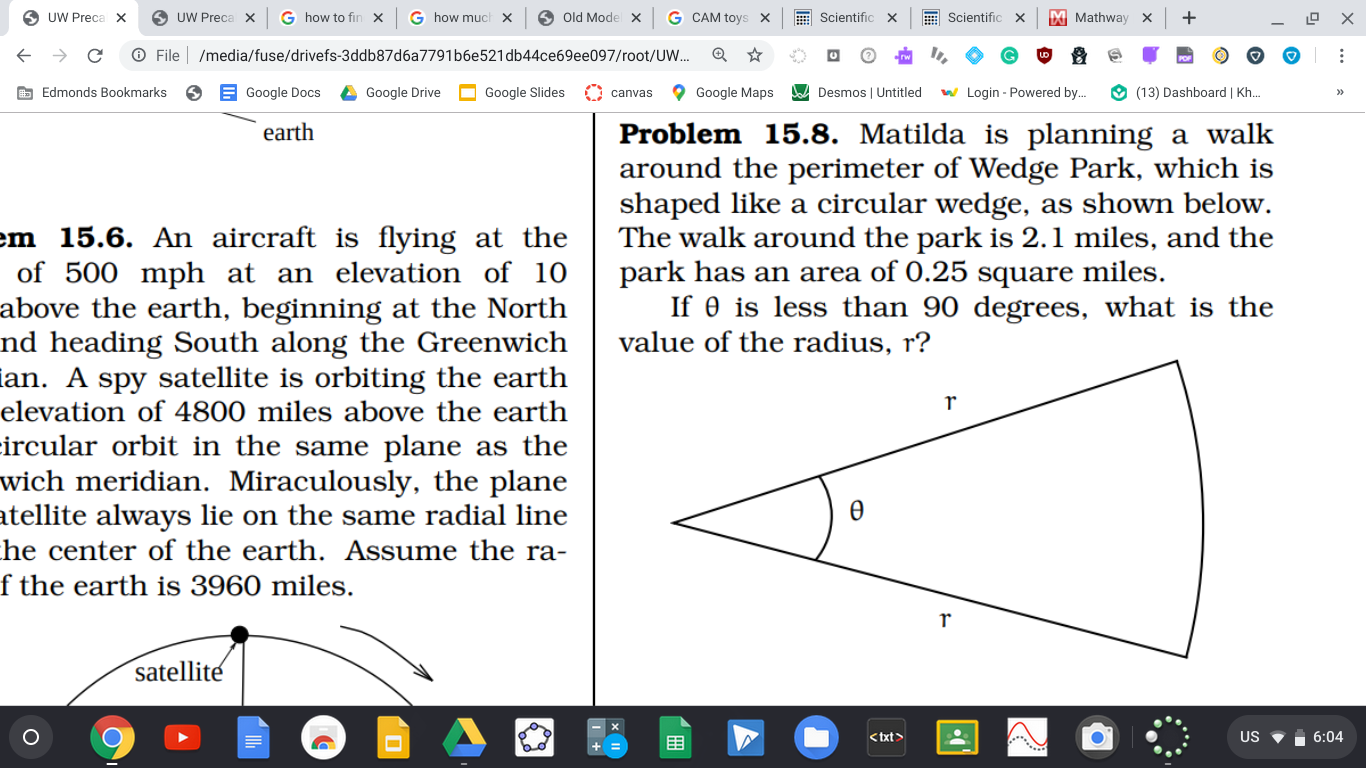 darkknight:
precalc
 Razor:
@Hero
 Hero:
Hero:
which problem are you currently working on?
darkknight:
8
Hero:
I'll have to get back to you on this one.
darkknight:
okay
darkknight:
wait hero, how do you find the arc knowing the central angle in degrees and the radian?
Hero:
\(s = r\theta\) That's the formula for arc length, if you know the radius and the angle.
darkknight:
k, thats what I thought, thanks. Im gonna see if I can do this again
darkknight:
angle in radians or degrees?
Hero:
Radians
darkknight:
well we know that 2r + s = 2.1 s is theta (in radians) times radius and we know that .25= (theta/360)((r^2)pi)
darkknight:
if I did that right
darkknight:
and that it is less than 90 degrees or pi/2 radians
Hero:
Okay, that looks like something we can work with. I mis-read the question at first overlooking the word perimeter.
Hero:
Hang on a min...
Hero:
Okay, they give us that theta is in degrees since it is less than 90 degrees so we have to use degrees not radians, sorry.
Hero:
I only said what I said earlier because I'm used to using radians when applying the arc length formula
darkknight:
okay
Hero:
I was thinking we could just assume that theta = 90 and whatever value we solve for, it will be less than \(r\)
darkknight:
u mean less than r/2
Hero:
No, the goal is to find the value of r which is what the question asks for. And whatever value we find for r, the actual r will be less than the value we find. That's what I mean.
darkknight:
oh
darkknight:
well the answer is 0.685078 miles.but we need to explain and show our work
Hero:
weird. I was getting more like \(r < 0.564\)
Hero:
But let me get back to you on it. I'll come up with a complete solution to this.
darkknight:
yeah there is for some reason there is a value for r
darkknight:
@dude
Hero:
Sorry for taking so long. I have the complete solution. I'm typing it up now.
darkknight:
u there?
Hero:
Yes, I'm typing it on a different document. Give me a few
darkknight:
ok
Hero:
Okay, I'm done typing up the solution but I still have to add the explanations so that will take another few minutes.
darkknight:
ok
Hero:
3 more minutes and I'll be done.
Hero:
Alright. All done.
Hero:
\(\begin{array}{ r l l } L= & \ \dfrac{\theta }{360} 2\pi r & L\ \mathrm{represents\ the\ length\ of\ the\ arc}\\ & & \\ S= & \dfrac{\theta }{360} \pi r^{2} & S\ \mathrm{represents\ the\ area\ of\ the\ sector}\\ & & \\ P= & 2r\ +L & P\ \mathrm{represents\ the\ perimeter\ of\ the\ Wedge}\\ & & \\ 2.1 & =2r\ +\ \dfrac{\theta }{360} 2\pi r & \begin{array}{l} \mathrm{In\ the\ perimeter\ equation\ replace} \ P\ \mathrm{with}\\ 2.1\ \mathrm{and} \ L\ \mathrm{with\ its\ expression.\ \ Then\ isolate}\\ \dfrac{\theta }{360} \end{array}\\ & & \\ 2.1-2r & =\dfrac{\theta }{360} 2\pi r & Subtract\ 2r\ from\ both\ sides\\ & & \\ \dfrac{( 2.1-2r)}{2\pi r} & =\dfrac{\theta }{360} & Divide\ both\ sides\ by\ 2\pi r \end{array}\)
Hero:
\(\begin{array}{ c l l } S & =\dfrac{( 2.1-2r)}{2\pi r} \pi r^{2} & \begin{array}{l} \mathrm{Now\ apply\ the\ expression\ for}\\ \mathrm{\dfrac{\theta }{360} \ to\ the} \ S\mathrm{\ equation} \end{array}\\ & & \\ 0.25 & =\dfrac{( 2.1-2r)}{2\pi r} \pi r^{2} & \mathrm{The\ value\ of\ } S\mathrm{\ =\ 0.25}\\ & & \\ \dfrac{2\pi r}{4} & =( 2.1-2r) \pi r^{2} & \begin{array}{l} \mathrm{convert\ 0.25\ to\ \dfrac{1}{4} .\ Multiply}\\ \mathrm{both\ sides\ by\ 2\pi } r \end{array}\\ & & \\ 2\pi r & =4( 2.1-2r) \pi r^{2} & \mathrm{Multiply\ both\ sides\ by\ 4}\\ & & \\ 2\pi r & =4\pi r^{2}( 2.1-2r) & \mathrm{Apply\ the\ associative\ property}\\ & & \\ 2\pi r & =8.4\pi r^{2} -8\pi r^{3} & \mathrm{Apply\ the\ distributive\ property}\\ & & \\ 8\pi r^{3} -8.4\pi r^{2} +2\pi r & =0 & \mathrm{Rewrite\ as\ a\ quadratic\ equation}\\ & & \\ 2\pi r\left( 4r^{2} -4.2r+1\right) & =0 & \mathrm{Simplify}\\ & & \\ 4r^{2} -4.2r+1 & =0 & \begin{array}{l} \mathrm{to\ finish\ you\ apply\ the\ }\\ \mathrm{quadratic\ equation.\ } \end{array} \end{array}\)
darkknight:
is S the area in this case?
Hero:
The only thing you have left to figure out is why the other value of \(r\) is not correct.
Hero:
Yes correct
darkknight:
oh ok
darkknight:
one last question: Why is this part of the area, I understand pi(r^2) (2.1−2r)/2πr
darkknight:
why is this part of the area (2.1−2r)/2πr
darkknight:
oh sorry, I didn't see the above section
Hero:
I thought you might be able to figure it out on your own.
darkknight:
thank you hero
Hero:
You're welcome
darkknight:
Ill tell you why the other value is not correct when I solve it
darkknight:
hero you have a typo at the 3rd to last step, its suppoosed to be -2pi(r) because you subtract
Hero:
1. I know why the other value of \(r\) is not correct. 2. My algebra is correct
Hero:
I left it for you to figure out
darkknight:
but it is supposed to be -8pi(r)^3+8.4(pi)r^2-2pi(r) u wrote something different
Hero:
If you notice, the expression is equal to zero. If an expression is equal to zero, you can multiply or divide by zero, which flip flops the the signs.
Hero:
Whenever I deal with quadratic equations, I like to set it up so that the \(a\) value is positive not negative.
darkknight:
oh
Hero:
It needs to be in the form \(ax^2 + bx + c = 0\) in order to apply the quadratic formula
Hero:
where \(a > 0\)
darkknight:
yes i understand that now, thx
darkknight:
i figured it out
Hero:
I made a typo above. You can't divide by zero. You can divide by -1 though.
darkknight:
so when you get your 2 values, you plug them back in (I did in the perimeter eqn and you have to see when theta is below 90
darkknight:
thank you hero
Hero:
Very good
Join our real-time social learning platform and learn together with your friends!
 KBaby:
Verse 1 We left our names in the dust of the driveway Watched the old town shrink
KBaby:
Lyrics Generator Use AI to write the lyrics for a song. Suggested Genres: Pop Hip
KBaby:
Verse 1 We left our names in the dust of the driveway Watched the old town shrink
KBaby:
Lyrics Generator Use AI to write the lyrics for a song. Suggested Genres: Pop Hip

 aitexturegenerator:
How are you all handling AI-generated textures for 3D models and game assets without losing the hand-made feel? I've been doing a small stylized environment
aitexturegenerator:
How are you all handling AI-generated textures for 3D models and game assets without losing the hand-made feel? I've been doing a small stylized environment

 Demon25:
Woke up feeling like that girl and that dude well he still aint crap pluse the du
Demon25:
Woke up feeling like that girl and that dude well he still aint crap pluse the du
 playtsec:
how do I get rid of stress from teachers... I just feel like running out the classroom and leaving on my own.
playtsec:
how do I get rid of stress from teachers... I just feel like running out the classroom and leaving on my own.
 JohnnyLFowler0812:
What type of gamer would play something and then get off for a while. Why not sta
JohnnyLFowler0812:
Which is better? Metallica Rap Country R&B hiphop Medal Gospel Chill Which 3 opti
JohnnyLFowler0812:
What type of gamer would play something and then get off for a while. Why not sta
JohnnyLFowler0812:
Which is better? Metallica Rap Country R&B hiphop Medal Gospel Chill Which 3 opti