
 Katy:
Katy:
Which of the following could represent the scale factor of the larger figure to the smaller figure? 15:9 5:3 3:2 21:14 2:3 20:30
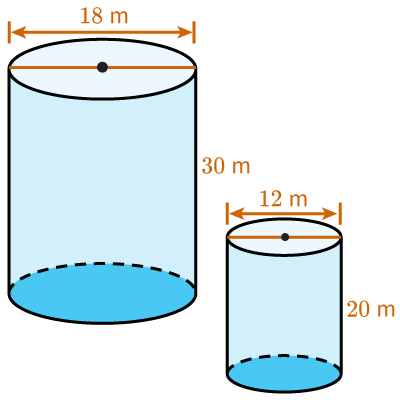
 imqwerty:
if the scale factor is \(\color{cyan} {a:b}\) then that means that if you multiply the dimensions(or lengths) of the first figure by \(\color{cyan}a \) it would be equal to the correposonding dimension(or length) in second figure multiplied by \(\color{cyan} b\)
imqwerty:
To find a scale factor between two similar figures, find two corresponding sides and write the ratio of the two sides
imqwerty:
\(\color{#0cbb34}{\text{Originally Posted by}}\) @Katy how to do that? \(\color{#0cbb34}{\text{End of Quote}}\) the problem is to find the scale factor
imqwerty:
\(\color{#0cbb34}{\text{Originally Posted by}}\) @Katy what are the lengths? \(\color{#0cbb34}{\text{End of Quote}}\) can you find two corresponding lengths in the given figure?
imqwerty:
good. The next step is to find the ratio of these corresponding sides. Make sure you find the ratio as \(\large{\frac{larger ~figure}{smaller~figure}}\) because it's mentioned in the question.
imqwerty:
yeah, simplify those ratios further
imqwerty:
cancel out the common factors
imqwerty:
find the common factor
imqwerty:
yeah
imqwerty:
divide the numerator and denominator by the common factors until it can't be simplified any futher
imqwerty:
no
imqwerty:
\(\Large{\frac{\frac{30}{10}}{\frac{20}{10}}}\)
imqwerty:
like this
imqwerty:
yes
imqwerty:
yeah, what do you get on simplification?
imqwerty:
yes.
imqwerty:
when did you get 2:3?
imqwerty:
how did you get 21:14?
imqwerty:
that is correct.
Katy:
3:2, and 21:14?
imqwerty:
yup
Join our real-time social learning platform and learn together with your friends!
 KBaby:
Verse 1 We left our names in the dust of the driveway Watched the old town shrink
KBaby:
Lyrics Generator Use AI to write the lyrics for a song. Suggested Genres: Pop Hip
KBaby:
Verse 1 We left our names in the dust of the driveway Watched the old town shrink
KBaby:
Lyrics Generator Use AI to write the lyrics for a song. Suggested Genres: Pop Hip
 aitexturegenerator:
How are you all handling AI-generated textures for 3D models and game assets without losing the hand-made feel? I've been doing a small stylized environment
aitexturegenerator:
How are you all handling AI-generated textures for 3D models and game assets without losing the hand-made feel? I've been doing a small stylized environment

 Demon25:
Woke up feeling like that girl and that dude well he still aint crap pluse the du
Demon25:
Woke up feeling like that girl and that dude well he still aint crap pluse the du
 playtsec:
how do I get rid of stress from teachers... I just feel like running out the classroom and leaving on my own.
playtsec:
how do I get rid of stress from teachers... I just feel like running out the classroom and leaving on my own.
 JohnnyLFowler0812:
What type of gamer would play something and then get off for a while. Why not sta
JohnnyLFowler0812:
Which is better? Metallica Rap Country R&B hiphop Medal Gospel Chill Which 3 opti
JohnnyLFowler0812:
What type of gamer would play something and then get off for a while. Why not sta
JohnnyLFowler0812:
Which is better? Metallica Rap Country R&B hiphop Medal Gospel Chill Which 3 opti