
 Ka1:
Ka1:
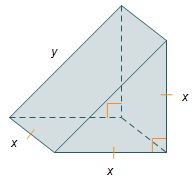
The volume of the triangular block is 4 cubic inches. A triangular prism has a volume of 4 cubic inches. The right triangle bases have side lengths of x and a hypotenuse length of y. The height of the prism is x. What is the approximate length of y? Round to the nearest tenth of an inch. 1.4 in. 2.8 in. 2.0 in. 3.5 in.
leila1234567:
what do you think it is
 Jabari33:
@Vocaloid
 Mercury:
imagine the bottom side of the triangle (the x by x side) is the base of the prism, while the height is the side at the bottom left (the x side) volume of a triangular prism: bh, where b is the area of the base, and h is the height. the area of the triangular base is (1/2)ab, where a is the base and b is the height of the triangle. therefore, volume = (1/2)(x)(x) * x = 4 solve for x once you have x, since you have a triangular base with legs x and x and hypotenuse y, simply set up the pythagorean theorem x^2 + x^2 = y^2 and solve for y
Ka1:
eh-whaaaaaaaaaaaaaaaa?😶😶😶
Mercury:
step by step: |dw:1591625676955:dw|
Mercury:
|dw:1591625681710:dw| red is the base, and blue is the height
Mercury:
volume of a prism = (area of base)(height) the base is a triangle, so we need to find the area of the red triangle first.
Mercury:
the area of a triangle = (1/2)(base)(height) notice on your triangle, the base is x and the height is also x so the area of the triangle is (1/2)(x)(x) |dw:1591625815266:dw|
Mercury:
now that we have the area of the base, let's look back at our volume equation volume of prism = (area of base)(height) we know from the previous step that the area of the base is (1/2)(x)(x) now, looking at our diagram, the height of the prism is also x so total volume = (area of base)(height) = (1/2)(x)(x)(x)
Mercury:
from the problem, it says that the volume of the prism is equal to 4 so (1/2)(x)(x)(x) = 4 solve for x
Mercury:
once you have x, notice how the base of the triangle is a right triangle. therefore, it follows the pythagorean theorem, where leg^2 + leg^2 = hypotenuse^2. x and x are your legs, y is the hypotenuse. so x^2 + x^2 = y^2 you should know what x is at this point, so solve for y
Mercury:
read over the steps slowly and carefully and let me know where you're getting stuck
Ka1:
so the answer 2.8
Mercury:
can I see your calculations?
Mercury:
Please explain how you arrived at 2.8 so I can look over your work.
Mercury:
I'm perfectly happy to explain any of my steps in more detail but I'm not going to just hand you the answer.
Ka1:
I just made a random answer from the choices
Mercury:
have you tried to read anything I've written? what specifically is confusing you?
Ka1:
The Math thing
Mercury:
volume of a prism = (area of base)(height) do you understand this part?
Ka1:
yes
Mercury:
ok, so when I drew the base in red, and the height in blue, did you understand that?
Ka1:
yes
Mercury:
so the base is a triangle, with base x and height x, do you understand this?
Mercury:
|dw:1591628371985:dw|
Mercury:
Please be honest, I can't teach if you aren't specific about what you don't understand.
Ka1:
yes
Ka1:
I am a dumbnut when it comes to math! I see it as gibberish!
Mercury:
ok, so we want to calculate the area of that triangle area of a triangle = (1/2)(base)(height) we know that the base and height are x, so what's the area of the triangle?
Ka1:
ummm 35
Mercury:
notice how we just said "base is x" and "height is x" so we can take area of a triangle = (1/2)(base)(height) and replace "base" and "height" with x, does that make sense?
Ka1:
yes
Mercury:
so take this formula area of a triangle = (1/2)(base)(height) and replace "base" and "height" with x, what do you get?
Ka1:
3.5
Mercury:
if base = x that means we can take the word "base" and replace it with "x" area of a triangle = (1/2)(base)(height) let's erase "base" area of a triangle = (1/2)(___)(height) now let's put "x" where "base" used to be area of a triangle = (1/2)(x)(height) does this make sense? since base is equal to x, we can replace "base" with "x"
Mercury:
we know that height is also equal to x, can you try replacing "height" with x, and see what you get?
Join our real-time social learning platform and learn together with your friends!
 KBaby:
Verse 1 We left our names in the dust of the driveway Watched the old town shrink
KBaby:
Lyrics Generator Use AI to write the lyrics for a song. Suggested Genres: Pop Hip
KBaby:
Verse 1 We left our names in the dust of the driveway Watched the old town shrink
KBaby:
Lyrics Generator Use AI to write the lyrics for a song. Suggested Genres: Pop Hip
 aitexturegenerator:
How are you all handling AI-generated textures for 3D models and game assets without losing the hand-made feel? I've been doing a small stylized environment
aitexturegenerator:
How are you all handling AI-generated textures for 3D models and game assets without losing the hand-made feel? I've been doing a small stylized environment

 Demon25:
Woke up feeling like that girl and that dude well he still aint crap pluse the du
Demon25:
Woke up feeling like that girl and that dude well he still aint crap pluse the du
 playtsec:
how do I get rid of stress from teachers... I just feel like running out the classroom and leaving on my own.
playtsec:
how do I get rid of stress from teachers... I just feel like running out the classroom and leaving on my own.
 JohnnyLFowler0812:
What type of gamer would play something and then get off for a while. Why not sta
JohnnyLFowler0812:
Which is better? Metallica Rap Country R&B hiphop Medal Gospel Chill Which 3 opti
JohnnyLFowler0812:
What type of gamer would play something and then get off for a while. Why not sta
JohnnyLFowler0812:
Which is better? Metallica Rap Country R&B hiphop Medal Gospel Chill Which 3 opti