
 carlosesgirl:
can someone help me with this
baleeteresemelchio:
wut is this???
 Downpour17:
What did you get for this?
carlosesgirl:
what do you mean
Downpour17:
Like, an answer
carlosesgirl:
so how do you do number one
Downpour17:
This looks like algebra. Is there anything that may help you with this?
carlosesgirl:
no there isn't and my teacher does not respond to emails at this time
Downpour17:
Understood. I need to find out what this question is asking
carlosesgirl:
can we to number two then
Downpour17:
I'm actually confused myself. I'll get someone else to help you. Sorry I couldn't help you.
carlosesgirl:
\(\color{#0cbb34}{\text{Originally Posted by}}\) @Downpour17 I'm actually confused myself. I'll get someone else to help you. Sorry I couldn't help you. \(\color{#0cbb34}{\text{End of Quote}}\) it's ok
carlosesgirl:
@jhonyy9
 Convert:
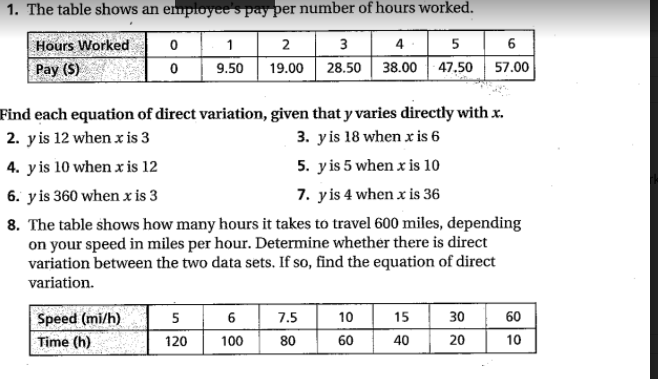
So for these we would use proportions to solve what it would be when we plug in the given answers so we could take any but lets use 1 as an example: 1/9.50=2/19.00 5/120=6/100 1/9.50= 0.10526315789, 2/19.00= 0.10526315789 5/120= 0.04166666666, 6/100= 0.06 Definition of Direct Variation: "mathematical relationship between two variables that can be expressed by an equation in which one variable is equal to a constant times the other" So this means, in simpler words, that a thing that can be shown in a equation. So because the 2 examples of the 1st thing (hours worked, pay), were equal it is a direct variation. However because the 2nd one the amounts aren't equal it is not a direct variation. Now for the next examples you have to divide the values to find the equation y=kx: 12= k(3) 12/3 = k 4=k k=4 So the direct variation would be y= 4x. So for the next problems use the formula: y=kx and plug in the values to find the direct variation for each one.
Join our real-time social learning platform and learn together with your friends!
VERNEISH:
Two objects are moving along separate linear paths where each path is described by position, d, and time, t.

 Maci:
what are the best stock apps for people who want to start investing?
Maci:
what are the best stock apps for people who want to start investing?
 Twaylor:
genuienly how do i get better self control i keep watcing youtube and theres this
Twaylor:
genuienly how do i get better self control i keep watcing youtube and theres this
 IzzyCookie:
|dw:1792074056138:dw| Uhm, I don't know where to ask this, but I'm in college welding at my community college, and I need help learning vertical welding for
IzzyCookie:
|dw:1792074056138:dw| Uhm, I don't know where to ask this, but I'm in college welding at my community college, and I need help learning vertical welding for

 thehearken:
not sure if this is considered spam, im sorry if it is, but does anyone have tips
thehearken:
not sure if this is considered spam, im sorry if it is, but does anyone have tips