
 kimberlydereza:
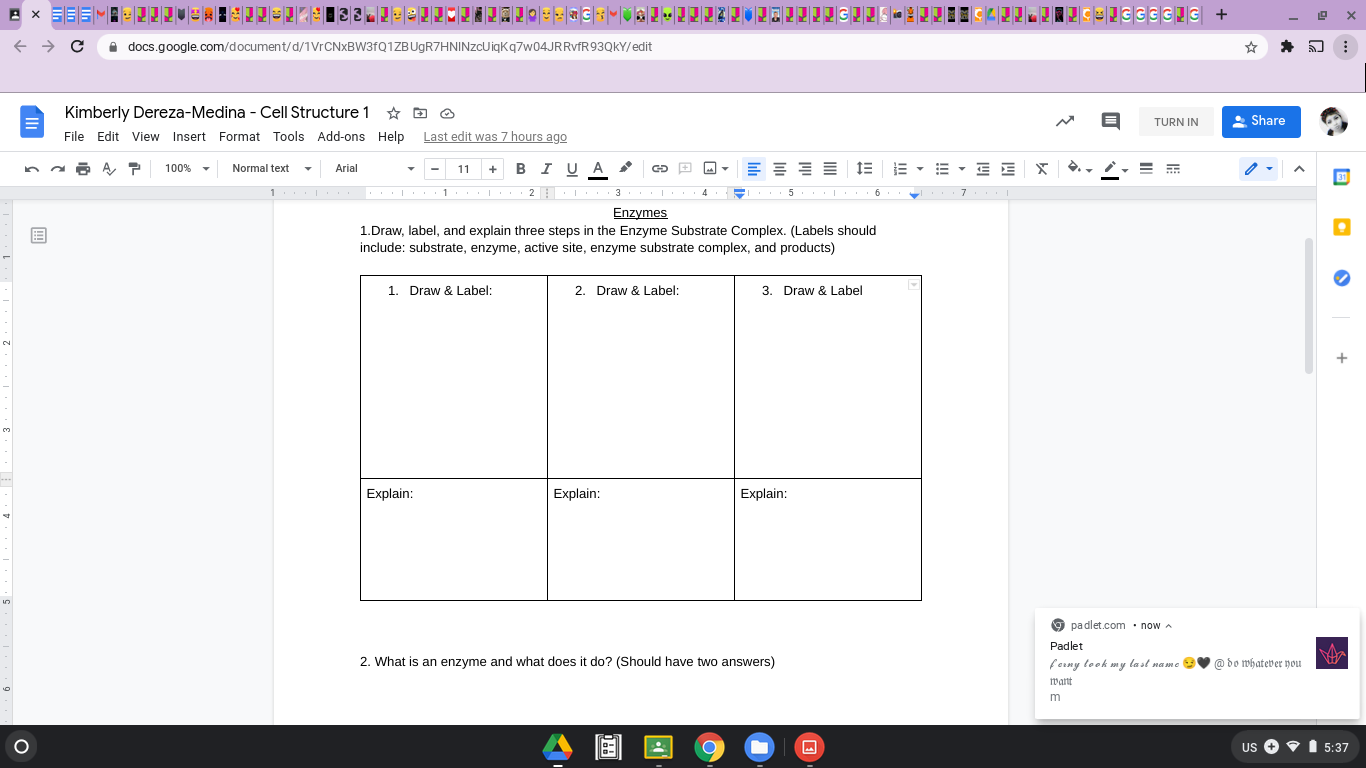
I need help. Idk nothing abt Cell Structure (Look at the comments)
 babygurlcrip:
@kimberlydereza yhu dumb and slow we BOTH have Biology class -.-
kimberlydereza:
\(\color{#0cbb34}{\text{Originally Posted by}}\) @babygurlcrip @kimberlydereza yhu dumb and slow we BOTH have Biology class -.- \(\color{#0cbb34}{\text{End of Quote}}\) Ik but i'm fr idk nothing abt Cell Structure
 Timmyspu:
What are some cells that you know?
kimberlydereza:
\(\color{#0cbb34}{\text{Originally Posted by}}\) @Timmyspu What are some cells that you know? \(\color{#0cbb34}{\text{End of Quote}}\) Ik I learned it in 7th grade but tbh idk one thing abt Cell Structure
Timmyspu:
What are the elements on the periodic table?
kimberlydereza:
\(\color{#0cbb34}{\text{Originally Posted by}}\) @Timmyspu What are the elements on the periodic table? \(\color{#0cbb34}{\text{End of Quote}}\) Ik what those r
Timmyspu:
What are some of them?
kimberlydereza:
\(\color{#0cbb34}{\text{Originally Posted by}}\) @Timmyspu What are some of them? \(\color{#0cbb34}{\text{End of Quote}}\) Helium, Carbon, Silver, Gold, etc.
Timmyspu:
ok good any more?
 KayleeElizabeth0419:
\(\color{#0cbb34}{\text{Originally Posted by}}\) @kimberlydereza \(\color{#0cbb34}{\text{Originally Posted by}}\) @Timmyspu What are some of them? \(\color{#0cbb34}{\text{End of Quote}}\) Helium, Carbon, Silver, Gold, etc. \(\color{#0cbb34}{\text{End of Quote}}\) \(\color{#0cbb34}{\text{Originally Posted by}}\) @Timmyspu ok good any more? \(\color{#0cbb34}{\text{End of Quote}}\) i take that as a no??
Timmyspu:
I would assume so.
KayleeElizabeth0419:
\(\color{#0cbb34}{\text{Originally Posted by}}\) @Timmyspu I would assume so. \(\color{#0cbb34}{\text{End of Quote}}\) lol
 Vocaloid:
enzyme-substrate reactions are actually pretty complicated, but I'll try to simplify enzymes are molecules that bind to other, smaller molecules called substrates. enzymes have special sites called "active sites" that are designed for substrates to bind to them so if you look at diagrams like this: https://www2.nau.edu/lrm22/lessons/enzymes/enzyme_substrate_complex.jpg the enzymes are drawn with "notches" that are perfectly designed to fit substrates (in real life it's more complicated than this, but for the purposes of this problem we can simplify) when the enzyme + substrate(s) are bound together ---> it's called an enzyme-substrate complex now, the enzyme lowers the activation energy of reactions, so the substrates can react more easily and make new products (on your diagram, make sure your products look different than the original substrates to make it clear that some reaction has taken place) once the products form, they'll detach from the ES complex and the enzyme should be leftover, untouched
kimberlydereza:
\(\color{#0cbb34}{\text{Originally Posted by}}\) @Vocaloid enzyme-substrate reactions are actually pretty complicated, but I'll try to simplify enzymes are molecules that bind to other, smaller molecules called substrates. enzymes have special sites called "active sites" that are designed for substrates to bind to them so if you look at diagrams like this: https://www2.nau.edu/lrm22/lessons/enzymes/enzyme_substrate_complex.jpg the enzymes are drawn with "notches" that are perfectly designed to fit substrates (in real life it's more complicated than this, but for the purposes of this problem we can simplify) when the enzyme + substrate(s) are bound together ---> it's called an enzyme-substrate complex now, the enzyme lowers the activation energy of reactions, so the substrates can react more easily and make new products (on your diagram, make sure your products look different than the original substrates to make it clear that some reaction has taken place) once the products form, they'll detach from the ES complex and the enzyme should be leftover, untouched \(\color{#0cbb34}{\text{End of Quote}}\) Thxs I understand now
Join our real-time social learning platform and learn together with your friends!
 VERNEISH:
Two objects are moving along separate linear paths where each path is described by position, d, and time, t.
VERNEISH:
Two objects are moving along separate linear paths where each path is described by position, d, and time, t.

 Maci:
what are the best stock apps for people who want to start investing?
Maci:
what are the best stock apps for people who want to start investing?
 Twaylor:
genuienly how do i get better self control i keep watcing youtube and theres this
Twaylor:
genuienly how do i get better self control i keep watcing youtube and theres this
 IzzyCookie:
|dw:1792074056138:dw| Uhm, I don't know where to ask this, but I'm in college welding at my community college, and I need help learning vertical welding for
IzzyCookie:
|dw:1792074056138:dw| Uhm, I don't know where to ask this, but I'm in college welding at my community college, and I need help learning vertical welding for

 thehearken:
not sure if this is considered spam, im sorry if it is, but does anyone have tips
thehearken:
not sure if this is considered spam, im sorry if it is, but does anyone have tips