
 XioGonz:
Am I wrong?
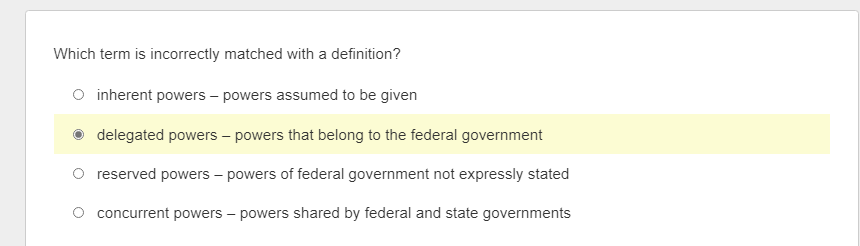 XioGonz:
@jimthompson5910
 yaz:
yaz:
no you are not wrong
bryna321:
No
 mxddi3:
i thought delegated powers which can sometimes be called expressed or enumerated powers were powers specifically given to the federal government. They are found in article 1, section 7 or 8, i dont remember...but yh.
XioGonz:
So...I'm incorrect?
 jhonyy9:
yes correct
XioGonz:
Ah okay thank you!
jhonyy9:
np yw
jimthompson5910:
Unfortunately choice B is not correct.
jimthompson5910:
Delegated powers are granted by the people to the federal government. So the people delegate or give out the right for the federal government to attain this power.
jimthompson5910:
hint: which powers are given to the states? Think of the 10th amendment.
XioGonz:
“police powers” of health, education, and welfare. …
mxddi3:
yeah i thought that as well. B and D are correct, so then between A and C, reserved means like, set aside for, and then inherent is like it's given. Xio i sent u smth to explain this
XioGonz:
Hmmm
XioGonz:
A
jimthompson5910:
I suppose you could argue that the powers aren't given to the states, but rather the powers are not given to the federal government. So by default they go to the states.
mxddi3:
since ur confused, lemme post it here. so if we you think it's B, let me show you what it says for the definition of delegated. "Delegated (sometimes called enumerated or expressed) powers are specifically granted to the federal government in Article I, Section 8 of the Constitution. This includes the power to coin money, to regulate commerce, to declare war, to raise and maintain armed forces, and to establish a Post Office." we know that B isnt the correct choice. now do yk what A and C mean? Have u studied them?
XioGonz:
Because inherent powers are powers held by a sovereign state
XioGonz:
\(\color{#0cbb34}{\text{Originally Posted by}}\) @mxddi3 since ur confused, lemme post it here. so if we you think it's B, let me show you what it says for the definition of delegated. "Delegated (sometimes called enumerated or expressed) powers are specifically granted to the federal government in Article I, Section 8 of the Constitution. This includes the power to coin money, to regulate commerce, to declare war, to raise and maintain armed forces, and to establish a Post Office." we know that B isnt the correct choice. now do yk what A and C mean? Have u studied them? \(\color{#0cbb34}{\text{End of Quote}}\) Yes
mxddi3:
ok so what have you learned for the definition reserved and inherent? i can't explain without a direct answer here
XioGonz:
Reserved powers are the powers that are not prohibited or given by law to any part of government. And inherent powers are powers held by a sovereign state
mxddi3:
Ok so look at the definitions next to the words. For reserved powers it says online "derived from the Tenth Amendment of the Constitution, that are not specifically delegated to the national government or denied to the states" does that look like the definition of reserved powers that has been given?
XioGonz:
reserved powers is correct
jimthompson5910:
another hint: if you don't directly say something, but still convey a certain message, then you imply something. Example: A person smiling implies that they are happy. They don't directly say so, but their facial expression shows it. Based on that, what do you think the difference between "expressed powers" and "implied powers" is?
Join our real-time social learning platform and learn together with your friends!
VERNEISH:
Two objects are moving along separate linear paths where each path is described by position, d, and time, t.

 Maci:
what are the best stock apps for people who want to start investing?
Maci:
what are the best stock apps for people who want to start investing?
 Twaylor:
genuienly how do i get better self control i keep watcing youtube and theres this
Twaylor:
genuienly how do i get better self control i keep watcing youtube and theres this
 IzzyCookie:
|dw:1792074056138:dw| Uhm, I don't know where to ask this, but I'm in college welding at my community college, and I need help learning vertical welding for
IzzyCookie:
|dw:1792074056138:dw| Uhm, I don't know where to ask this, but I'm in college welding at my community college, and I need help learning vertical welding for

 thehearken:
not sure if this is considered spam, im sorry if it is, but does anyone have tips
thehearken:
not sure if this is considered spam, im sorry if it is, but does anyone have tips