
 InsatiableSuffering:
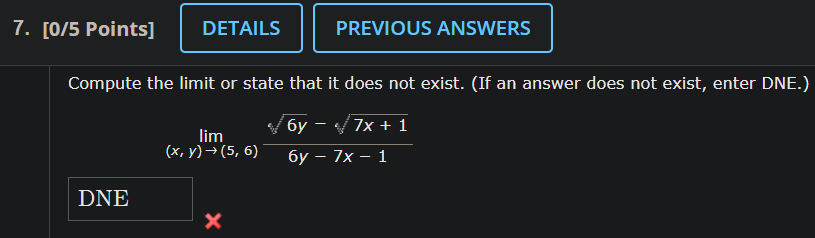
Does anyone know how to find the limit of this function?
 dude:
dude:
Substituting only gives you \(\dfrac00\) I would multiply by its conjugate then substitute
InsatiableSuffering:
\(\color{#0cbb34}{\text{Originally Posted by}}\) @dude Substituting only gives you \(\dfrac00\) I would multiply by its conjugate then substitute \(\color{#0cbb34}{\text{End of Quote}}\) I tried doing that, but I got \[\frac{ 1 }{ \sqrt{6y}-\sqrt{7x+1} }\] And when I subbed in the values, it just doesn't give me a value. Did I do something wrong here?
dude:
\(\color{#0cbb34}{\text{Originally Posted by}}\) InsatiableSuffering \(\color{#0cbb34}{\text{Originally Posted by}}\) dude Substituting only gives you \(\dfrac00\) I would multiply by its conjugate then substitute \(\color{#0cbb34}{\text{End of Quote}}\) I tried doing that, but I got \[\frac{ 1 }{ \sqrt{6y}-\sqrt{7x+1} }\] And when I subbed in the values, it just doesn't give me a value. Did I do something wrong here? \(\color{#0cbb34}{\text{End of Quote}}\) \(\dfrac{1}{\sqrt{6y}\color{red}{+}\sqrt{7x+1}}\)
InsatiableSuffering:
\(\color{#0cbb34}{\text{Originally Posted by}}\) @dude \(\color{#0cbb34}{\text{Originally Posted by}}\) InsatiableSuffering \(\color{#0cbb34}{\text{Originally Posted by}}\) dude Omg thank you so much! That makes so much more sense. Substituting only gives you \(\dfrac00\) I would multiply by its conjugate then substitute \(\color{#0cbb34}{\text{End of Quote}}\) I tried doing that, but I got \[\frac{ 1 }{ \sqrt{6y}-\sqrt{7x+1} }\] And when I subbed in the values, it just doesn't give me a value. Did I do something wrong here? \(\color{#0cbb34}{\text{End of Quote}}\) \(\dfrac{1}{\sqrt{6y}\color{red}{+}\sqrt{7x+1}}\) \(\color{#0cbb34}{\text{End of Quote}}\)
 jhonyy9:
so there is this question to find the limit of this fraction : \[\frac{ \sqrt{6y -\sqrt{7x+1}} }{ 6y -7x -1 }\] so given that we need find the limit of this fraction for x=5 and y=6 but first of all if you check these value of x and y substituting inside this faction you get the denominator equal zero what mean that this fraction for x=5 and y=6 is undefined bc. hope you know that a fraction need be defined to can work ,make calcule with ... so in this way thats all what you can make - from this result DNE - does not exist hope helped understandably easy @dude
jhonyy9:
and any idea about conjugate so bc. in denominator there isnt radical we dont use conjugate - not is necessary - we use conjugate in case when there is radical in denominator and using conjugate we try eliminate the radical(s) from denominator - hope helped
jhonyy9:
@AZ
 AZ:
AZ:
I will have to agree with @dude. When you plug in (5, 6) , you get \(\dfrac{0}{0}\) which is an indeterminate form. This doesn't mean that the final answer is DNE (which as you can see from the screenshot was incorrect). I do see where Jhonyy is coming from- that conjugates are normally used when we have a radical in the denominator and we're trying to remove it from the denominator. But it is also a perfectly valid method to multiply the numerator and denominator by the conjugate to see if you can then evaluate the limit. (It's basically like multiplying by 1 so you're not changing anything.) Also, since OP got the conjugate wrong I'd just like to remind that The conjugate of a+b is a-b The conjugate of a-b is a+b You're essentially changing the signs. Which reminds me that we also use conjugates to simplify complex numbers like 1/(3+4i)
AZ:
We can't use L'Hopital's rule since we're dealing with a multivariable function. As a refresher, L'Hopital's rule allows us to evaluate limits that are indeterminate so either \(\dfrac{0}{0}\) or \(\dfrac{\infty}{\infty}\) and states \[\lim_{x \rightarrow c} \frac{ f(x) }{ g(x) } = \lim_{x \rightarrow c}\frac{ f'(x) }{ g'(x) }\] Even if you are taking multivariable calculus, I don't think you would be expected to know nor will they teach you how to use L'Hopital's rule. However, if you are interested: https://arxiv.org/pdf/1209.0363.pdf
jhonyy9:
\(\color{#0cbb34}{\text{Originally Posted by}}\) @AZ We can't use L'Hopital's rule since we're dealing with a multivariable function. As a refresher, L'Hopital's rule allows us to evaluate limits that are indeterminate so either \(\dfrac{0}{0}\) or \(\dfrac{\infty}{\infty}\) and states \[\lim_{x \rightarrow c} \frac{ f(x) }{ g(x) } = \lim_{x \rightarrow c}\frac{ f'(x) }{ g'(x) }\] Even if you are taking multivariable calculus, I don't think you would be expected to know nor will they teach you how to use L'Hopital's rule. However, if you are interested: https://arxiv.org/pdf/1209.0363.pdf \(\color{#0cbb34}{\text{End of Quote}}\) ty @AZ but any idea - opinion about these my words please - : ,,but first of all if you check these value of x and y substituting inside this faction you get the denominator equal zero what mean that this fraction for x=5 and y=6 is undefined bc. hope you know that a fraction need be defined to can work ,make calcule with ..."
AZ:
Yes, I understand. Because the fraction is undefined we need to multiply by the conjugate so that it won't be undefined at x=5 and y=6.
jhonyy9:
so sorry but i think we dont understand - i mean that when for any variable values we get for a fraction the denominator equal zero so this mean that this fraction is undefined and for next steps we not can work - make any calcule with this fraction bc this not can be used - how i ve read somewhere : the presently mathematics not is on this level to can make calcules with undefined fractions - so with denominator equal zero ...
AZ:
Just because the denominator equals 0 does not mean that that the limit is undefined :) For example \[\lim_{x \rightarrow 1}\dfrac{x^2 +x-2}{x^2-1}\] You will get 0/0 if you plug in x=1. But if you graph it, you will notice that the limit approaches 1.5 as x gets closer to 1. You could simplify it and then evaluate the limit. We could have also used L'Hopital's rule to help us in evaluating this limits as well as limits that we would otherwise believe are undefined but are actually not. But for our original question, multiplying by the conjugate is the best way to go.
jhonyy9:
\(\color{#0cbb34}{\text{Originally Posted by}}\) @AZ Just because the denominator equals 0 does not mean that that the limit is undefined :) For example \[\lim_{x \rightarrow 1}\dfrac{x^2 +x-2}{x^2-1}\] You will get 0/0 if you plug in x=1. But if you graph it, you will notice that the limit approaches 1.5 as x gets closer to 1. You could simplify it and then evaluate the limit. We could have also used L'Hopital's rule to help us in evaluating this limits as well as limits that we would otherwise believe are undefined but are actually not. But for our original question, multiplying by the conjugate is the best way to go. \(\color{#0cbb34}{\text{End of Quote}}\) ok ty so much
Join our real-time social learning platform and learn together with your friends!
 VERNEISH:
Two objects are moving along separate linear paths where each path is described by position, d, and time, t.
VERNEISH:
Two objects are moving along separate linear paths where each path is described by position, d, and time, t.

 Maci:
what are the best stock apps for people who want to start investing?
Maci:
what are the best stock apps for people who want to start investing?
 Twaylor:
genuienly how do i get better self control i keep watcing youtube and theres this
Twaylor:
genuienly how do i get better self control i keep watcing youtube and theres this
 IzzyCookie:
|dw:1792074056138:dw| Uhm, I don't know where to ask this, but I'm in college welding at my community college, and I need help learning vertical welding for
IzzyCookie:
|dw:1792074056138:dw| Uhm, I don't know where to ask this, but I'm in college welding at my community college, and I need help learning vertical welding for

 thehearken:
not sure if this is considered spam, im sorry if it is, but does anyone have tips
thehearken:
not sure if this is considered spam, im sorry if it is, but does anyone have tips