
 Seafoam:
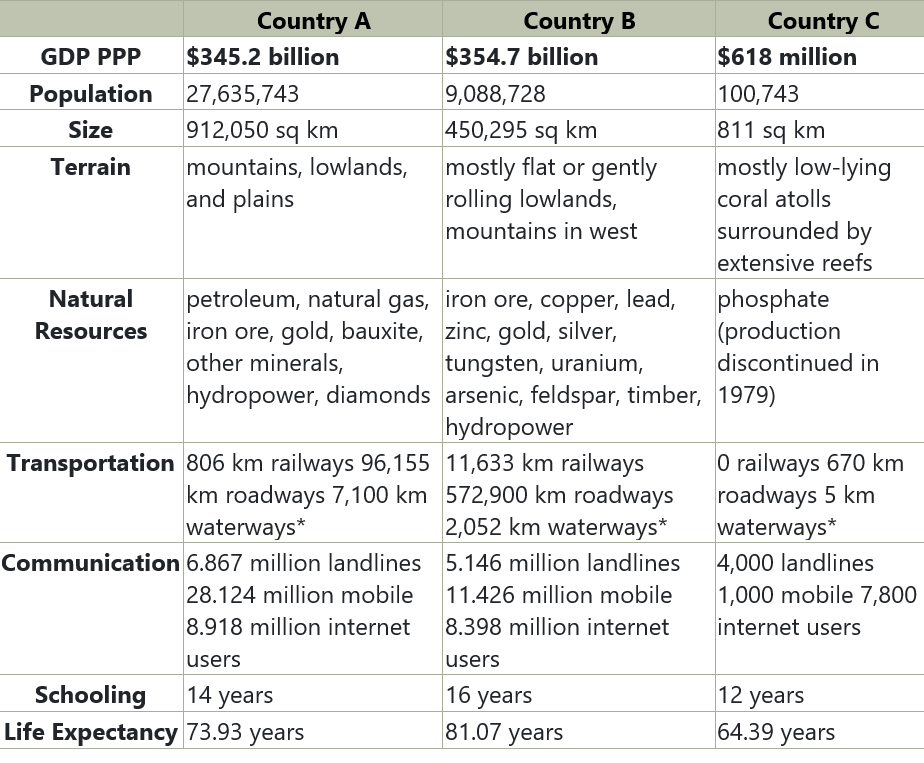
Country A Country B Country C GDP PPP $345.2 billion $354.7 billion $618 million Population 27,635,743 9,088,728 100,743 Size 912,050 sq km 450,295 sq km 811 sq km Terrain mountains, lowlands, and plains mostly flat or gently rolling lowlands, mountains in west mostly low-lying coral atolls surrounded by extensive reefs Natural Resources petroleum, natural gas, iron ore, gold, bauxite, other minerals, hydropower, diamonds iron ore, copper, lead, zinc, gold, silver, tungsten, uranium, Toastnic, feldspar, timber, hydropower phosphate (production discontinued in 1979) Transportation 806 km railways 96,155 km roadways 7,100 km waterways* 11,633 km railways 572,900 km roadways 2,052 km waterways* 0 railways 670 km roadways 5 km waterways* Communication 6.867 million landlines 28.124 million mobile 8.918 million internet users 5.146 million landlines 11.426 million mobile 8.398 million internet users 4,000 landlines 1,000 mobile 7,800 internet users Schooling 14 years 16 years 12 years Life Expectancy 73.93 years 81.07 years 64.39 years Write a paragraph that describes each country's level of development and explain what data helped you arrive at your analysis.
Seafoam:
Country A Country B Country C GDP PPP $345.2 billion $354.7 billion $618 million Population 27,635,743 9,088,728 100,743 Size 912,050 sq km 450,295 sq km 811 sq km Terrain mountains, lowlands, and plains mostly flat or gently rolling lowlands, mountains in west mostly low-lying coral atolls surrounded by extensive reefs Natural Resources petroleum, natural gas, iron ore, gold, bauxite, other minerals, hydropower, diamonds iron ore, copper, lead, zinc, gold, silver, tungsten, uranium, Toastnic, feldspar, timber, hydropower phosphate (production discontinued in 1979) Transportation 806 km railways 96,155 km roadways 7,100 km waterways* 11,633 km railways 572,900 km roadways 2,052 km waterways* 0 railways 670 km roadways 5 km waterways* Communication 6.867 million landlines 28.124 million mobile 8.918 million internet users 5.146 million landlines 11.426 million mobile 8.398 million internet users 4,000 landlines 1,000 mobile 7,800 internet users Schooling 14 years 16 years 12 years Life Expectancy 73.93 years 81.07 years 64.39 years
 AZ:
AZ:
Now that screenshot allows me to process the information much better so thank you for that :) Your question/prompt asks you to describe the level of development of the countries Is there anything in your lessons about that?
AZ:
You'll definitely be comparing the GDP PPP column. Take a look at their populations as well when you take it into consideration. I also found this which talks about the different types of development https://www.coolgeography.co.uk/A-level/AQA/Year%2013/Development%20&%20Globalisation/Background/Types%20of%20development.htm
Seafoam:
It has something on regional patterns, Gross Domestic product, Gross national income, human development index, and other stuff
Seafoam:
Oh that should be useful
AZ:
Life expectancy is listed on that website and is also part of the human development index And if you think about it, it does say a lot about the quality of healthcare and whatnot so you can compare that as well among these three countries
AZ:
This also has some good information: https://www.bbc.co.uk/bitesize/guides/zvp39j6/revision/1 For example, quoting from that website: `Some pieces of data do not help to measure development. For example the size of a country is not very helpful because some large countries are very poorly developed while other large countries are very advanced.` This one has some more good info https://www.bbc.co.uk/bitesize/guides/z838xsg/revision/1
Seafoam:
Whats a big country with a small population?
AZ:
The size, terrain, and natural resources can all influence the development of a country. (Imagine if you're a tiny island, what could you possibly export and how large would your economy be based off of that?) So those can influence it but the real marker for how developed the country is the GDP (and remember you have to use it in conjunction with their population) as well as the life expectancy. A country with 100 people that has a GDP of $10,000,000 is not the same as a country with 100,000 people with the same GDP But the transportation and communication do tell us how advanced they are as well like country C has 1000 mobile for a population of 100,000 while country B has 11.426 million for a population of 9.088 million
AZ:
\(\color{#0cbb34}{\text{Originally Posted by}}\) @Seafoam Whats a big country with a small population? \(\color{#0cbb34}{\text{End of Quote}}\) I don't know if there's a term for it but I don't think that's relevant
Seafoam:
Oh I was just making an example in the parapgraph
Seafoam:
Paragraph*
AZ:
OHH you meant a country as an example Canada could work for that I guess especially if you're talking about a developed country
Seafoam:
Ok then
Seafoam:
Country C sounds like an island
AZ:
mhmm, it is it has low-lying corals surrounded by reefs
Seafoam:
That'll have an impact on economy because they have to get there resources shipped right?
AZ:
Uhh I don't know what you mean by impact but yeah whatever they don't have, they'd need to get shipped But you don't have to dwell into that as much since we really just need to use the information they gave us to come to conclusions
Seafoam:
Oh, right
Join our real-time social learning platform and learn together with your friends!
 VERNEISH:
Two objects are moving along separate linear paths where each path is described by position, d, and time, t.
VERNEISH:
Two objects are moving along separate linear paths where each path is described by position, d, and time, t.

 Maci:
what are the best stock apps for people who want to start investing?
Maci:
what are the best stock apps for people who want to start investing?
 Twaylor:
genuienly how do i get better self control i keep watcing youtube and theres this
Twaylor:
genuienly how do i get better self control i keep watcing youtube and theres this
 IzzyCookie:
|dw:1792074056138:dw| Uhm, I don't know where to ask this, but I'm in college welding at my community college, and I need help learning vertical welding for
IzzyCookie:
|dw:1792074056138:dw| Uhm, I don't know where to ask this, but I'm in college welding at my community college, and I need help learning vertical welding for

 thehearken:
not sure if this is considered spam, im sorry if it is, but does anyone have tips
thehearken:
not sure if this is considered spam, im sorry if it is, but does anyone have tips