
 jkmiec26:
I need help on math. I'll attach a ss below.
 jkmiec26:
@jhonyy9
 supie:
@az
 new2luv:
@snowflake0531
 snowflake0531:
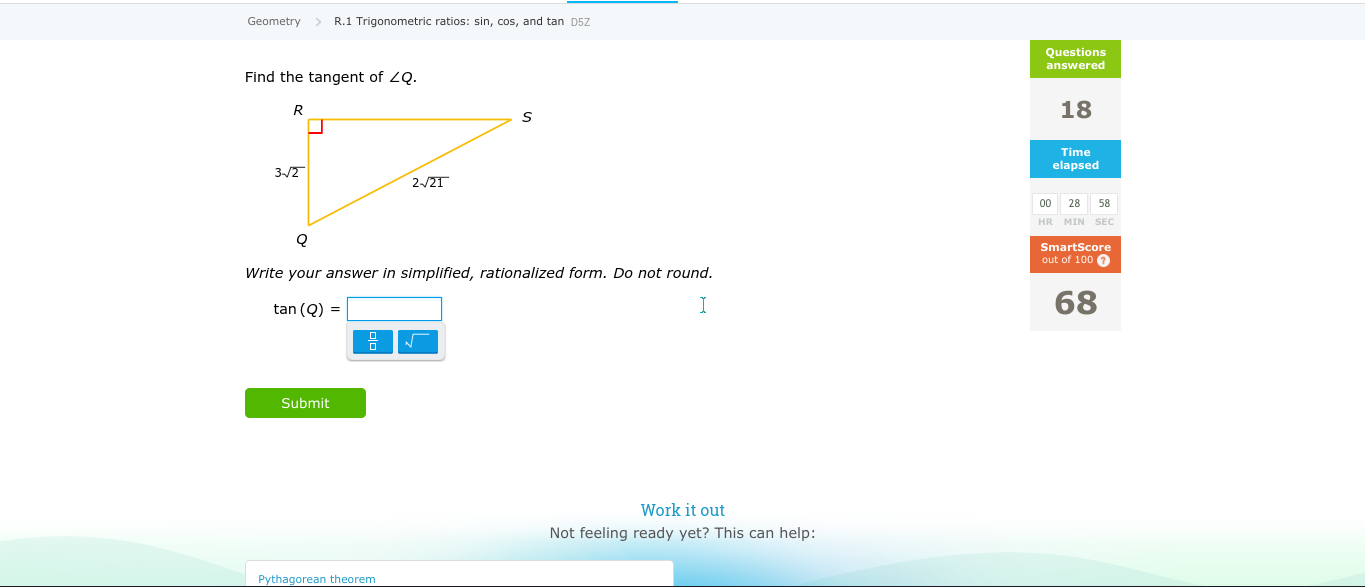
You first have to use the pythagorean theorem to find the third side of the triangle can you do that
jkmiec26:
Kind of
jkmiec26:
\[2\sqrt{21}^{2}=x ^{2}+3\sqrt{2}\] is that it?
jkmiec26:
\[3\sqrt{2}^{2}\] that's what the last one supposed to look like
 AZ:
AZ:
almost, but let's add parenthesis so we don't get confused that it's the square of the whole number \( (2 \sqrt{21})^2 = x^2 + ( 3\sqrt{2})^2\)
AZ:
now let's solve for x but first let's find out what those numbers are when you \(^2\) to them so you should know that \( (ab)^2 = a^2 b^2\) and that \(\sqrt{x} ^2 = x\)
AZ:
so we have \( (2 \sqrt{21})^2 \) what do you get when you square it?
jkmiec26:
|dw:1616520673520:dw|
jkmiec26:
would that be that side?
AZ:
Yes!
AZ:
Now do you know that tan = opposite / adjacent
jkmiec26:
so √66 / 3√2?
AZ:
Yup!
AZ:
I'm not sure if that is an acceptable answer or if they want us to multiply by \(\sqrt{2}\) in the numerator and denominator so that way we don't have any square root in the denominator
jkmiec26:
|dw:1616520927070:dw|
jkmiec26:
?
AZ:
Well, you are on a roll!
AZ:
So let's simplify it a little more 132 = 33 * 4 so what is \(\sqrt{132} =?\)
jkmiec26:
I don't think that will work bc I get a decimal I think I need something like number√number is that makes sense
jkmiec26:
\[2\]\[2\sqrt{33}\]
AZ:
yes, I understand but remember you can pull out the 4 yes!
AZ:
So now you have \( \dfrac{2\sqrt{33}}{6}\) you can simplify it just a little bit more and get rid of that 2 what does the denominator become?
jkmiec26:
would the answer be \[\sqrt{33} / 3\]
AZ:
That would be your final answer!
jkmiec26:
Thank you so much!!!! Do you think you can help me on one more?
AZ:
wait
jkmiec26:
okay
AZ:
okay, yup that was the correct answer! And sure :)
 jkmiec26:
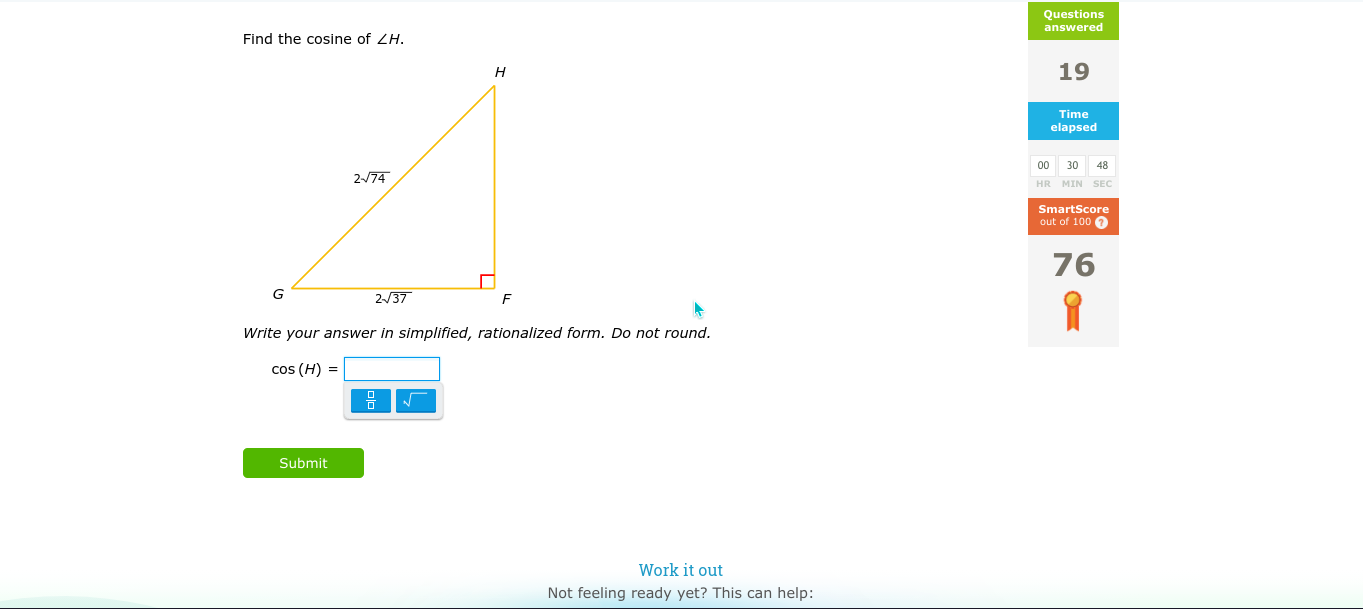
cosine is opposite / hypotenuse right?
AZ:
No, that's sin SOH CAH TOA Sin = Opposite / Hypotenuse Cos = Adjacent / Hypotenuse Tan = Opposite / Adjacent
jkmiec26:
so now I have to find the adjacent side?
AZ:
yeah, they really are making you do a lot of work for these questions hmm
AZ:
Use the Pythagorean theorem to find the adjacent side and then we use the ratio adjacent / hypotenuse and simplify it
jkmiec26:
x=√74
jkmiec26:
|dw:1616521746703:dw|
AZ:
are you saying that's the adjacent side? because I got a different answer for that mhmm
jkmiec26:
oh well I thought it was the adjacent side
jkmiec26:
it would be √148?
AZ:
so if we use the Pythagorean theorem \( x^2 = (2\sqrt{74})^2 - (2\sqrt{37})^2\)
AZ:
\(\color{#0cbb34}{\text{Originally Posted by}}\) @jkmiec26 it would be √148? \(\color{#0cbb34}{\text{End of Quote}}\) Yes!
jkmiec26:
|dw:1616521918937:dw|
jkmiec26:
|dw:1616521974387:dw|
jkmiec26:
@AZ ??
AZ:
ah, okay, let's take a step back 148 = 74 * 2 so \(\sqrt{148} = \sqrt{2 \times 74} = \sqrt{2} \times \sqrt{74}\) so now you can just cross out sqrt(74) from both the numerator and denominator
jkmiec26:
would the answer be \[5\sqrt{437} / 148\] ??
AZ:
no, you cannot simplify sqrt(10952) to 5 sqrt(437) I don't know how you did that
AZ:
But let's go back one step before you multiplied it all |dw:1616522674833:dw|
AZ:
|dw:1616522696994:dw|
AZ:
remember \(\sqrt{a\times b} = \sqrt{a} \times \sqrt{b}\) so \(\sqrt{148} = \sqrt{2 \times 74} = \sqrt{2} \times \sqrt{74}\)
jkmiec26:
sice you get 74 in both can you cancel out?
jkmiec26:
since
AZ:
Yes! And what are you left with?
jkmiec26:
√2 / 2
jkmiec26:
Tysm! I really appreciate your help
AZ:
You got it! Well done :))
AZ:
It was my pleasure!!
Join our real-time social learning platform and learn together with your friends!
 VERNEISH:
Two objects are moving along separate linear paths where each path is described by position, d, and time, t.
VERNEISH:
Two objects are moving along separate linear paths where each path is described by position, d, and time, t.

 Maci:
what are the best stock apps for people who want to start investing?
Maci:
what are the best stock apps for people who want to start investing?
 Twaylor:
genuienly how do i get better self control i keep watcing youtube and theres this
Twaylor:
genuienly how do i get better self control i keep watcing youtube and theres this
 IzzyCookie:
|dw:1792074056138:dw| Uhm, I don't know where to ask this, but I'm in college welding at my community college, and I need help learning vertical welding for
IzzyCookie:
|dw:1792074056138:dw| Uhm, I don't know where to ask this, but I'm in college welding at my community college, and I need help learning vertical welding for

 thehearken:
not sure if this is considered spam, im sorry if it is, but does anyone have tips
thehearken:
not sure if this is considered spam, im sorry if it is, but does anyone have tips