
 KyledaGreat:
Consider the following relation. x=−4|y|+3 Find four points contained in the inverse. Express your values as an integer or simplified fraction.
KyledaGreat:
@snowflake0531
 Tranquility:
What is the inverse function?
Tranquility:
Switch x and y. What do you get?
KyledaGreat:
y=−4|x|+3
KyledaGreat:
There is no inverse
Tranquility:
That is the inverse
Tranquility:
Now find four points that are on that graph
KyledaGreat:
i couldn't find them
Tranquility:
Seems like you're struggling... you can replace x with any number and then solve for y. And you'll then have the y-coordinate for that x-value and thus you have one point. You then repeat the process
Tranquility:
It's really simple. Alternatively, you can just graph it and pick points from that: https://www.desmos.com/calculator/gozrhvd5jk
KyledaGreat:
(0, 3), (1, -1), (2, -5) , (-1, 1)
Tranquility:
the fourth point you listed should be (-1, -1)
KyledaGreat:
(0, 3), (1, -1), (2, -5) , (-1, -1)
KyledaGreat:
is that right in order ?
KyledaGreat:
is that right in order ?
Tranquility:
the order doesn't matter but all those points are valid
KyledaGreat:
ok
KyledaGreat:
Consider the following relation. x= −4|y|+3 Find the domain and range of the inverse. Express your answer in interval notation.
KyledaGreat:
@tranquility
Tranquility:
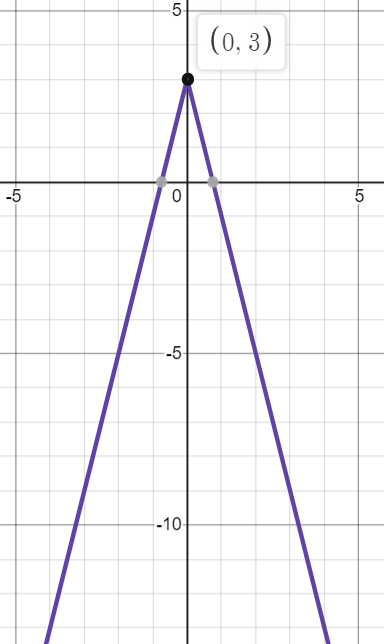
Look at the graph. What are the possible x-values? What are the possible y-values?
KyledaGreat:
well the previous answer was (0, 3), (1, -1), (2, -5) , (-1, 1)
Tranquility:
can x be 100? can it be 1000?
Tranquility:
can it be -100?
KyledaGreat:
sure
Tranquility:
so then you would say the domain (or the possible x-values for the graph) is from negative infinity to positive infinity
Tranquility:
What about the range? Is there a certain value that the y-coordinate can't be? Look at the graph to find it The range is going to be all numbers (that's less than that number) to negative infinity
KyledaGreat:
5/4
Tranquility:
No
 KyledaGreat:
0,3
Tranquility:
So... what is the maximum y-value of the equation?
KyledaGreat:
x
Tranquility:
that doesn't look like a number to me
Tranquility:
|dw:1637520796380:dw| The y-values are on the y-axis can the y-value ever be 4?
KyledaGreat:
yes
Tranquility:
No.
KyledaGreat:
oh i just checked over, no it couldn't from that row
Tranquility:
So what is the maximum y value?
Tranquility:
What is the range going to be? What are the possible y-values
KyledaGreat:
1 or -1
Tranquility:
... that doesn't seem like a range of possible values for the y-value
Tranquility:
Can the y-value be 5? Can it be 4? Can it be 3? Can it be 2? Can it be 1? Can it be 0? Can it be -100?
KyledaGreat:
it can be 5
Tranquility:
look at the graph again and again
Tranquility:
can the y-value EVER be 5?
KyledaGreat:
oh no
KyledaGreat:
it seems on the graph could be 0 or 2 to me if i'm not mistaken
Tranquility:
the y-value can be ANYTHING less than 3
KyledaGreat:
Or
KyledaGreat:
okay, i could go with 1 instead
Tranquility:
the y-value can be 3 when x is 0 the y-value can be 0 when x is 0.75 or -0.75 the y-value can be -5 when x is 2 or -2
Tranquility:
Tranquility:
KyledaGreat:
oh sorry , see i wasn't much good with math and it's been a while so it kind've has to flow back into my memory
Tranquility:
You need to review a lot of basics https://www.khanacademy.org/math/algebra/x2f8bb11595b61c86:functions/x2f8bb11595b61c86:introduction-to-the-domain-and-range-of-a-function/v/introduction-to-interval-notation https://www.khanacademy.org/math/algebra/x2f8bb11595b61c86:functions/x2f8bb11595b61c86:introduction-to-the-domain-and-range-of-a-function/v/domain-of-a-function-intro https://www.khanacademy.org/math/algebra/x2f8bb11595b61c86:functions/x2f8bb11595b61c86:introduction-to-the-domain-and-range-of-a-function/v/range-of-a-function
Tranquility:
Excuses won't help you learn
KyledaGreat:
I get it
Tranquility:
You watched all three videos in less than 2 minutes?
KyledaGreat:
I meant what you said
KyledaGreat:
ok i seen them
KyledaGreat:
can we go back to the question and finally solve it ?
Tranquility:
I doubt you watched them but sure So what's the answer?
Tranquility:
I've already told you the answers
Tranquility:
Nope
Tranquility:
Is that all the possible y-values? Is that how you write it in interval notation?
KyledaGreat:
So far, that is not all the possible y values has to be defined and No
Tranquility:
Watch the videos first. It'll help you understand the concepts and will help you on the rest of your questions because it's the same concept again and again. I've tried my best explaining it through text but obviously it wasn't good enough. Maybe the video will be easier to understand
KyledaGreat:
I understand a little bit of it now
KyledaGreat:
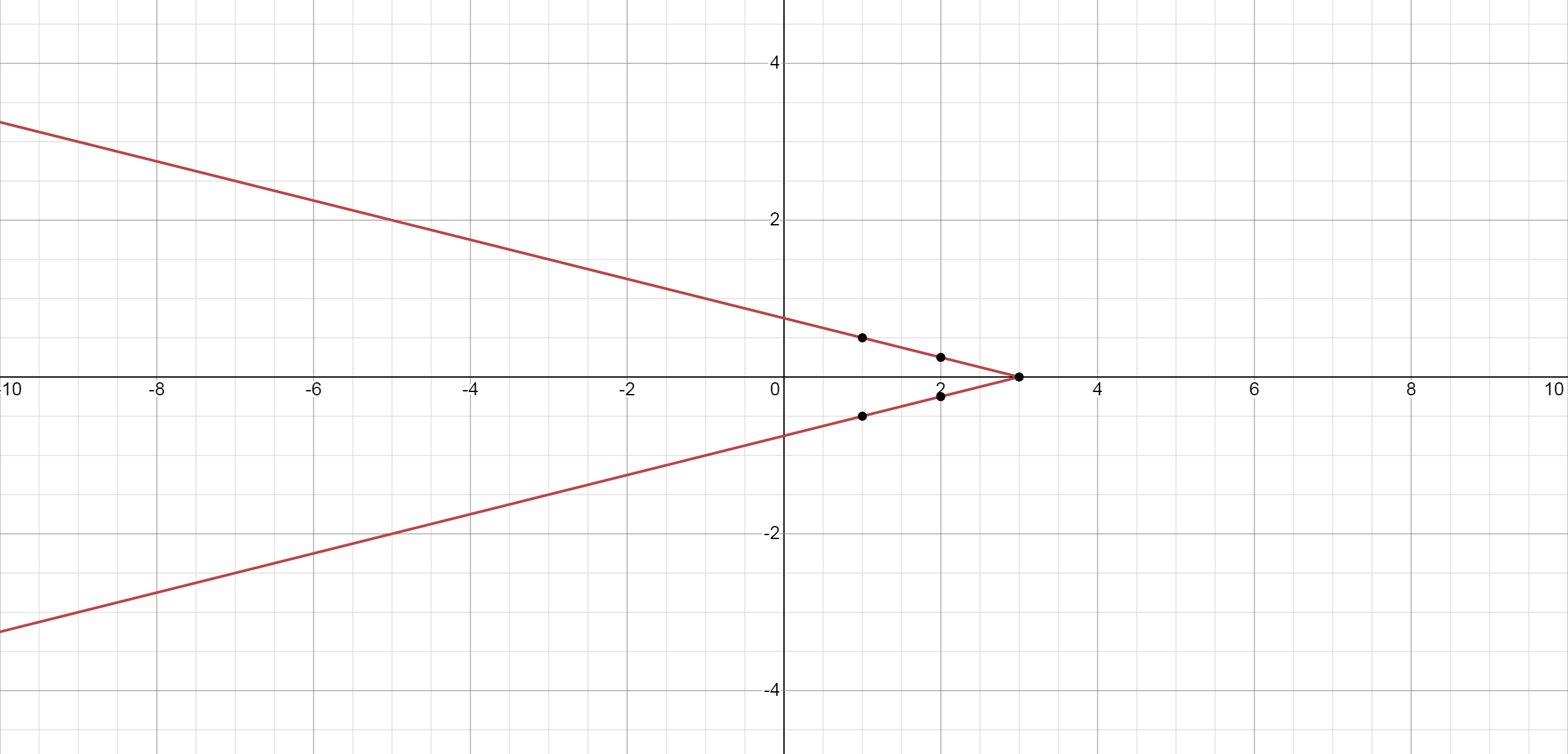
It demonstrates to find the domain, you would have to find the domain from left to right and the range starts from up and down. Correct ?
 KyledaGreat:
Domain: 3
KyledaGreat:
@tranquility
Tranquility:
Tranquility:
KyledaGreat:
oh sorry
KyledaGreat:
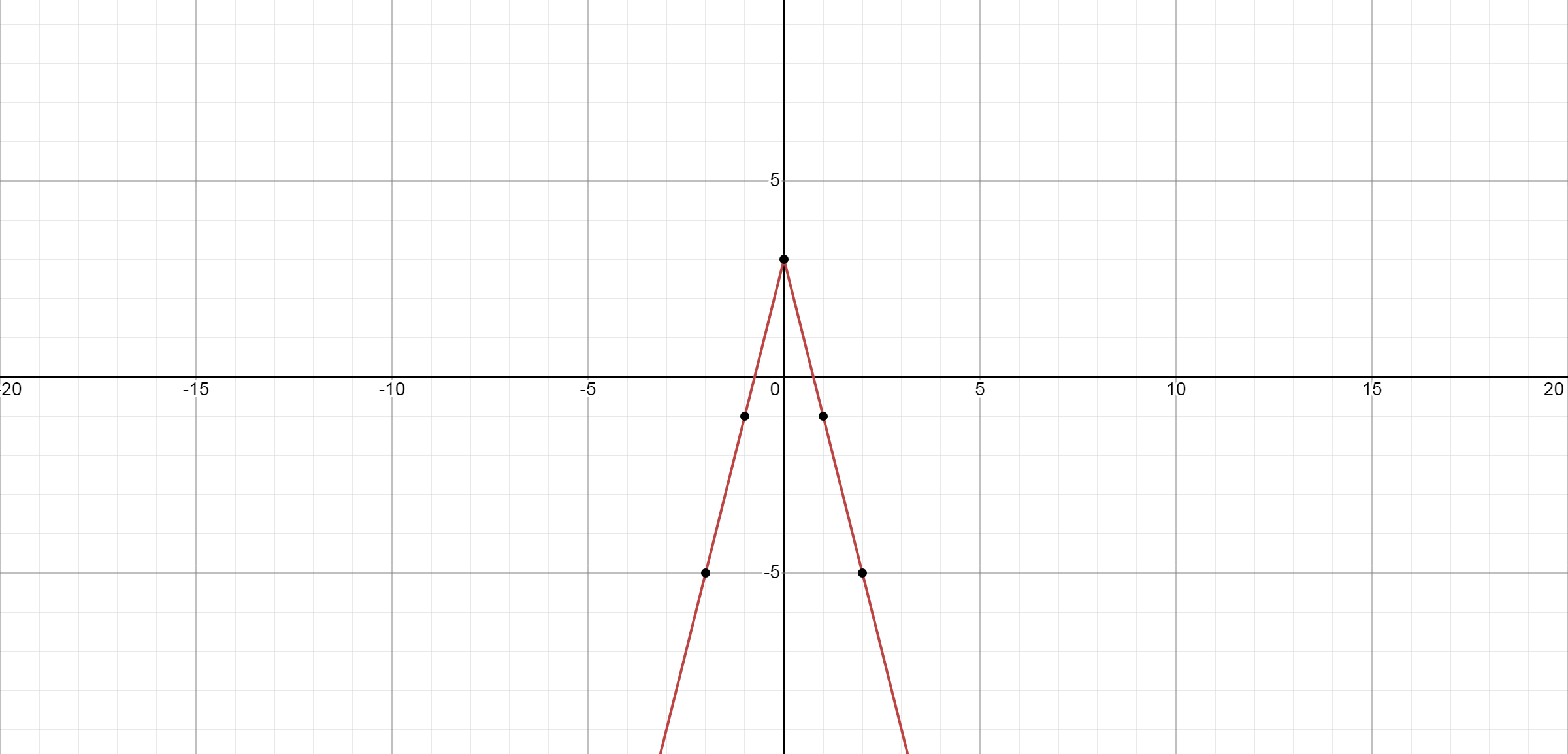
ok first , 0 would be the only maximum value
 KyledaGreat:
The domain by the point seems to be : 0, 3 right or wrong
KyledaGreat:
The domain by the point seems to be : 0, 3 right or wrong
Tranquility:
the domain is a range of numbers that can be possible from left to right
Tranquility:
Basically when you look at the graph, it keeps extending downwards you could plug in x = 10000 and you would get a y-value for it you could plug in x = -10000 and you would get a y-value for it
KyledaGreat:
Oh my mistake , i mistaken that from the Range
Tranquility:
since x can be any possible number on the number line, you say that the domain is all real numbers
Tranquility:
Do you know how you would write that in interval notation?
KyledaGreat:
yes i think so , I believe like this \[(\infty, 3)\]
Tranquility:
That is interval notation but not how you would write it Since it can be any number, it's going to be from negative infinity to positive infinity We are not stuck at x being equal to 3 because x can be equal to 4, 5, 6, 7.... any number all the way to infinity so \( (- \infty, \infty)\)
KyledaGreat:
Oh and look , my apologizes for making you frustrated when you tried to explain it to me and showing me the videos . I have gained a little by little insight by the domain and range and now you put it in a way that all by real numbers by the x can be defined in any number,
KyledaGreat:
Now , for the range i almost had off the tip of my tongue but i could be wrong
Tranquility:
No worries! I hope you're learning something :)
Tranquility:
For the range, you want to look from top to bottom As we said, the graph would keep continuing downwards all the way to negative infinity. And it begins at 3 So how would you write in interval notation that the range goes from 3 to negative infinity
Tranquility:
Remember, since the 3 is included we have to use ] instead of ) for that side of the interval notation
KyledaGreat:
\[(-\infty , 3]\]
Tranquility:
Good job!
KyledaGreat:
Alright , thank you sir and i'll still keep learning.
Tranquility:
No problem
Join our real-time social learning platform and learn together with your friends!
 VERNEISH:
Two objects are moving along separate linear paths where each path is described by position, d, and time, t.
VERNEISH:
Two objects are moving along separate linear paths where each path is described by position, d, and time, t.

 Maci:
what are the best stock apps for people who want to start investing?
Maci:
what are the best stock apps for people who want to start investing?
 Twaylor:
genuienly how do i get better self control i keep watcing youtube and theres this
Twaylor:
genuienly how do i get better self control i keep watcing youtube and theres this
 IzzyCookie:
|dw:1792074056138:dw| Uhm, I don't know where to ask this, but I'm in college welding at my community college, and I need help learning vertical welding for
IzzyCookie:
|dw:1792074056138:dw| Uhm, I don't know where to ask this, but I'm in college welding at my community college, and I need help learning vertical welding for

 thehearken:
not sure if this is considered spam, im sorry if it is, but does anyone have tips
thehearken:
not sure if this is considered spam, im sorry if it is, but does anyone have tips