
 kekeman:
I need help with math
 axie:
axie:
@vocaloid
 Gucchi:
is this for an exam?
 Joe348:
I believe for the first part it would be -5 and something
kekeman:
No its not for an exam
 kekeman:
Its for my segment exam notes
kekeman:
 lifewmylilweeb:
kekeman:
Thanks
lifewmylilweeb:
yw
 lea0728:
@lazorwolf64
kekeman:
 SmokeyBrown:
kekeman:
Ohhhh ok thanks
kekeman:
I just need to figure out what to come up with on part B.)
SmokeyBrown:
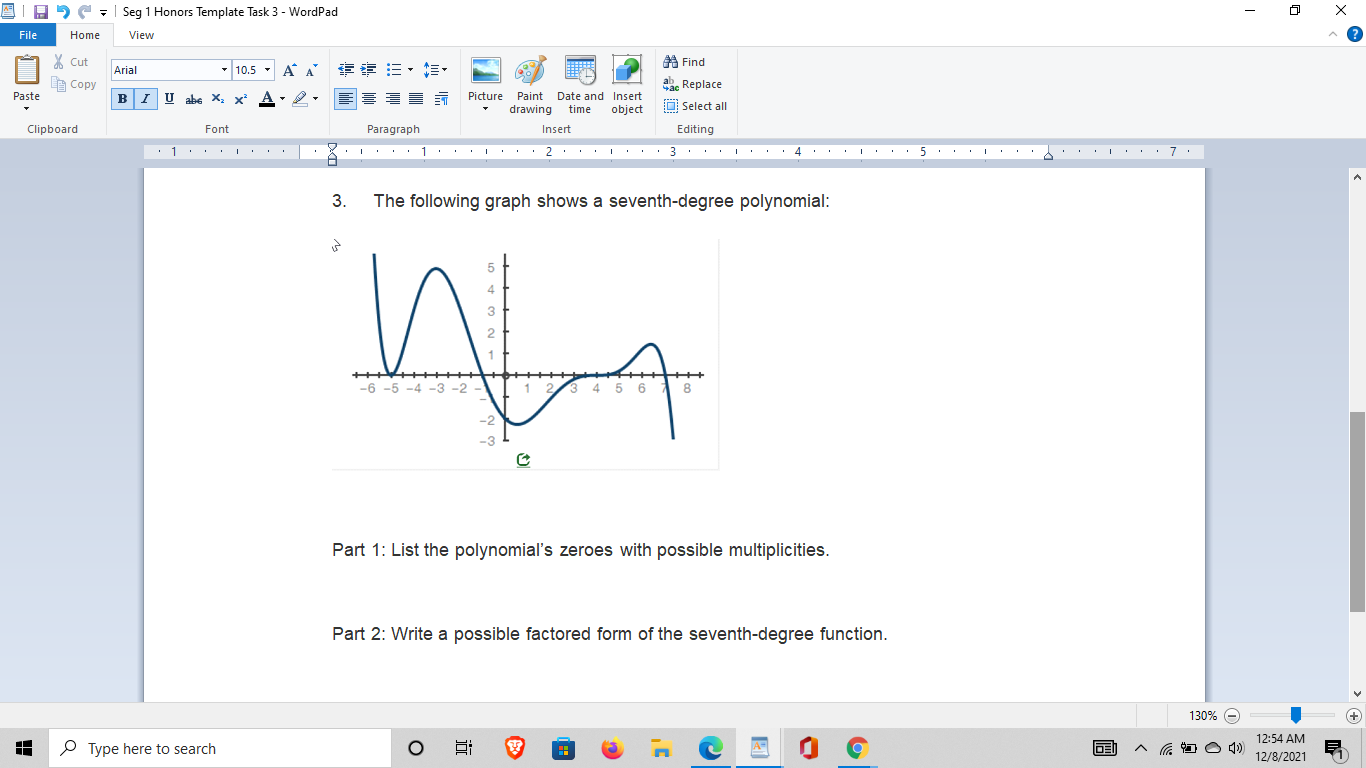
For part 2 of the question, you don't need to give the actual equation of the curve, just a possible equation based on the zeroes you found in part 1. (By the way, I think -5 and 4 are the ones with "possible multiplicities", since the shapes when they intersect are a parabola and a cubed function, respectively. I could be off base with this conclusion) So, with the zeroes -5, -1, 4, 7, assuming -5 has multiplicity of 2 and 4 has multiplicity of 3, one possible equation could be: (x+5) * (x+5) * (x+1) * (x-4) * (x-4) * (x-4) * (x-7) This would also result in a seventh-degree polynomial, as the problem describes since 7 terms are multiplied together. I think this is what the question is getting at, but to be honest, I'm guessing a bit on some parts
kekeman:
SmokeyBrown:
I think 4 has a multiplicity of 3, based on the shape of the curve near that point, but I could be mistaken about that
kekeman:
Omg yes thats what i was thinking
kekeman:
So 4 has a multiplicity of
kekeman:
3
kekeman:
Which one would be a better one for part B.) (x+5)^2(x+1)(x+2)(x-4)(x-7) or -(x-4)^3*(x+5)^2*(x+1)*(x-7)
SmokeyBrown:
Sorry for the late response I think I would go with the second option, -(x-4)^3*(x+5)^2*(x+1)*(x-7) The formatting is a bit neater and it shows the proper multiplicity of 4 and -5
kekeman:
Ok even putting "*" in between it?
SmokeyBrown:
Yeah, you can use the asterisk * to signify multiplication so that's fine to include
kekeman:
Ok thanks :)
Join our real-time social learning platform and learn together with your friends!
 VERNEISH:
Two objects are moving along separate linear paths where each path is described by position, d, and time, t.
VERNEISH:
Two objects are moving along separate linear paths where each path is described by position, d, and time, t.

 Maci:
what are the best stock apps for people who want to start investing?
Maci:
what are the best stock apps for people who want to start investing?
 Twaylor:
genuienly how do i get better self control i keep watcing youtube and theres this
Twaylor:
genuienly how do i get better self control i keep watcing youtube and theres this
 IzzyCookie:
|dw:1792074056138:dw| Uhm, I don't know where to ask this, but I'm in college welding at my community college, and I need help learning vertical welding for
IzzyCookie:
|dw:1792074056138:dw| Uhm, I don't know where to ask this, but I'm in college welding at my community college, and I need help learning vertical welding for

 thehearken:
not sure if this is considered spam, im sorry if it is, but does anyone have tips
thehearken:
not sure if this is considered spam, im sorry if it is, but does anyone have tips