
 Aubree:
For the person who is helping me on my math
 NoodlesAndRiceYT:
could you explain what the question is?
Aubree:
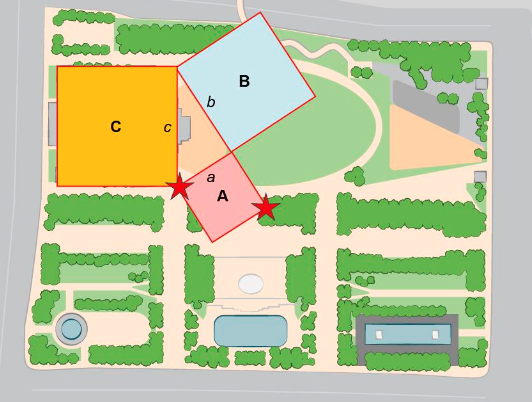
there are three questions that go with that pic tho, but here are two of the questions c) Millennium Park has an outdoor concert theater. Before a concert, the area reserved for special seating is roped off in the shape of a triangle as shown below. How can the converse of the Pythagorean theorem help you determine whether the roped off area is in the shape of a right triangle? d) The front of the stage, side C, is 50 feet long. A 40-foot rope runs along the side of square B. A 30-foot rope runs along the side of square A. Is the roped off area, triangle ABC, a right triangle? Explain.
 Aubree:
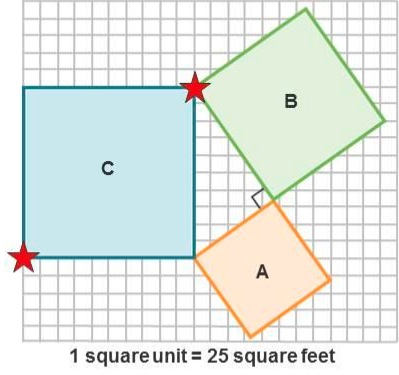
the questions that go to that pic a) This is a blueprint drawing of the stage area at Millennium Park. The length of one square on the grid is equal to 5 feet. According to the blueprint, the length of the diagonal of square C is 60 feet. Is that correct? Explain. b) If the blueprint is drawn on the coordinate plane with vertices (1, 5) and (11, 15) for the corners labeled with red stars, would that be an accurate representation of the length of the diagonal of the square C? Show your work and explain your reasoning.
 Mooshroom:
So to help with "A" Given in the question that length of one square = 5 ft Length of Square C = 10 small squares 1 square = 5 ft 10 square = 5ft * 10 = 50 ft As we know that in a square all side are of equal length and make an angle of 90° at each corner. So, by using pythagorus theorem Diagonal of square² = side² + side² Diagonal of square² = 2side² Diagonal of square = √(2side²) Diagonal of square = √2 (side) where side = 50 ft Diagonal of square = √2 (50) Diagonal of square = 70.71 ft
Mooshroom:
And then to help with "B" Given the vertices (1, 5) and (11, 15) for the corners labeled with red stars, the diagonal of the square C will be the length of the line joining the two vertices. Using the Distance Formula: Since 1 Square Unit = 25 Square Feet 1 Unit =5 feet Therefore, the length of the diagonal
Mooshroom:
does that help?
Aubree:
yes
Mooshroom:
 Mooshroom:
Aubree:
Give me a min
Aubree:
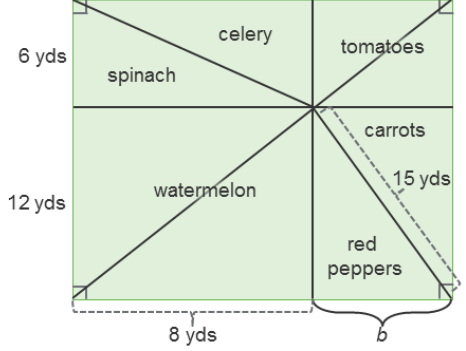
Ik that there is no b btw, idk y there isn't, but here are the questions a) The members of the gardening group plan to build a walkway through the garden as formed by the hypotenuse of each of the four triangles in the drawing. That way, the gardeners will be able to access all sections of the garden. Calculate the length of the entire walkway to the nearest hundredth of a yard. Show your work. c) Is the value you just wrote for the total length of the walkway a rational or irrational number? Explain. d) The group is planning to build a fence around the garden. How many yards of fencing materials do they need for the fence? Show your work.
Join our real-time social learning platform and learn together with your friends!
 VERNEISH:
Two objects are moving along separate linear paths where each path is described by position, d, and time, t.
VERNEISH:
Two objects are moving along separate linear paths where each path is described by position, d, and time, t.

 Maci:
what are the best stock apps for people who want to start investing?
Maci:
what are the best stock apps for people who want to start investing?
 Twaylor:
genuienly how do i get better self control i keep watcing youtube and theres this
Twaylor:
genuienly how do i get better self control i keep watcing youtube and theres this
 IzzyCookie:
|dw:1792074056138:dw| Uhm, I don't know where to ask this, but I'm in college welding at my community college, and I need help learning vertical welding for
IzzyCookie:
|dw:1792074056138:dw| Uhm, I don't know where to ask this, but I'm in college welding at my community college, and I need help learning vertical welding for

 thehearken:
not sure if this is considered spam, im sorry if it is, but does anyone have tips
thehearken:
not sure if this is considered spam, im sorry if it is, but does anyone have tips