
 Gucchi:
geometry help!
 Gucchi:
@jhonyy9
Gucchi:
@vocaloid
 bbftyftydghvc:
so u are going to wich the letters around 3 times if i remember geometry right
Gucchi:
wym??
bbftyftydghvc:
so like acd u do cad dac cda
Gucchi:
@questioncovebot
Gucchi:
@rylee88
Gucchi:
@hero
 Vocaloid:
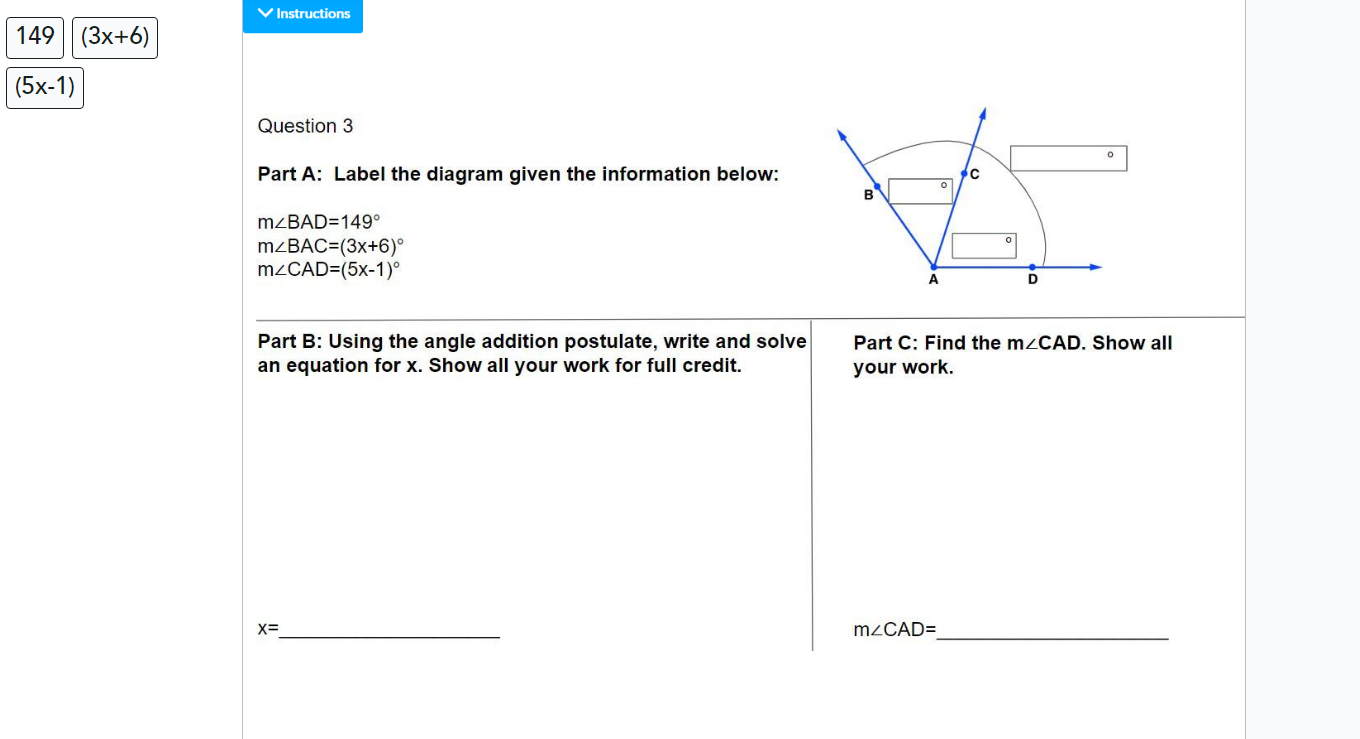
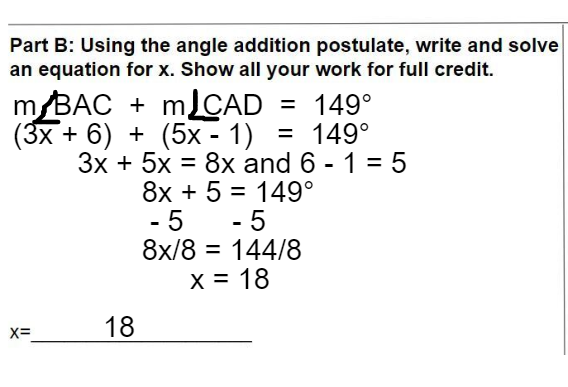
The problem gives you the information to put into the diagram. Ex: m<BAD is 149 degrees so you’d put 149 for <BAD in the diagram. Using the angle addition postulate, the large angle <BAD is made up of the smaller angles <BAC and <CAD. Therefore m<BAD = m<BAC + m<CAD. Fill in the measures and solve for x. Once you have the x value, you can calculate m<CAD by calculating 5x - 1.
Gucchi:
 Gucchi:
this was my answer.
Vocaloid:
Yup looks good
 Gucchi:
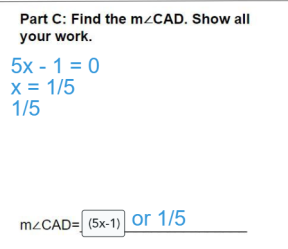
does this next one look good?
Gucchi:
@vocaloid
Gucchi:
wait i think im doing it wrong..
Vocaloid:
Why are you setting it equal to 0? x is 18 as calculated in part B. Plug x = 18 into 5x - 1.
Gucchi:
my fault hold up
Gucchi:
so the answer would be 89?
Vocaloid:
Yeah
Gucchi:
ok ok thank you
Join our real-time social learning platform and learn together with your friends!
 VERNEISH:
Two objects are moving along separate linear paths where each path is described by position, d, and time, t.
VERNEISH:
Two objects are moving along separate linear paths where each path is described by position, d, and time, t.

 Maci:
what are the best stock apps for people who want to start investing?
Maci:
what are the best stock apps for people who want to start investing?
 Twaylor:
genuienly how do i get better self control i keep watcing youtube and theres this
Twaylor:
genuienly how do i get better self control i keep watcing youtube and theres this
 IzzyCookie:
|dw:1792074056138:dw| Uhm, I don't know where to ask this, but I'm in college welding at my community college, and I need help learning vertical welding for
IzzyCookie:
|dw:1792074056138:dw| Uhm, I don't know where to ask this, but I'm in college welding at my community college, and I need help learning vertical welding for

 thehearken:
not sure if this is considered spam, im sorry if it is, but does anyone have tips
thehearken:
not sure if this is considered spam, im sorry if it is, but does anyone have tips