
 MidniteSunny:
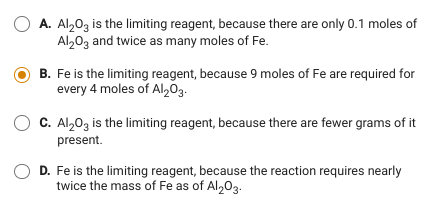
Aluminum oxide and iron react according to the following equation: 4al2o3+9fe→ 3fe3o4+8al If there are 10.2 grams of al2o3 and 11.2 grams of fe, which statement identifies the limiting reagent in this reaction and best supports that claim? (options below)
 Vocaloid:
The equation is balanced (always check first) Between Al2O3 and Fe, determine which makes less product. You can’t tell just by looking at the reaction coefficients, you have to determine how many moles of each you have. Starting with 10.2g Al2O3, convert this to moles by dividing by the molar mass of Al2O3. Then divide by 4 moles since the reaction uses 4 moles Al2O3. Repeat with Fe. Convert to moles by dividing by the molar mass of Fe. Then divide by 9 moles. Whichever product gives you a smaller result is your limiting reactant.
Vocaloid:
This question is a bit tricky but the limiting reactant is determined by the actual quantity (mass) not simply the reaction coefficients.
MidniteSunny:
Yes, I meant to update my progress. So it's 0.200555107887904 mol Fe for 11.2 g of Fe. 0.10003797912454528 mol Al2O3 for 10.2 g of Al2O3. What I did was divide Fe by Al2O3 and compare it to the 9 Fe/4 Al2O3, which was 2.00 compared to 2.25 which got me confused as to which one made it smaller, so I'll try what you suggested. Turned out Fe was indeed the lower number, so I got that much right at least. And based on your comment about it being determined by the mass, I'm gonna assume the answer is D.
MidniteSunny:
(was correct)
Join our real-time social learning platform and learn together with your friends!
 VERNEISH:
Two objects are moving along separate linear paths where each path is described by position, d, and time, t.
VERNEISH:
Two objects are moving along separate linear paths where each path is described by position, d, and time, t.

 Maci:
what are the best stock apps for people who want to start investing?
Maci:
what are the best stock apps for people who want to start investing?
 Twaylor:
genuienly how do i get better self control i keep watcing youtube and theres this
Twaylor:
genuienly how do i get better self control i keep watcing youtube and theres this
 IzzyCookie:
|dw:1792074056138:dw| Uhm, I don't know where to ask this, but I'm in college welding at my community college, and I need help learning vertical welding for
IzzyCookie:
|dw:1792074056138:dw| Uhm, I don't know where to ask this, but I'm in college welding at my community college, and I need help learning vertical welding for

 thehearken:
not sure if this is considered spam, im sorry if it is, but does anyone have tips
thehearken:
not sure if this is considered spam, im sorry if it is, but does anyone have tips