
 carmelle:
Expand (x – 4)^5 using the Binomial Theorem and Pascal’s triangle.
 jhonyy9:
\[x^{a} × x^{b} = x^{(a+b)}\] use this formula like a first step
carmelle:
I'm confused, will a and b be 5 or -4?
jhonyy9:
a and b are exponents like how you can see there
carmelle:
x^5+5 = x^10 ?
jhonyy9:
carmelle:
I have no idea, sorry. I dont know what to multiply to get to the 5th power.
jhonyy9:
formula of exponents \[a^{x} × a^{y} = a^{(x+y)}\]
carmelle:
3+2?
jhonyy9:
\[a^{x} ÷ a^{y} = a^{(x-y)}\]
jhonyy9:
carmelle:
-4, maybe? because they don't specify in the question
jhonyy9:
no just -4 ? no this ,,a" is in your posted question (x-4)
carmelle:
Is it "x"?
 Vocaloid:
I'm confused about the above approach. The -4 is not an exponent, it's being subtracted from x. The expression is x minus 4, all raised to the fifth power. binomial expansion theorem: \[(x+y)^{n}=\sum_{k=0}^{n}\left(\begin{matrix}n \\ k\end{matrix}\right)x^{n-k}y^{k}\] I'll explain how this formula works step by step (I promise it's a lot easier to actually use than explain). comparing (x+y)^n to your problem (x-4)^5 you can see that x corresponds to... well, x, and y = -4, and n is the exponent 5. k is simply an integer "counter" that starts from k = 0 and goes all the way up to n. the sigma sign simply means you'll be summing terms from k = 0 to your n-value of 5. \[\left(\begin{matrix}n \\ k\end{matrix}\right)\]represents all possible combinations of n and k values. that's how many terms you'll have. k is all integers from 0 to n = 5, you'll have 6 total terms. (k = 0, k = 1, ... to k = 6). now, for this part:\[x^{n-k}y^{k}\] start with k = 0 and n = 5. fill them into the formula to get __\(x^{5-0}y^{0}\)=__\(x^{5}\). this is the first term. notice how I left a blank in front? that's where the coefficient goes, which we'll use pascal's triangle to fill in. keep going until you get to k = 5, at which point you should have 6 terms.
Vocaloid:
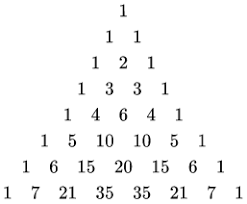
now, for the cofficients, you can use Pascal's triangle. this triangle starts with 1 at the top row, and 1 1 on the second row. for every row after that, the row starts and ends with 1, and every number in the middle is the sum of the two numbers directly above it. the row numbers correspond to k. since your k = 6, you'd go to the sixth row 1 5 10 10 5 1 and fill in these coefficients. the first term has coefficient 1, the second term has 5, etc.
 Vocaloid:
now that I've explained formally how the formula works, I'll explain a simpler way to explain this process. start (x+y)^5, since your highest power is 5, your first term is x^5. the next term reduces the power of x by 4 and adds one y factor in. x^4 * y. this pattern continues until you get to y^5. then fill in the coefficients using pascal's triangle.
Join our real-time social learning platform and learn together with your friends!
 VERNEISH:
Two objects are moving along separate linear paths where each path is described by position, d, and time, t.
VERNEISH:
Two objects are moving along separate linear paths where each path is described by position, d, and time, t.

 Maci:
what are the best stock apps for people who want to start investing?
Maci:
what are the best stock apps for people who want to start investing?
 Twaylor:
genuienly how do i get better self control i keep watcing youtube and theres this
Twaylor:
genuienly how do i get better self control i keep watcing youtube and theres this
 IzzyCookie:
|dw:1792074056138:dw| Uhm, I don't know where to ask this, but I'm in college welding at my community college, and I need help learning vertical welding for
IzzyCookie:
|dw:1792074056138:dw| Uhm, I don't know where to ask this, but I'm in college welding at my community college, and I need help learning vertical welding for

 thehearken:
not sure if this is considered spam, im sorry if it is, but does anyone have tips
thehearken:
not sure if this is considered spam, im sorry if it is, but does anyone have tips