
 chuckthedonut:
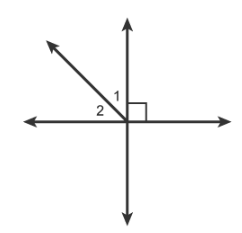
Which relationships describe angles 1 and 2? Select each correct answer. A) adjacent angles B) vertical angles C) complementary angles D) supplementary angles
 chuckthedonut:
@kyledagreat can you help?
 iHeartjulesx:
Angle is the measurement of rotation, with the way the terminal axis rotated. The given angles are adjacent angles and supplementary angles both. What are adjacent angles? Two angles are called adjacent angles if they share a common side. What are complementary angles? Two angles whose sum is 90° are called complementary angles. What are supplementary angles? Two angels whose sum is 180° are called supplementary angles. What are vertical angles? Each of the pairs of the opposite angles made by two intersecting lines are called vertical angles. In the figure attached below, it is visible that the angles 1 and 2 are such that they are sharing a side. Thus, they are adjacent angles. Also, as we add those angles, we see that a straight line is formed (which is of 180° always), thus, they are supplementary angles too. Hence, the given angles are adjacent angles and supplementary angles both.
chuckthedonut:
chuckthedonut:
 KyledaGreat:
Based on the image you provided, angles 1 and 2 are vertical angles. Vertical angles are a pair of non-adjacent angles formed by two intersecting lines. They are opposite each other and share only a common vertex. In the image, the intersecting lines are the line segments AB and CD, and angles 1 and 2 are formed where these lines intersect. Since angles 1 and 2 are opposite each other and share only the common vertex at point E, they are vertical angles.
Join our real-time social learning platform and learn together with your friends!
 VERNEISH:
Two objects are moving along separate linear paths where each path is described by position, d, and time, t.
VERNEISH:
Two objects are moving along separate linear paths where each path is described by position, d, and time, t.

 Maci:
what are the best stock apps for people who want to start investing?
Maci:
what are the best stock apps for people who want to start investing?
 Twaylor:
genuienly how do i get better self control i keep watcing youtube and theres this
Twaylor:
genuienly how do i get better self control i keep watcing youtube and theres this
 IzzyCookie:
|dw:1792074056138:dw| Uhm, I don't know where to ask this, but I'm in college welding at my community college, and I need help learning vertical welding for
IzzyCookie:
|dw:1792074056138:dw| Uhm, I don't know where to ask this, but I'm in college welding at my community college, and I need help learning vertical welding for

 thehearken:
not sure if this is considered spam, im sorry if it is, but does anyone have tips
thehearken:
not sure if this is considered spam, im sorry if it is, but does anyone have tips