
 Lars:
Lars:
Angelica uses the point (4, 3) to represent the location of her house and uses the point (10, 8) to represent the location of a gas station. Each unit on the graph represents 1 mi. Use Pythagorean theorem to determine how far the gas station is from Angelica’s house? Show your work. Answer: (If you are writing on a separate paper, just draw a triangle and label it with the correct lengths on them) 1. Use the graph above and show the distance for leg “a” and write it here? _____________________ 2. Use the graph above and show the distance for leg “b” and write it here?______________________ 3. Fill the distances into the formula and use the Pythagorean Theorem to solve for c. (Show all steps) 𝑎𝑎2 + 𝑏𝑏2 = 𝑐𝑐2 4. C ≈ ___________________________
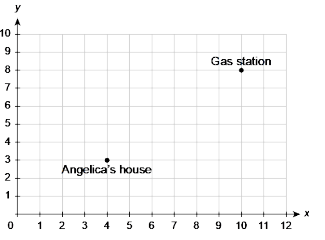 Lars:
Lars:
@shadow @oliver69 @joe348 @luigi0210
 Luigi0210:
Have you drawn the triangle at least, or do you need help with that part?
Lars:
Luigi0210:
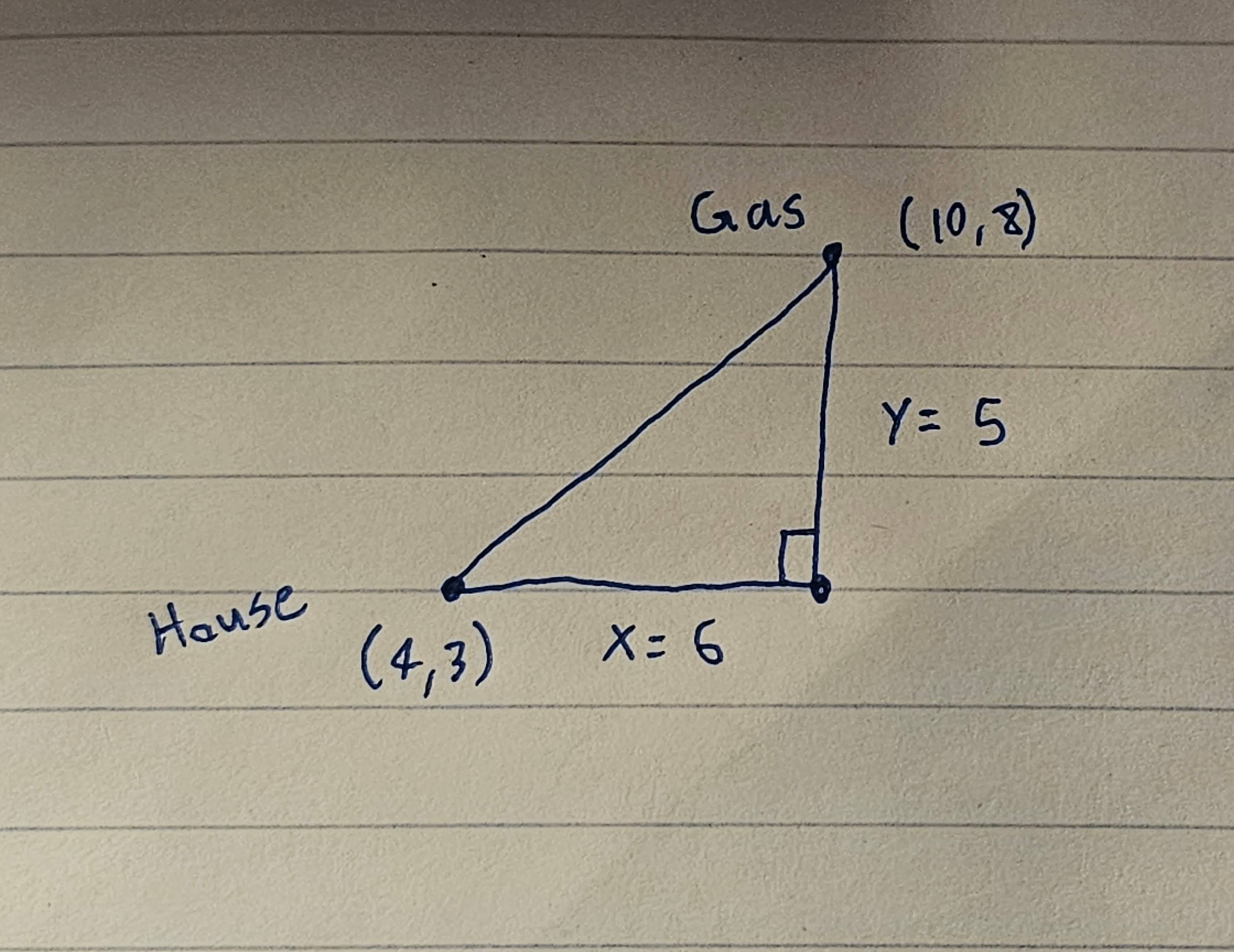
Well, here is what I got for the triangle. What you have to do is connect the points, and the lengths will be the differences between the respective x & y coordinate points:
 Luigi0210:
From here, you can assign A and B to whatever side lengths you wish.
Lars:
Luigi0210:
I used the coordinate points to get the lengths, for example: (10, 8) (4, 3) Labeling 10 as x1 and 4 as x2 get the difference: x1-x2 = 10-4 = 6 6 would be the horizontal distance, along the x-axis same for y: 8-3 = 5 5 would be the vertical distance, along the y-axis
Luigi0210:
Set 6 as A and set 5 as B, this will allow you to set up the equation to solve for C \[\Large 6^2 + 5^2 = C^2\]
Lars:
c= 61 and c= − 61 ?
Luigi0210:
It's not worth it to engage with them. Simply ignore them and move on.
 KyledaGreat:
1. Leg "a" is the horizontal distance between the two points, which is 10 - 4 = 6 miles. a = 6 2. Leg "b" is the vertical distance between the two points, which is 8 - 3 = 5 miles. b = 5 3. Using Pythagorean theorem, we can calculate the length of the hypotenuse (c) as follows: a^2 + b^2 = c^2 6^2 + 5^2 = c^2 36 + 25 = c^2 61 = c^2 c = √61 4. c ≈ 7.81 miles.
Join our real-time social learning platform and learn together with your friends!
 VERNEISH:
Two objects are moving along separate linear paths where each path is described by position, d, and time, t.
VERNEISH:
Two objects are moving along separate linear paths where each path is described by position, d, and time, t.

 Maci:
what are the best stock apps for people who want to start investing?
Maci:
what are the best stock apps for people who want to start investing?
 Twaylor:
genuienly how do i get better self control i keep watcing youtube and theres this
Twaylor:
genuienly how do i get better self control i keep watcing youtube and theres this
 IzzyCookie:
|dw:1792074056138:dw| Uhm, I don't know where to ask this, but I'm in college welding at my community college, and I need help learning vertical welding for
IzzyCookie:
|dw:1792074056138:dw| Uhm, I don't know where to ask this, but I'm in college welding at my community college, and I need help learning vertical welding for

 thehearken:
not sure if this is considered spam, im sorry if it is, but does anyone have tips
thehearken:
not sure if this is considered spam, im sorry if it is, but does anyone have tips