
 Vixen:
I need help with math again 😭
Vixen:
Consider the equation (2x^3 - 4x^2 + 6x - 8 = 0). Find all complex solutions for (x) that satisfy this equation.
 arron234:
do u slove all of it at once our just one part first
Vixen:
Vixen:
arron234:
surreeee what.
Vixen:
The line on my paper is like long so the answer looks like it's larger than just 1.6 or 1.7
 DivideMusic:
Hmm. Thinking about it. Give me a second.
DivideMusic:
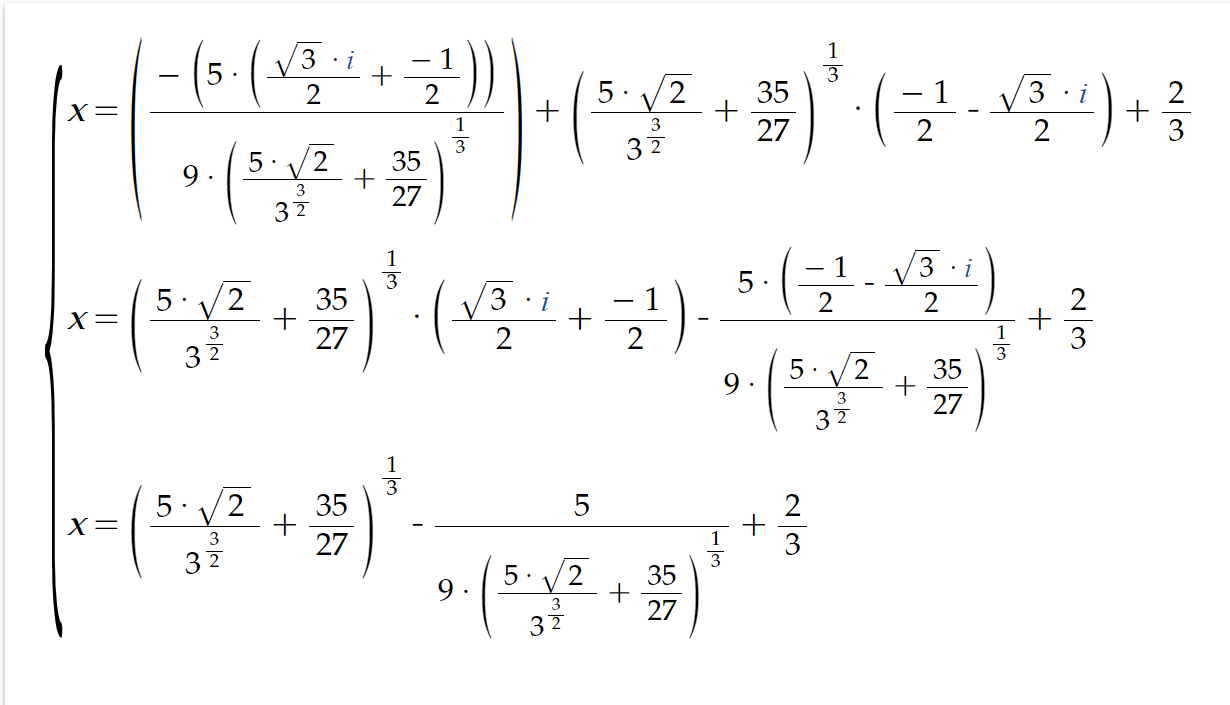
It's really complex. Here.
 Vixen:
Oh my god who could've figured that out
poopoopeepee:
If you're doing this in the context of rational roots theorem, you probably have a typo in the problem (either you copied it down wrong or your teacher/problem bank has a typo). Typically the K12 sequence to solve this problem is to use the rational roots theorem to determine if there are any rational roots by looking at the quotient of the last and first term (a result of galois field theory). After finding that there is at least one rational root, you factor this from the cubic to obtain a quadratic equation. This quadratic equation can then be solved with the quadratic equation. If you're doing this in the context of just solving random cubics, you can use Cardano's formula, although you might hit a roadblock in simplifying nested roots solutions. You can use what people here have given you, which are either numeric solutions to the problem (likely via Newton's method), or just throwing it at a computer algebra system (wolfram alpha, mathematica, matlab, maple, mathcad, etc) and telling it to find your solution. But yeah, it's probably a typo and you should have a rational root.
 SolidGoldKing10:
All I found was this: [ \int \frac{\sin^2(x)}{e^x \cdot \sqrt{1 - \cos^2(x)}} , dx ]
 toga:
toga:
To solve the equation \(2x^3 - 4x^2 + 6x - 8 = 0\), we can use the cubic formula or factor by grouping to simplify the equation. After factoring by grouping, we get: \[2x^2(x - 2) + 4(x - 2) = 0\] \[(2x^2 + 4)(x - 2) = 0\] Setting each factor equal to zero, we find: \[2x^2 + 4 = 0 \quad \text{and} \quad x - 2 = 0\] Solving for \(x\) in the first equation, we get: \[2x^2 = -4\] \[x^2 = -2\] \[x = \pm \sqrt{-2}\] \[x = \pm i\sqrt{2}\] Solving for \(x\) in the second equation, we get: \[x = 2\] Therefore, the complex solutions for \(x\) that satisfy the equation are: \[x = 2\] \[x = \pm i\sqrt{2}\]
Join our real-time social learning platform and learn together with your friends!
 DoltonCarlee:
what are y'all's options on S A T essays because honestly their not that bad
DoltonCarlee:
what are y'all's options on S A T essays because honestly their not that bad

 thereneelg:
Can someone give me a summary of article 231, The war guilt clause?? I need to explain what it is, but I can't find any shortened version of what it is and
thereneelg:
Can someone give me a summary of article 231, The war guilt clause?? I need to explain what it is, but I can't find any shortened version of what it is and
 luisaam2:
What should you do when the person you want to talk to the most is the one making
luisaam2:
What should you do when the person you want to talk to the most is the one making
 Breathless:
https://medal.tv/games/roblox/clips/nAYivIl6oXB6q9QAI?invite=cr-MSxCSk4sMTY4OTA4N
Breathless:
https://medal.tv/games/roblox/clips/nAYivIl6oXB6q9QAI?invite=cr-MSxCSk4sMTY4OTA4N
 Twaylor:
I'm not that good at law can someone fact check this without bias? June 29, 2026, the Supreme Court decided Chatrie v.
Twaylor:
I'm not that good at law can someone fact check this without bias? June 29, 2026, the Supreme Court decided Chatrie v.
 Demon25:
For a hoco proposal with a cheerleader and football player, what else should be a
Demon25:
For a hoco proposal with a cheerleader and football player, what else should be a
