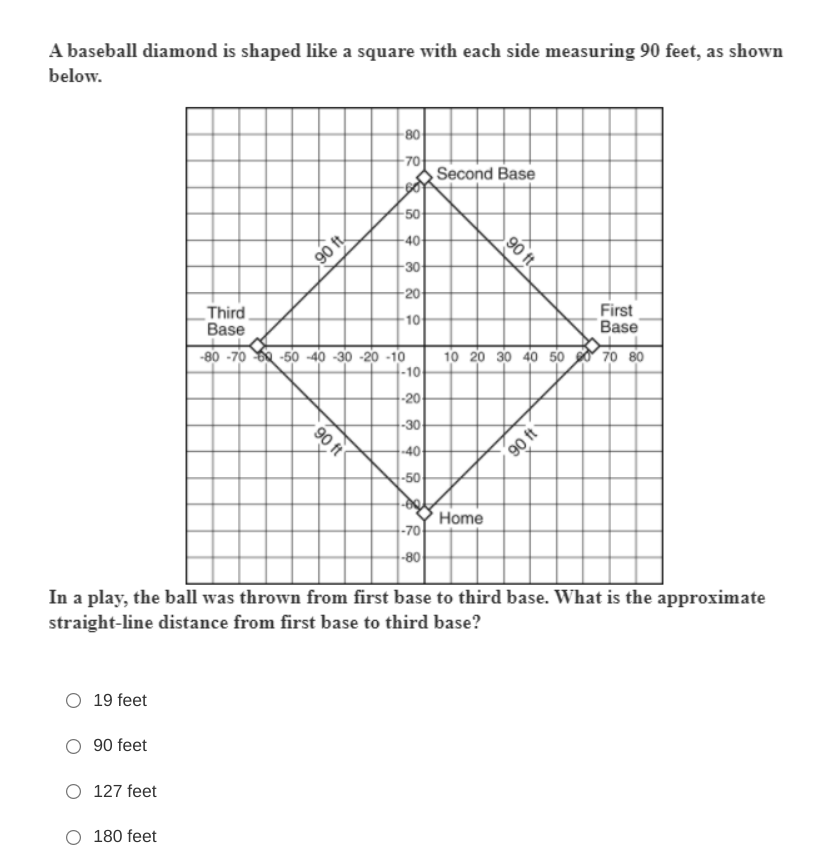
To find the approximate straight-line distance from first base to third base in a baseball diamond, we can use the Pythagorean theorem.
First, we can find the length of one of the diagonals of the square by using the formula a^2 + b^2 = c^2, where a and b are the lengths of the sides of the square and c is the length of the diagonal.
In this case, a = b = 90 feet, so:
90^2 + 90^2 = c^2
8100 + 8100 = c^2
16200 = c^2
c ≈
toga:
did this help
Midnight97:
Thank you both
Still Need Help?
Join the QuestionCove community and study together with friends!
Join the QuestionCove community and study together with friends!
Sign Up
Phantomdex:
@midnight97 wrote:
@phantomdex wrote:
Look at these smart people
Fr
Couldn't be me
luhivqqcherry:
@phantomdex wrote:
@midnight97 wrote:
@phantomdex wrote:
Look at these smart people
Fr
Couldn't be me
WYM UR SO SMART BRO .
Midnight97:
@phantomdex wrote:
@midnight97 wrote:
@phantomdex wrote:
Look at these smart people
Fr
Couldn't be me
Lol, same I am not good with math
Phantomdex:
@midnight97 wrote:
@phantomdex wrote:
@midnight97 wrote:
@phantomdex wrote:
Look at these smart people
Fr
Couldn't be me
Lol, same I am not good with math
Same but hey you got me a 100% on my last thing so you're smarter than me.
toga:
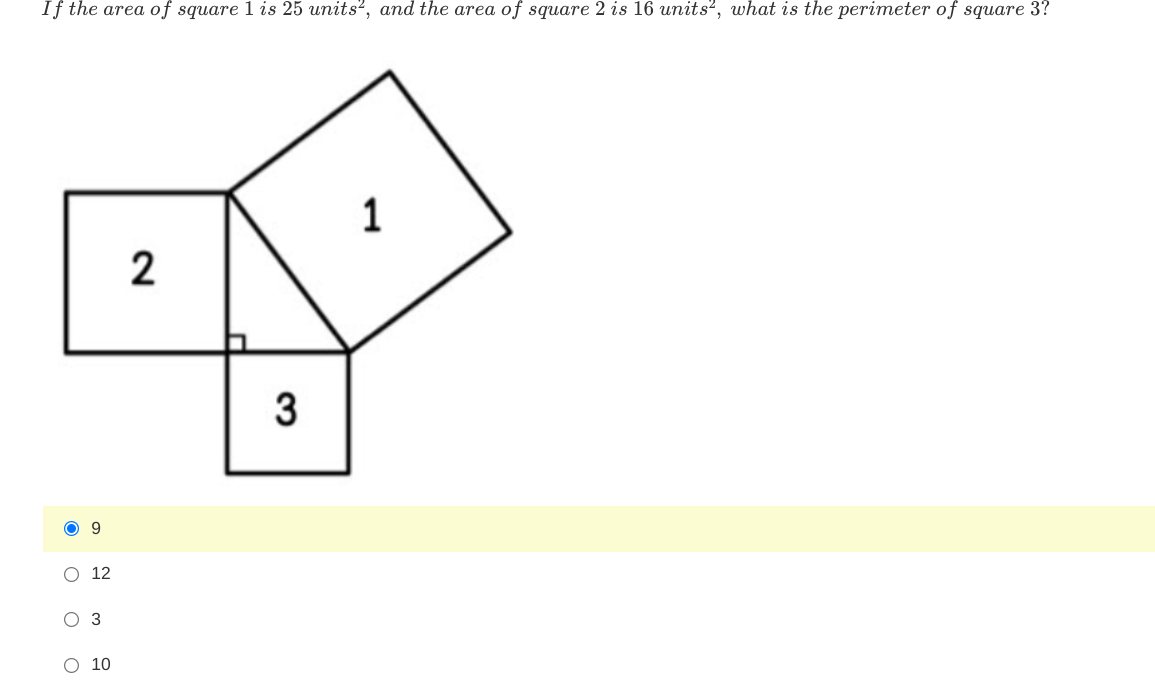
To find the perimeter of square 3, we need to know the area of square 3. However, we are not given the area of square 3 directly. One way to find the area of square 3 is to use the fact that the areas of squares are proportional to the squares of their side lengths. That is, if the side length of square 1 is "a", and the side length of square 2 is "b", then the side length of square 3 can be found by taking the square root of the ratio of their areas: (area of square 1 / area of square 2)^(1/2). Once we know the side length of square 3, we can easily find its perimeter by multiplying the side length by 4
Still Need Help?
Join the QuestionCove community and study together with friends!
Sign Up
Midnight97:
@toga wrote:
To find the perimeter of square 3, we need to know the area of square 3. However, we are not given the area of square 3 directly. One way to find the area of square 3 is to use the fact that the areas of squares are proportional to the squares of their side lengths. That is, if the side length of square 1 is "a", and the side length of square 2 is "b", then the side length of square 3 can be found by taking the square root of the ratio of their areas: (area of square 1 / area of square 2)^(1/2). Once we know the side length of square 3, we can easily find its perimeter by multiplying the side length by 4
Join the QuestionCove community and study together with friends!
Sign Up
toga:
@midnight97 wrote:
@phantomdex wrote:
Cherry's math has hurt my brain enough today
Math always does that to me hehehe
i good at math but i do not like it
luhivqqcherry:
@phantomdex wrote:
yeah but cherry's is ickyyy
agreed .
toga:
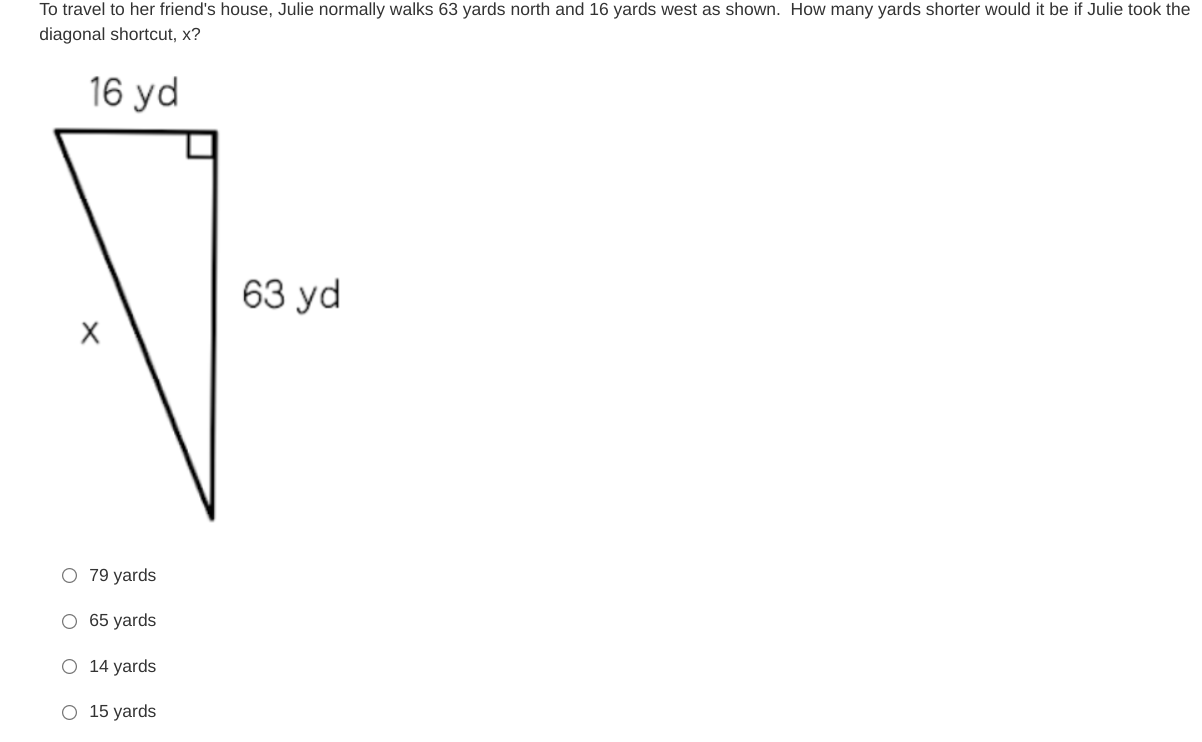
To find out how much shorter the diagonal shortcut is, we first need to calculate the distance Julie walks using the given route. We can use the Pythagorean theorem to calculate the distance:
d = √(63² + 16²)
where d is the distance Julie walks using the given route.
Next, we need to find the length of the diagonal shortcut, x. We can use the Pythagorean theorem again:
x = √(63² + 16²)
where x is the length of the diagonal shortcut.
Finally, we can find the difference between the two distances to see how much shorter the diagonal shortcut is:
difference = d - x
This will give us the answer in yards.
Phantomdex:
@luhivqqcherry wrote:
@phantomdex wrote:
yeah but cherry's is ickyyy
agreed .
Says the one that's supposed to be a human calculator
toga:
@phantomdex wrote:
@luhivqqcherry wrote:
@phantomdex wrote:
yeah but cherry's is ickyyy
agreed .
Says the one that's supposed to be a human calculator
lol
Still Need Help?
Join the QuestionCove community and study together with friends!
Sign Up
toga:
@toga wrote:
@phantomdex wrote:
@luhivqqcherry wrote:
@phantomdex wrote:
yeah but cherry's is ickyyy
agreed .
Says the one that's supposed to be a human calculator
lol
we good at math but we do not like it
Midnight97:
@toga wrote:
To find out how much shorter the diagonal shortcut is, we first need to calculate the distance Julie walks using the given route. We can use the Pythagorean theorem to calculate the distance:
d = √(63² + 16²)
where d is the distance Julie walks using the given route.
Next, we need to find the length of the diagonal shortcut, x. We can use the Pythagorean theorem again:
x = √(63² + 16²)
where x is the length of the diagonal shortcut.
Finally, we can find the difference between the two distances to see how much shorter the diagonal shortcut is:
difference = d - x
This will give us the answer in yards.
Join the QuestionCove community and study together with friends!
Sign Up
Midnight97:
@toga wrote:
@midnight97 wrote:
So it would be B?
no try again
??
toga:
@toga wrote:
To find out how much shorter the diagonal shortcut is, we first need to calculate the distance Julie walks using the given route. We can use the Pythagorean theorem to calculate the distance:
d = √(63² + 16²)
where d is the distance Julie walks using the given route.
Next, we need to find the length of the diagonal shortcut, x. We can use the Pythagorean theorem again:
x = √(63² + 16²)
where x is the length of the diagonal shortcut.
Finally, we can find the difference between the two distances to see how much shorter the diagonal shortcut is:
difference = d - x
This will give us the answer in yards.
it is c
Midnight97:
@toga wrote:
@toga wrote:
To find out how much shorter the diagonal shortcut is, we first need to calculate the distance Julie walks using the given route. We can use the Pythagorean theorem to calculate the distance:
d = √(63² + 16²)
where d is the distance Julie walks using the given route.
Next, we need to find the length of the diagonal shortcut, x. We can use the Pythagorean theorem again:
x = √(63² + 16²)
where x is the length of the diagonal shortcut.
Finally, we can find the difference between the two distances to see how much shorter the diagonal shortcut is:
difference = d - x
This will give us the answer in yards.
it is c
Ah okie
toga:
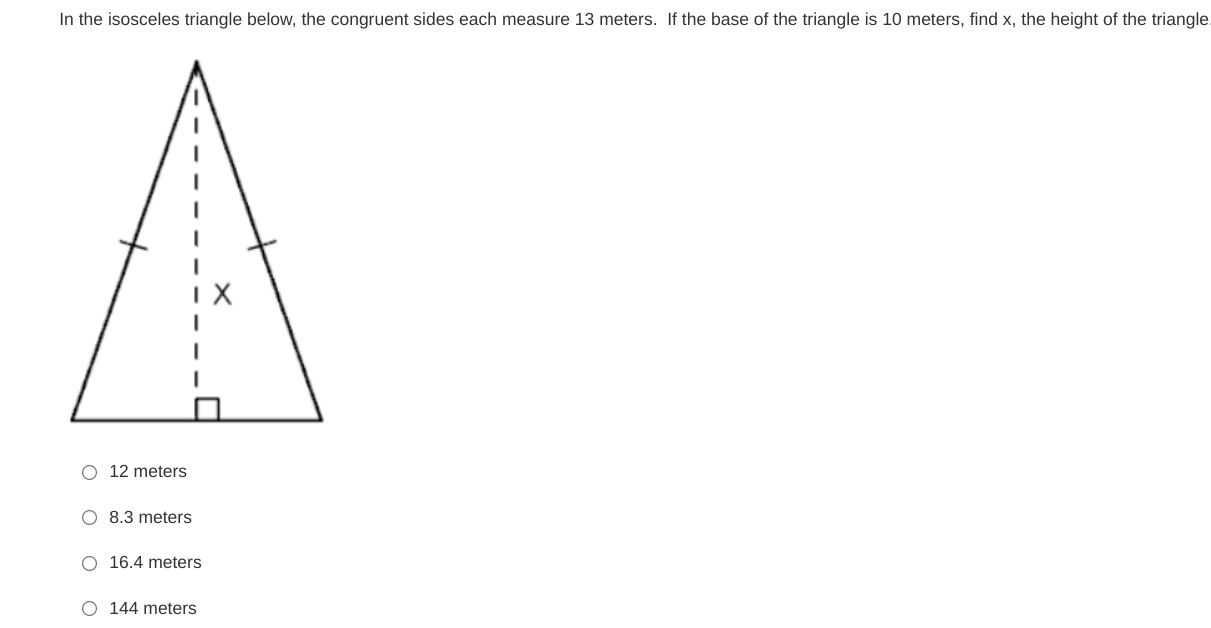
To find the height (x) of the isosceles triangle, we can use the Pythagorean theorem. We know that the base of the triangle is 10 meters and that the two congruent sides each measure 13 meters. We can split the triangle into two right triangles, each with a base of 5 meters and a hypotenuse of 13 meters. Using the Pythagorean theorem, we can solve for the height (x):
h^2 + 5^2 = 13^2
h^2 + 25 = 169
h^2 = 144
h =
Therefore, the height (x) of the isosceles triangle is

 Midnight97:
 luhivqqcherry:
 toga:
toga:
 Phantomdex:
 DoltonCarlee:
what are y'all's options on S A T essays because honestly their not that bad
DoltonCarlee:
what are y'all's options on S A T essays because honestly their not that bad

 thereneelg:
Can someone give me a summary of article 231, The war guilt clause?? I need to explain what it is, but I can't find any shortened version of what it is and
thereneelg:
Can someone give me a summary of article 231, The war guilt clause?? I need to explain what it is, but I can't find any shortened version of what it is and
 luisaam2:
What should you do when the person you want to talk to the most is the one making
luisaam2:
What should you do when the person you want to talk to the most is the one making
 Breathless:
https://medal.tv/games/roblox/clips/nAYivIl6oXB6q9QAI?invite=cr-MSxCSk4sMTY4OTA4N
Breathless:
https://medal.tv/games/roblox/clips/nAYivIl6oXB6q9QAI?invite=cr-MSxCSk4sMTY4OTA4N
 Twaylor:
I'm not that good at law can someone fact check this without bias? June 29, 2026, the Supreme Court decided Chatrie v.
Twaylor:
I'm not that good at law can someone fact check this without bias? June 29, 2026, the Supreme Court decided Chatrie v.
 Demon25:
For a hoco proposal with a cheerleader and football player, what else should be a
Demon25:
For a hoco proposal with a cheerleader and football player, what else should be a
