
 Phantomdex:
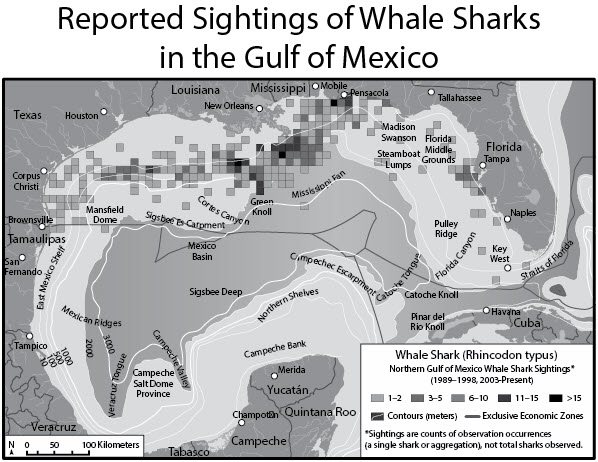
The following map of the Gulf of Mexico shows reported sightings of whale sharks. What explanation best describes why the highest reported sightings occur near the mouth of the Mississippi River? A map of the Gulf of Mexico displaying reported sightings of whale sharks in the region. The map is shaded to indicate various numbers of whale shark sightings. The lightest gray shading indicates one to two whale sharks and can be found spread out along the coastline surrounding the Gulf of Mexico. The next shade of gray indicates three to five whale sharks. This shade of gray can also be found spread out along the coastline surrounding the Gulf of Mexico. The next darker shade of gray indicates six to eleven whale sharks and is primarily concentrated closer to the area where the Mississippi River meets the Gulf of Mexico. The very dark gray indicates eleven to fifteen whale sharks and is concentrated toward the region where the Mississippi River meets the Gulf of Mexico. The darkest shaded area, which is black, has the greatest concentration near the region where the Mississippi River meets the Gulf of Mexico. © 2015, Ocean Conservancy Whale sharks are bottom feeders, and this area is rich in bottom dwellers due to runoff. Whale sharks are bottom feeders, and this area is rich in nutrients due to runoff. Whale sharks are filter feeders, and this area is rich in plankton due to runoff. Whale sharks are filter feeders, and this area is rich in fish populations due to runoff.
 Phantomdex:
@curriful
 curriful:
let me think im thinking dont pressure me
curriful:
ok so whale sharks are filter feeders , not bottom feeders. that eliminates a and b.
curriful:
filter feeders mainly feed on plankton and not fish, so that leaves?
Phantomdex:
C-
curriful:
Join our real-time social learning platform and learn together with your friends!
 DoltonCarlee:
what are y'all's options on S A T essays because honestly their not that bad
DoltonCarlee:
what are y'all's options on S A T essays because honestly their not that bad

 thereneelg:
Can someone give me a summary of article 231, The war guilt clause?? I need to explain what it is, but I can't find any shortened version of what it is and
thereneelg:
Can someone give me a summary of article 231, The war guilt clause?? I need to explain what it is, but I can't find any shortened version of what it is and
 luisaam2:
What should you do when the person you want to talk to the most is the one making
luisaam2:
What should you do when the person you want to talk to the most is the one making
 Breathless:
https://medal.tv/games/roblox/clips/nAYivIl6oXB6q9QAI?invite=cr-MSxCSk4sMTY4OTA4N
Breathless:
https://medal.tv/games/roblox/clips/nAYivIl6oXB6q9QAI?invite=cr-MSxCSk4sMTY4OTA4N
 Twaylor:
I'm not that good at law can someone fact check this without bias? June 29, 2026, the Supreme Court decided Chatrie v.
Twaylor:
I'm not that good at law can someone fact check this without bias? June 29, 2026, the Supreme Court decided Chatrie v.
 Demon25:
For a hoco proposal with a cheerleader and football player, what else should be a
Demon25:
For a hoco proposal with a cheerleader and football player, what else should be a
