
 Subshilava:
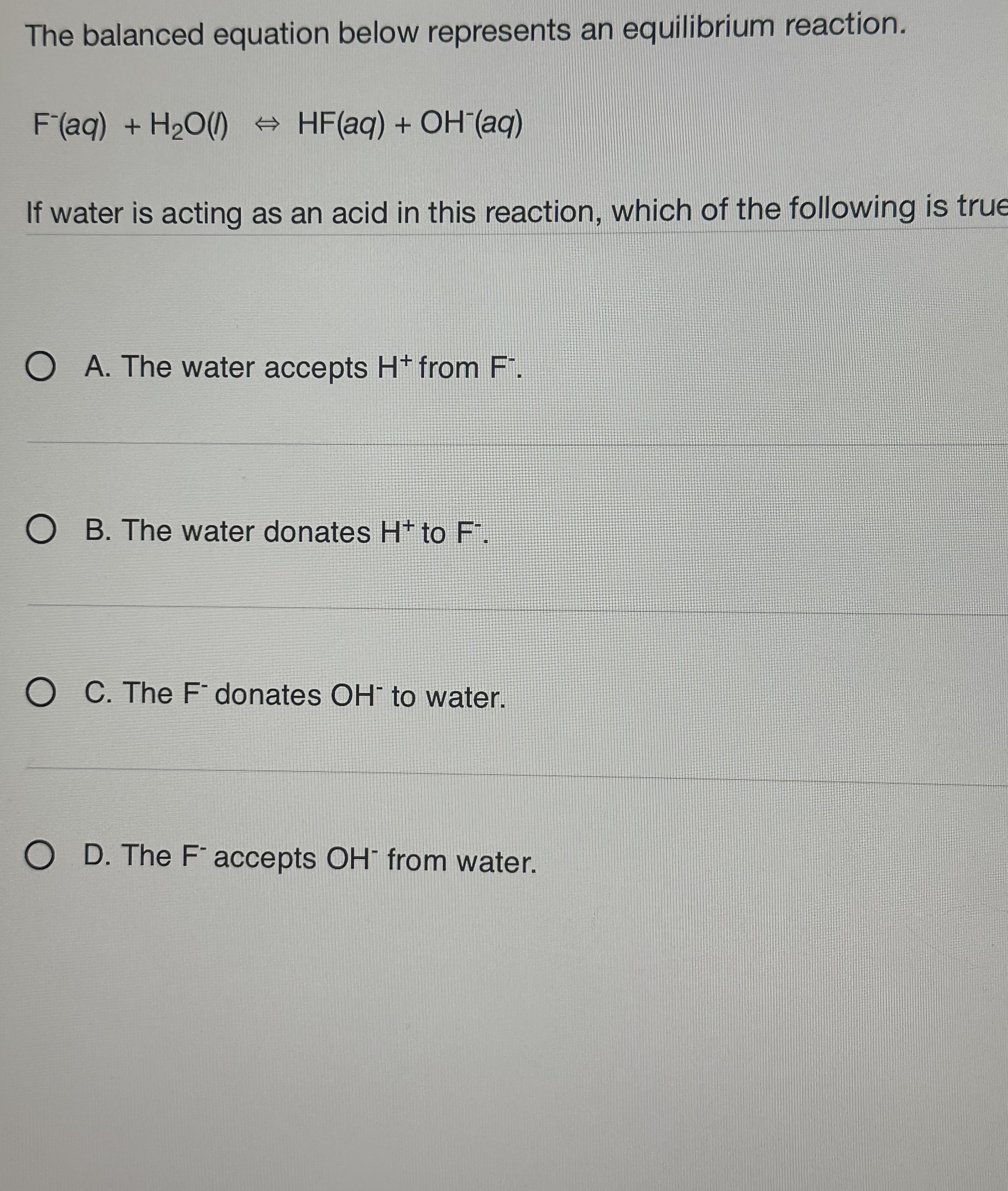
Can someone explain this to me Pic below
 Aliciaa:
In the given equilibrium reaction: F − ( 𝑎 𝑞 ) + H 2 O ⇌ HF ( 𝑎 𝑞 ) + OH − ( 𝑎 𝑞 ) F − (aq)+H 2 O⇌HF(aq)+OH − (aq) If water is acting as an acid, it means that it is donating a proton (H + + ) to another species. In this case, water is donating a proton to the fluoride ion (F − − ). Therefore, the correct answer is: B. The water donates H + + to F − − .
Aliciaa:
Idk y it did tht
 somnium:
Aliciaa:
No not from google. My friends text
 Luigi0210:
One thing you should take notice of is the charges on the elements as it transitions from one side to the other. The fluorine (\(\color{red}{F} \)) goes from \(\color{red}{-1} \) to a neutral charge of \(\color{green}{0} \), meaning it gained a proton. In this case, it gained a hydrogen ion (aka a proton). The water, which was acting as an acid, lost a proton going from \(\color{green}{0} \) to \(\color{red}{-1} \). So you can conclude that the water molecule donated a proton/hydrogen \( H^+ \) to the ion Florine \( F^- \)
Join our real-time social learning platform and learn together with your friends!
 DoltonCarlee:
what are y'all's options on S A T essays because honestly their not that bad
DoltonCarlee:
what are y'all's options on S A T essays because honestly their not that bad

 thereneelg:
Can someone give me a summary of article 231, The war guilt clause?? I need to explain what it is, but I can't find any shortened version of what it is and
thereneelg:
Can someone give me a summary of article 231, The war guilt clause?? I need to explain what it is, but I can't find any shortened version of what it is and
 luisaam2:
What should you do when the person you want to talk to the most is the one making
luisaam2:
What should you do when the person you want to talk to the most is the one making
 Breathless:
https://medal.tv/games/roblox/clips/nAYivIl6oXB6q9QAI?invite=cr-MSxCSk4sMTY4OTA4N
Breathless:
https://medal.tv/games/roblox/clips/nAYivIl6oXB6q9QAI?invite=cr-MSxCSk4sMTY4OTA4N
 Twaylor:
I'm not that good at law can someone fact check this without bias? June 29, 2026, the Supreme Court decided Chatrie v.
Twaylor:
I'm not that good at law can someone fact check this without bias? June 29, 2026, the Supreme Court decided Chatrie v.
 Demon25:
For a hoco proposal with a cheerleader and football player, what else should be a
Demon25:
For a hoco proposal with a cheerleader and football player, what else should be a
