
 zarkam21:
Can someone help me
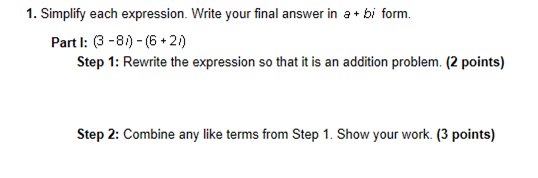 zarkam21:
@alones
zarkam21:
@Nnesha
 Nnesha:
distribute 2nd parentheses by -1 and then combine like terms add the coefficient with the variable i
zarkam21:
@satellite73 can you help please
zarkam21:
@satellite73 oh lol I just opened peer answer and saw that you replied
zarkam21:
?
 satellite73:
i am here
satellite73:
\[(3-8i)-(6+2i)=3-8i-6-2i=-3-10i\]
zarkam21:
Hi =)
zarkam21:
OKay so would that be for step 1?
satellite73:
distribute the minus sign
satellite73:
it would be the same fo r\[(3-8x)-(6+2x)\]
satellite73:
just with an \(i\) instead of an \(x\) like combining like terms remove the parentheses using the distributive property first, then combine like terms
zarkam21:
Okay so would all of this be step 1?
satellite73:
\[(3-8i)-(6+2i)\] step one, distribute the minus sign \[3-8i-6-2i\]
zarkam21:
Play and then step 2
zarkam21:
Okay**
satellite73:
maybe you can arrange the like terms next to each other, not sure if that is a step or not \[3-6-8i-2i\]
satellite73:
or just combine the like terms \[-3-10i\]
satellite73:
ok now i see it says "rewrite as an addition problem" we can do that too
satellite73:
\[(3-8i)-(6+2i)=(3-8i)+(-6-2i)\]
satellite73:
it is silly, but you can write it like that then second step is still to combine like terms, and you still get \[-3-10i\]
zarkam21:
Okay so step one is (3-8i)-(6+2i)=(3-8i)+(-6-2i)
zarkam21:
and then step two -3-10i
zarkam21:
?
Join our real-time social learning platform and learn together with your friends!
 DoltonCarlee:
what are y'all's options on S A T essays because honestly their not that bad
DoltonCarlee:
what are y'all's options on S A T essays because honestly their not that bad

 thereneelg:
Can someone give me a summary of article 231, The war guilt clause?? I need to explain what it is, but I can't find any shortened version of what it is and
thereneelg:
Can someone give me a summary of article 231, The war guilt clause?? I need to explain what it is, but I can't find any shortened version of what it is and
 luisaam2:
What should you do when the person you want to talk to the most is the one making
luisaam2:
What should you do when the person you want to talk to the most is the one making
 Breathless:
https://medal.tv/games/roblox/clips/nAYivIl6oXB6q9QAI?invite=cr-MSxCSk4sMTY4OTA4N
Breathless:
https://medal.tv/games/roblox/clips/nAYivIl6oXB6q9QAI?invite=cr-MSxCSk4sMTY4OTA4N
 Twaylor:
I'm not that good at law can someone fact check this without bias? June 29, 2026, the Supreme Court decided Chatrie v.
Twaylor:
I'm not that good at law can someone fact check this without bias? June 29, 2026, the Supreme Court decided Chatrie v.
 Demon25:
For a hoco proposal with a cheerleader and football player, what else should be a
Demon25:
For a hoco proposal with a cheerleader and football player, what else should be a
