
 zarkam21:
URGENT HELP ON THIS
 Hero:
Hero:
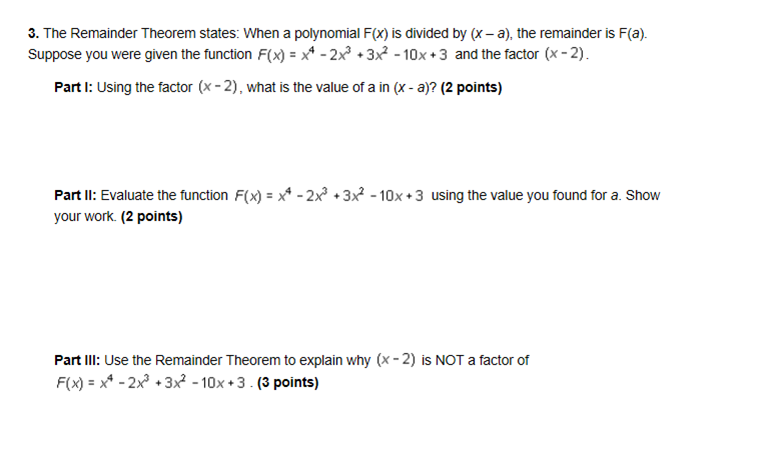
Find F(2)
Hero:
@zarkam21
zarkam21:
Hi please help me please
Hero:
@zarkam21 I gave you a huge hint on what to do.
zarkam21:
would I do F(2)= x^4-2x^3+3x^2-10x+3?
Hero:
F(2) = 2^4 - 2(2)^3 = 3(2)^2 - 10(2) + 3
zarkam21:
I got 0?
Hero:
F(2) = 16 - 16 + 12 - 20 + 3
zarkam21:
-5/2?
zarkam21:
@Hero
Hero:
Explain how you got -5/2
Hero:
There is no way to get -5/2 if you have nothing but whole numbers to evaluate
 coacoapuffprincess:
Ill help ya!
zarkam21:
11?
zarkam21:
@Hero
zarkam21:
-7
zarkam21:
@Hero
Hero:
That is closer to the answer but not quite.
zarkam21:
-5
Hero:
Correct finally. Congrats
zarkam21:
Okay so is that step one to the problem
Hero:
Actually, that was part II. Part I was to identify the "a".
Hero:
Hopefully you know what "a" is at this point.
zarkam21:
2?
zarkam21:
?
zarkam21:
@Hero
Hero:
Yes, a = 2 in this case. Are you familiar with the remainder theorem?
zarkam21:
umm I think so
Hero:
Can you describe what the remainder theorem is in your own words?
zarkam21:
It factors F(x)
Hero:
The remainder theorem is the assertion that \(P(c)\) is the remainder when polynomial \(P(x)\) is divided by \(x – c\). What is implied here is that \((x - c)\) divides \(P(c)\) evenly only if the remainder is zero. In other words, \((x - c)\) is a factor of \(P(x)\) if and only if \(P(c) = 0\).
zarkam21:
so only if it ends up in zero it applies
Hero:
What I wrote above, is the explanation for Part III.
zarkam21:
Oh okay thank you
Join our real-time social learning platform and learn together with your friends!
 VERNEISH:
Two objects are moving along separate linear paths where each path is described by position, d, and time, t.
VERNEISH:
Two objects are moving along separate linear paths where each path is described by position, d, and time, t.

 Maci:
what are the best stock apps for people who want to start investing?
Maci:
what are the best stock apps for people who want to start investing?
 Twaylor:
genuienly how do i get better self control i keep watcing youtube and theres this
Twaylor:
genuienly how do i get better self control i keep watcing youtube and theres this
 IzzyCookie:
|dw:1792074056138:dw| Uhm, I don't know where to ask this, but I'm in college welding at my community college, and I need help learning vertical welding for
IzzyCookie:
|dw:1792074056138:dw| Uhm, I don't know where to ask this, but I'm in college welding at my community college, and I need help learning vertical welding for

 thehearken:
not sure if this is considered spam, im sorry if it is, but does anyone have tips
thehearken:
not sure if this is considered spam, im sorry if it is, but does anyone have tips