
 Mrmanniquin102:
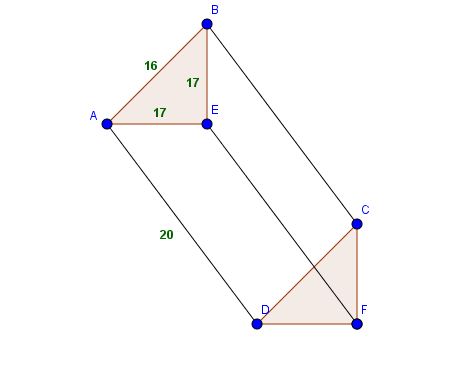
A candy bar box is in the shape of a triangular prism. The volume of the box is 2,400 cubic centimeters. A triangular prism is shown with base of triangle labeled 16 cm, sides of triangles labeled 17 cm, and length of the box equal to 20 cm. Part A: What is the height of the box? Show your work. (5 points) Part B: What is the approximate amount of cardboard used to make the sides of the candy box? Explain how you got your answer. (5 points)
 Hero:
Hero:
Hero:
We are given the dimensions and volume of the candy bar box which is in the shape of a triangular prism and we are tasked with finding two things:
a) The height of the box
b) The amount of cardboard box used to make the sides of the candy bar box
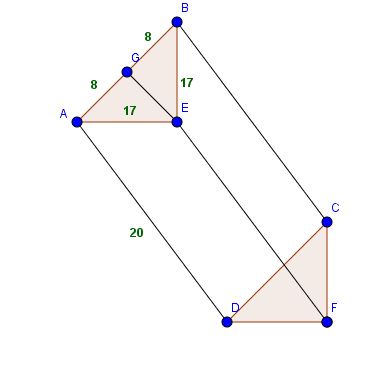
Notice, the height of the box is the distance from the base to segment EF which can be found by perpendicularly bisecting segment AB with E being on the perpendicular bisector. Doing so, creates segment EG and splits AB to two smaller segments each 8 cm in length:
Hero:
From here we can see that the lengths of the sides of triangle AGE is a Pythagorean triple. You can use this idea or you can use the Pythagorean Theorem to find length of segment GE which will reveal the height of the box.
Hero:
To find the amount of cardboard used to make the sides of the candy bar box, simply find the area of both triangles and the area of the base and sides of the prism, then sum them all together. In case you are unaware: The area of a triangle is half the product of its base and height. The area of a rectangle is product of its length and width. There will be five areas for each side of the prism to sum up. 2 Triangle areas and 3 Rectangular areas.
 Ultrilliam:
@Mrmanniquin102
Join our real-time social learning platform and learn together with your friends!
VERNEISH:
Two objects are moving along separate linear paths where each path is described by position, d, and time, t.

 Maci:
what are the best stock apps for people who want to start investing?
Maci:
what are the best stock apps for people who want to start investing?
 Twaylor:
genuienly how do i get better self control i keep watcing youtube and theres this
Twaylor:
genuienly how do i get better self control i keep watcing youtube and theres this
 IzzyCookie:
|dw:1792074056138:dw| Uhm, I don't know where to ask this, but I'm in college welding at my community college, and I need help learning vertical welding for
IzzyCookie:
|dw:1792074056138:dw| Uhm, I don't know where to ask this, but I'm in college welding at my community college, and I need help learning vertical welding for

 thehearken:
not sure if this is considered spam, im sorry if it is, but does anyone have tips
thehearken:
not sure if this is considered spam, im sorry if it is, but does anyone have tips