
 joriiannesegarra:
A chemical ________ involves one or more reactants changing into new products. synthesis displacement reaction notation
joriiannesegarra:
@Ultrilliam
 Ultrilliam:
Reaction
joriiannesegarra:
In a chemical reaction, one or more substances called __________ are combined or broken down to form ___________. products; reactants products; compounds reactants; products reactants; elements
joriiannesegarra:
In a chemical change, the substance you start with is the product synthesis element reaction reactant
Ultrilliam:
In a chemical reaction, one or more substances called __________ are combined or broken down to form ___________. -> reactants; products In a chemical change, the substance you start with is the -> reactant
Ultrilliam:
Sorry if I'm a bit slow on answering, it's still early morning *yawn*
joriiannesegarra:
is okay
Ultrilliam:
Moved the question to chemistry BTW
joriiannesegarra:
okay i still need some help
Ultrilliam:
Gladly ^_^
joriiannesegarra:
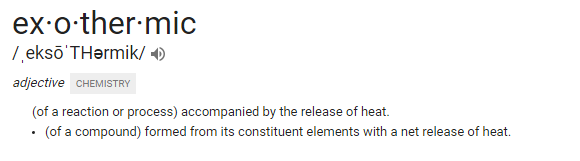
A chemical reaction takes place within a test tube. After the reaction, the test tube feels warmer than it did before the reaction. The reaction was endothermic exothermic ectothermic esothermic
joriiannesegarra:
Combustion of coal is a(n) ___________ reaction. endothermic physical heat-absorbing exothermic
 Ultrilliam:
To the first one, sorry didn't see the second one till now
Ultrilliam:
wait... sorry both is exothermic
Ultrilliam:
¯\_(ツ)_/¯
joriiannesegarra:
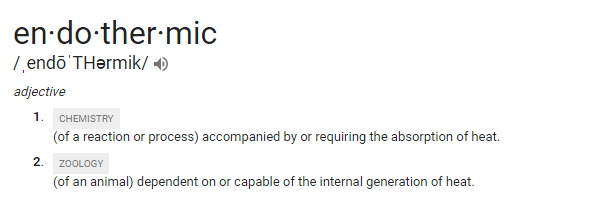
You place ammonium nitrate crystals in water and stir. As you do so, the container becomes cold to the touch. This is an example of _______ reaction. an exothermic an endothermic a physical
joriiannesegarra:
a heat pack
 joriiannesegarra:
Which of the following takes place during a synthesis reaction? a complex substance breaks down into two or more simple substances a single substance replaces another substance in a compound two simple substances combine to form a new complex substance parts of compounds switch places to form two new compounds
joriiannesegarra:
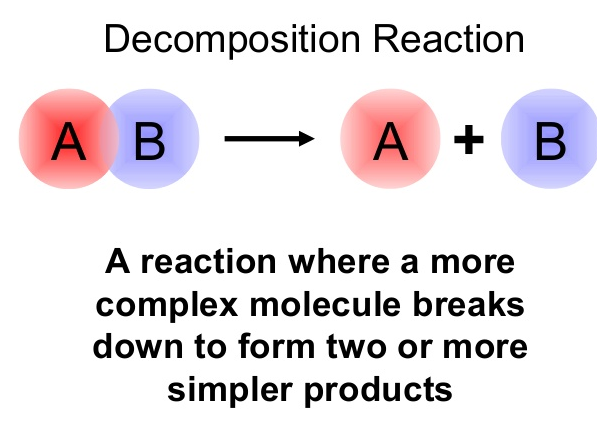
The generalized equation AB → A + B represents a _________ reaction. decomposition double displacement single displacement synthesis
joriiannesegarra:
Consider the equation CaF2 + H2SO4 → CaSO4 + 2 HF. What type of reaction is this? synthesis decomposition single displacement double displacement
Ultrilliam:
Which of the following takes place during a synthesis reaction? => two simple substances combine to form a new complex substance The generalized equation AB → A + B represents a _________ reaction. => decomposition Consider the equation CaF2 + H2SO4 → CaSO4 + 2 HF. What type of reaction is this? => Double displacement
joriiannesegarra:
Consider the equation 2KBr + Cl2 → KCl + Br2. What type of reaction is this? synthesis decomposition single displacement double displacement
joriiannesegarra:
Which of the following is a decomposition reaction? reactant + reactant yields product reactant– reactant yields product reactant yields product + product reactant yields product x product
Ultrilliam:
Consider the equation 2KBr + Cl2 → KCl + Br2. What type of reaction is this? =? I'm sorry I don't know this one. As for the second one,
Ultrilliam:
uh one second, the image didn't paste
 joriiannesegarra:
you got them mixed up
joriiannesegarra:
you gave the 2nd one for the first and then the other one for the second one
Ultrilliam:
??? Sorry I'm not fully awake yet, haven't even gotten dressed yet lol
joriiannesegarra:
During a chemical reaction, atoms can be rearranged or destroyed but not created. TRUE FALSE
joriiannesegarra:
Though energy can change forms, the total amount of energy in the universe remains constant. TRUE FALSE
Ultrilliam:
During a chemical reaction, atoms can be rearranged or destroyed but not created. -> true Though energy can change forms, the total amount of energy in the universe remains constant. -> According to Einstein, this is true.
joriiannesegarra:
Since exothermic reactions give off heat, they are exceptions to the law of conservation of energy and they are able to create new energy. TRUE FALSE
joriiannesegarra:
Suppose two chemicals are reacted together. It takes 1000 kJ of energy to break the bonds of the reactants and 850 kJ of energy are released by the formation of the products. Which statement is true about the reaction? The reaction is exothermic. The reaction will need an external energy source to proceed. The reaction will give off 150 kJ of energy. The reaction will likely be explosive.
joriiannesegarra:
Suppose two chemicals are reacted together. It takes 750 kJ of energy to break the bonds of the reactants and 1050 kJ of energy are released by the formation of the products. Which statement is true about the reaction? The reaction is exothermic. The reaction is endothermic. The reaction will not proceed without addition of energy. The reaction will absorb energy from its surroundings.
Ultrilliam:
Since exothermic reactions give off heat, they are exceptions to the law of conservation of energy and they are able to create new energy. -> false Suppose two chemicals are reacted together. It takes 1000 kJ of energy to break the bonds of the reactants and 850 kJ of energy are released by the formation of the products. Which statement is true about the reaction? -> The reaction will give off 150 kJ of energy. Suppose two chemicals are reacted together. It takes 750 kJ of energy to break the bonds of the reactants and 1050 kJ of energy are released by the formation of the products. Which statement is true about the reaction? -> The reaction is exothermic.
Ultrilliam:
Sorry for that delay
joriiannesegarra:
Suppose two chemicals are reacted together. It takes 600 kJ of energy to break the bonds of the reactants and 950 kJ of energy are released by the formation of the products. What is ∆H for the reaction? 0 kJ -600 kJ 600 kJ -350 kJ
joriiannesegarra:
In the chemical formula 3NH3, how many atoms of nitrogen (N) are there? 1 2 3 4
joriiannesegarra:
In the chemical formula 3NH3, how many atoms of hydrogen (H) are there? 3 6 9 11
Ultrilliam:
Suppose two chemicals are reacted together. It takes 600 kJ of energy to break the bonds of the reactants and 950 kJ of energy are released by the formation of the products. What is ∆H for the reaction? => -350 kJ In the chemical formula 3NH3, how many atoms of nitrogen (N) are there? -> 3 In the chemical formula 3NH3, how many atoms of hydrogen (H) are there? -> I don't know this one... sorry x.x
joriiannesegarra:
In the chemical formula CH4, how many atoms of carbon (C) are there? 1 2 3 4
joriiannesegarra:
When balancing an equation you must make sure that the number of atoms for each element are the same in the product side and the reactant side the products have more atoms than the reactants the reactants have more atoms than the products the coefficients are all the same number
joriiannesegarra:
How many total hydrogen (H) atoms are present in the reactants side of the equation C2H5OH + 3O2 → 2CO2 + 3H2O? 2 3 6 10
Ultrilliam:
In the chemical formula CH4, how many atoms of carbon (C) are there? -> 1 When balancing an equation you must make sure that -> the number of atoms for each element are the same in the product side and the reactant side How many total hydrogen (H) atoms are present in the reactants side of the equation C2H5OH + 3O2 → 2CO2 + 3H2O? -> 6
joriiannesegarra:
In the chemical formula 3NO2, the number “3” is a subscript place holder element coefficient
joriiannesegarra:
The atomic bomb is produced by the energy released during nuclear fusion nuclear fission gamma decay electron emission
joriiannesegarra:
In a nuclear chain reaction, _______ are used to trigger fission reactions. electrons protons alpha particles neutrons
Ultrilliam:
In the chemical formula 3NO2, the number “3” is a -> coefficient In a nuclear chain reaction, _______ are used to trigger fission reactions. -> Neutrons
joriiannesegarra:
you missed one
Ultrilliam:
oh, so i did...
joriiannesegarra:
The nuclear fission process releases neutrons and alpha particles electrons energy beta particles
Ultrilliam:
The atomic bomb is produced by the energy released during -> nuclear fission
joriiannesegarra:
In a nuclear power plant, the chain reaction takes place within the turbine generator reactor cooling system
Ultrilliam:
The nuclear fission process releases neutrons and -> energy In a nuclear power plant, the chain reaction takes place within the -> reactor
joriiannesegarra:
Suppose you have 50 grams of a radioactive isotope with a half-life of 2 years. How much of the isotope will you have after 4 years? 50 25 12.5 6.25 grams
joriiannesegarra:
The half-life of an isotope is the time it takes ________ of the original material to decay to the daughter product. 25% 50% 75% 100%
Ultrilliam:
Suppose you have 50 grams of a radioactive isotope with a half-life of 2 years. How much of the isotope will you have after 4 years? -> 50 The half-life of an isotope is the time it takes ________ of the original material to decay to the daughter product. -> 50%
joriiannesegarra:
High-level nuclear waste should ideally be stored in landfills in above ground storage tanks deep underground at the site of the power plant
joriiannesegarra:
Most nuclear waste in the US is low-level transuranic military high-level
joriiannesegarra:
Transuranic waste requires deep geological burial. TRUE FALSE
Ultrilliam:
High-level nuclear waste should ideally be stored -> This is a very VERY debatable topic, but it's probably looking for: deep underground, but I can't possibly be sure on this one. Most nuclear waste in the US is -> this one, I do not know... I tried researching but couldn't find anything useful. Sorry. Transuranic waste requires deep geological burial. -> True
joriiannesegarra:
Clothing that comes into contact with radiation is considered high-level nuclear waste. TRUE FALSE
joriiannesegarra:
Nuclear power produces tons of high-level radioactive waste that has to be disposed of carefully. TRUE FALSE
joriiannesegarra:
We have plentiful supplies of nuclear fuel and nuclear power could extend our fossil fuel supply. TRUE FALSE
joriiannesegarra:
Nuclear power is a major contributor to global warming. TRUE FALSE
Ultrilliam:
Clothing that comes into contact with radiation is considered high-level nuclear waste. -> I think this is false. Nuclear power produces tons of high-level radioactive waste that has to be disposed of carefully. -> True We have plentiful supplies of nuclear fuel and nuclear power could extend our fossil fuel supply. -> True Nuclear power is a major contributor to global warming. -> Probably false.
joriiannesegarra:
only got 4 wrong but is okay thanks
Ultrilliam:
Sorry that I got any wrong... Chemistry is not my strongest subject :(
joriiannesegarra:
have a nice day im out
Ultrilliam:
Ok, you to ^_^
Join our real-time social learning platform and learn together with your friends!
VERNEISH:
Two objects are moving along separate linear paths where each path is described by position, d, and time, t.

 Maci:
what are the best stock apps for people who want to start investing?
Maci:
what are the best stock apps for people who want to start investing?
 Twaylor:
genuienly how do i get better self control i keep watcing youtube and theres this
Twaylor:
genuienly how do i get better self control i keep watcing youtube and theres this
 IzzyCookie:
|dw:1792074056138:dw| Uhm, I don't know where to ask this, but I'm in college welding at my community college, and I need help learning vertical welding for
IzzyCookie:
|dw:1792074056138:dw| Uhm, I don't know where to ask this, but I'm in college welding at my community college, and I need help learning vertical welding for

 thehearken:
not sure if this is considered spam, im sorry if it is, but does anyone have tips
thehearken:
not sure if this is considered spam, im sorry if it is, but does anyone have tips