
 pandasurvive:
English help.
 pandasurvive:
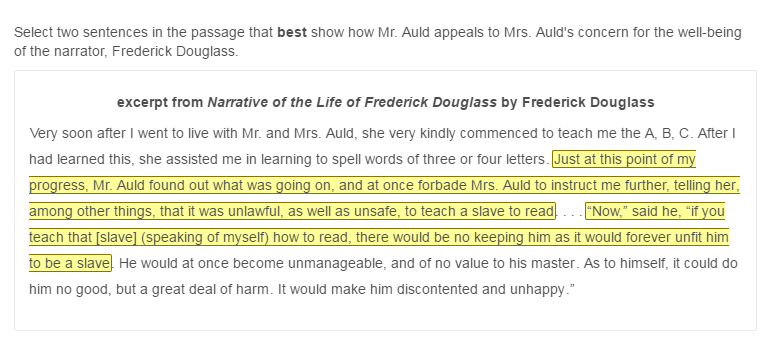
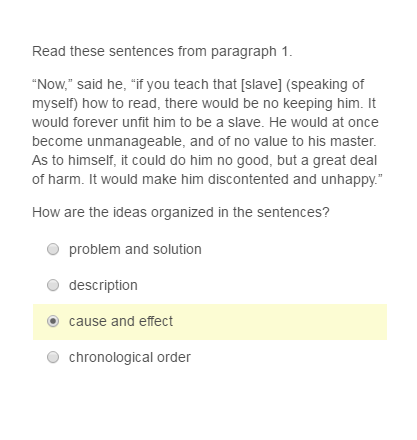
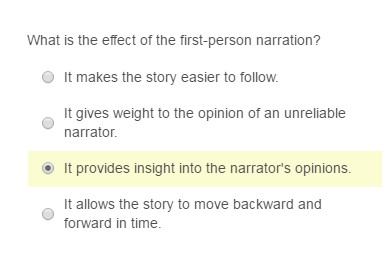
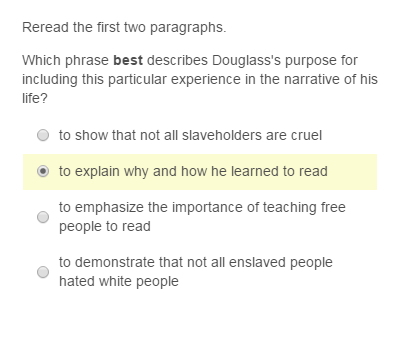
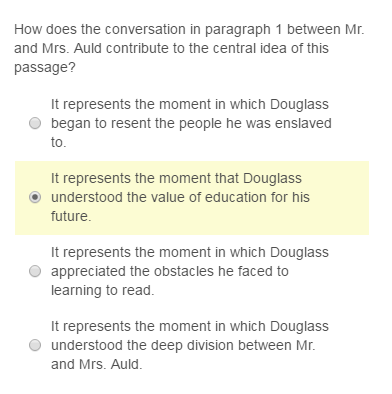
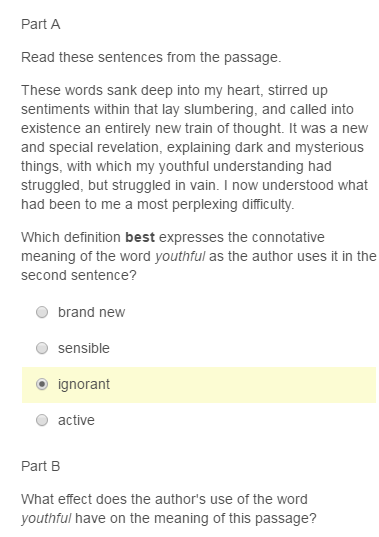
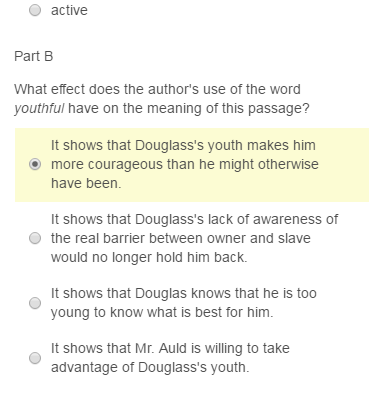
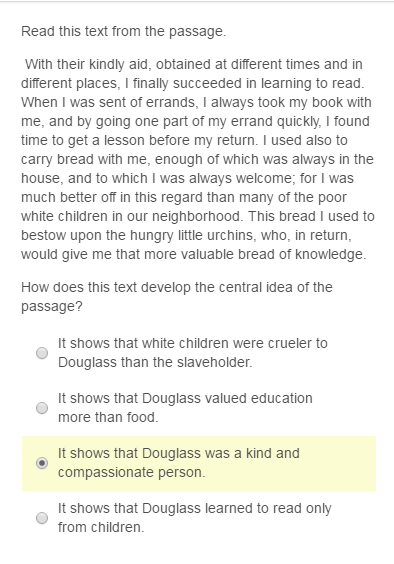
excerpt from Narrative of the Life of Frederick Douglass by Frederick Douglass Very soon after I went to live with Mr. and Mrs. Auld, she very kindly commenced to teach me the A, B, C. After I had learned this, she assisted me in learning to spell words of three or four letters. Just at this point of my progress, Mr. Auld found out what was going on, and at once forbade Mrs. Auld to instruct me further, telling her, among other things, that it was unlawful, as well as unsafe, to teach a slave to read. To use his own words, further, he said, "If you give a [slave] an inch, he will take an ell. A [slave] should know nothing but to obey his master—to do as he is told to do. Learning would spoil the best [slave] in the world. Now," said he, "if you teach that [slave] (speaking of myself) how to read, there would be no keeping him. It would forever unfit him to be a slave. He would at once become unmanageable, and of no value to his master. As to himself, it could do him no good, but a great deal of harm. It would make him discontented and unhappy." These words sank deep into my heart, stirred up sentiments within that lay slumbering, and called into existence an entirely new train of thought. It was a new and special revelation, explaining dark and mysterious things, with which my youthful understanding had struggled, but struggled in vain. I now understood what had been to me a most perplexing difficulty—to wit, the white man's power to enslave the black man. It was a grand achievement, and I prized it highly. From that moment, I understood the pathway from slavery to freedom. It was just what I wanted, and I got it at a time when I the least expected it. Whilst I was saddened by the thought of losing the aid of my kind mistress, I was gladdened by the invaluable instruction which, by the merest accident, I had gained from my master. Though conscious of the difficulty of learning without a teacher, I set out with high hope, and a fixed purpose, at whatever cost of trouble, to learn how to read. The very decided manner with which he spoke, and strove to impress his wife with the evil consequences of giving me instruction, served to convince me that he was deeply sensible of the truths he was uttering. It gave me the best assurance that I might rely with the utmost confidence on the results which, he said, would flow from teaching me to read. What he most dreaded, that I most desired. What he most loved, that I most hated. That which to him was a great evil, to be carefully shunned, was to me a great good, to be diligently sought; and the argument which he so warmly urged, against my learning to read, only served to inspire me with a desire and determination to learn. In learning to read, I owe almost as much to the bitter opposition of my master, as to the kindly aid of my mistress. I acknowledge the benefit of both. . . The plan which I adopted, and the one by which I was most successful, was that of making friends of all the little white boys whom I met in the street. As many of these as I could, I converted into teachers. With their kindly aid, obtained at different times and in different places, I finally succeeded in learning to read. When I was sent of errands, I always took my book with me, and by going one part of my errand quickly, I found time to get a lesson before my return. I used also to carry bread with me, enough of which was always in the house, and to which I was always welcome; for I was much better off in this regard than many of the poor white children in our neighborhood. This bread I used to bestow upon the hungry little urchins, who, in return, would give me that more valuable bread of knowledge. I am strongly tempted to give the names of two or three of those little boys, as a testimonial of the gratitude and affection I bear them; but prudence forbids;—not that it would injure me, but it might embarrass them; for it is almost an unpardonable offence to teach slaves to read in this Christian country. It is enough to say of the dear little fellows, that they lived on Philpot Street, very near Durgin and Bailey's ship-yard. I used to talk this matter of slavery over with them. I would sometimes say to them, I wished I could be as free as they would be when they got to be men. "You will be free as soon as you are twenty-one, but I am a slave for life! Have not I as good a right to be free as you have?" These words used to trouble them; they would express for me the liveliest sympathy, and console me with the hope that something would occur by which I might be free.
 Vocaloid:
good, there's just one that might be incorrect - "What affect does the author's use of the word 'youthful' in paragraph 2 have on the passage'. You answered "it shows that Douglass' youth makes him more courageous..." which is not one of the main ideas in paragraph 2. In paragraph 2 Douglass talks about how education is "the white man's power to enslave the black man" and "the pathway to slavery to freedom" so I believe B is the better answer
Vocaloid:
"youthful understanding" is more about his mental state than his actual age
pandasurvive:
So you think ignorant was correct for part one?
Vocaloid:
yes
pandasurvive:
This test is longer than the math one unfortunately. And I am sorry I am having you check all my answers. I just need to do good to bring my grade up to an A so I wanna be careful.
Vocaloid:
that's fine, that's what we're here for ^^
pandasurvive:
You sure?
Vocaloid:
yeah, do you have more questions?
pandasurvive:
Yes I do
Vocaloid:
ok, go for it
pandasurvive:
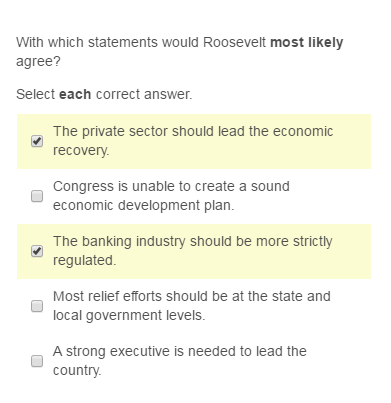
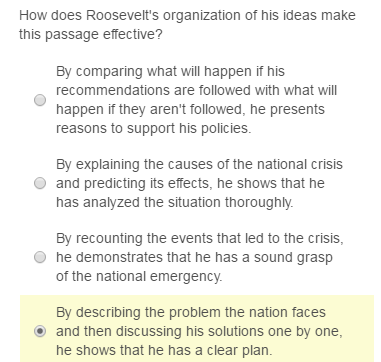
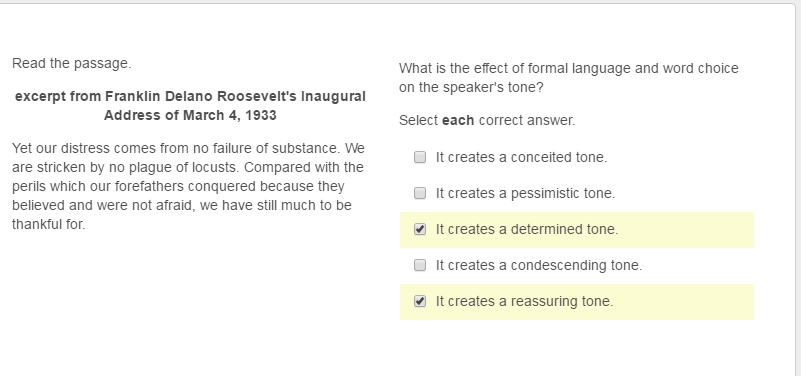
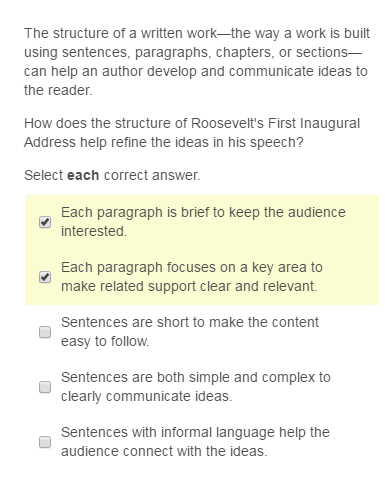
excerpt from First Inaugural Address of Franklin D. Roosevelt, March 4, 1933 I am certain that my fellow Americans expect that on my induction into the Presidency I will address them with a candor and a decision which the present situation of our Nation impels. This is preeminently the time to speak the truth, the whole truth, frankly and boldly. Nor need we shrink from honestly facing conditions in our country today. This great Nation will endure as it has endured, will revive and will prosper. So, first of all, let me assert my firm belief that the only thing we have to fear is fear itself—nameless, unreasoning, unjustified terror which paralyzes needed efforts to convert retreat into advance. In every dark hour of our national life a leadership of frankness and vigor has met with that understanding and support of the people themselves which is essential to victory. I am convinced that you will again give that support to leadership in these critical days. In such a spirit on my part and on yours we face our common difficulties. They concern, thank God, only material things. Values have shrunken to fantastic levels; taxes have risen; our ability to pay has fallen; government of all kinds is faced by serious curtailment of income; the means of exchange are frozen in the currents of trade; the withered leaves of industrial enterprise lie on every side; farmers find no markets for their produce; the savings of many years in thousands of families are gone. . . Our greatest primary task is to put people to work. This is no unsolvable problem if we face it wisely and courageously. It can be accomplished in part by direct recruiting by the Government itself, treating the task as we would treat the emergency of a war, but at the same time, through this employment, accomplishing greatly needed projects to stimulate and reorganize the use of our natural resources. Hand in hand with this we must frankly recognize the overbalance of population in our industrial centers and, by engaging on a national scale in a redistribution, endeavor to provide a better use of the land for those best fitted for the land. The task can be helped by definite efforts to raise the values of agricultural products and with this the power to purchase the output of our cities. It can be helped by preventing realistically the tragedy of the growing loss through foreclosure of our small homes and our farms. It can be helped by insistence that the Federal, State, and local governments act forthwith on the demand that their cost be drastically reduced. It can be helped by the unifying of relief activities which today are often scattered, uneconomical, and unequal. It can be helped by national planning for and supervision of all forms of transportation and of communications and other utilities which have a definitely public character. There are many ways in which it can be helped, but it can never be helped merely by talking about it. We must act and act quickly. Finally, in our progress toward a resumption of work we require two safeguards against a return of the evils of the old order; there must be a strict supervision of all banking and credits and investments; there must be an end to speculation with other people's money, and there must be provision for an adequate but sound currency. . . I am prepared under my constitutional duty to recommend the measures that a stricken nation in the midst of a stricken world may require. These measures, or such other measures as the Congress may build out of its experience and wisdom, I shall seek, within my constitutional authority, to bring to speedy adoption. But in the event that the Congress shall fail to take one of these two courses, and in the event that the national emergency is still critical, I shall not evade the clear course of duty that will then confront me. I shall ask the Congress for the one remaining instrument to meet the crisis—broad Executive power to wage a war against the emergency, as great as the power that would be given to me if we were in fact invaded by a foreign foe
 Vocaloid:
For the last one I would add "sentences are both simple and complex to communicate ...etc" because he has both very short sentences and very long sentences
Vocaloid:
like, in paragraph 2 he uses several semicolons to join phrases together, emphasizing the many problems the country has. but in paragraph 3 he starts with the simple sentence "our greatest task is to put people to work"
pandasurvive:
Oh, I see what you mean.
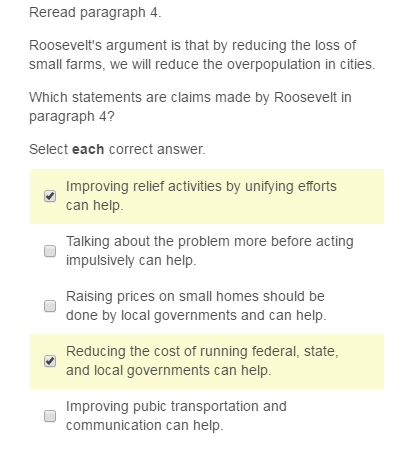
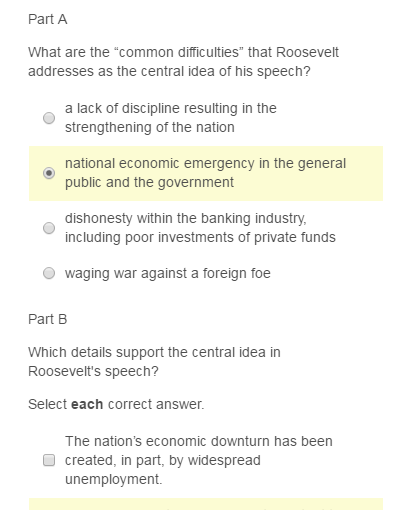
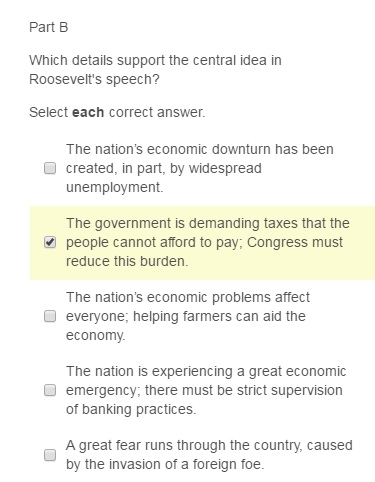 Vocaloid:
I'm not sure on the "frozen in the currents of trade" b/c none of the answers seem right to me. he means that money in credit markets is not moving/ unable to be loaned out :/
pandasurvive:
Its ok lol, thanks for trying on that one :).
Vocaloid:
nvm
pandasurvive:
lol
pandasurvive:
The last few questions should be alot easier.
pandasurvive:
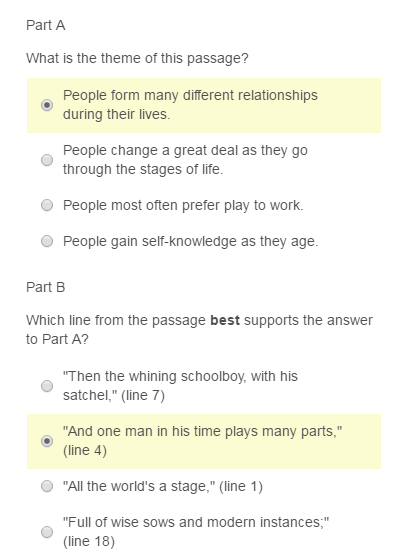
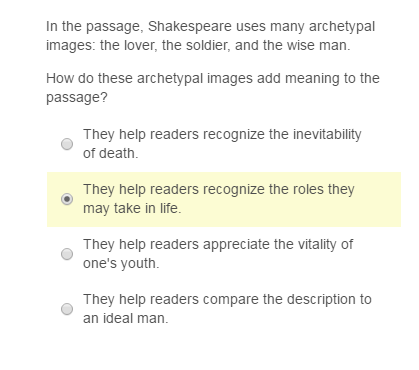
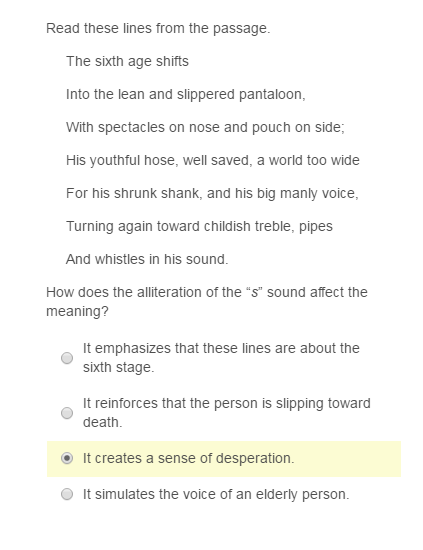
"All the World's a Stage" from As You Like It by William Shakespeare All the world’s a stage, And all the men and women merely players; They have their exits and their entrances, And one man in his time plays many parts, His acts being seven ages. At first, the infant, Mewling and puking in the nurse’s arms. Then the whining schoolboy, with his satchel And shining morning face, creeping like snail Unwillingly to school. And then the lover, Sighing like furnace, with a woeful ballad Made to his mistress’ eyebrow. Then a soldier, Full of strange oaths and bearded like the pard, Jealous in honor, sudden and quick in quarrel, Seeking the bubble reputation Even in the cannon’s mouth. And then the justice, In fair round belly with good capon lined, With eyes severe and beard of formal cut, Full of wise saws and modern instances; And so he plays his part. The sixth age shifts Into the lean and slippered pantaloon, With spectacles on nose and pouch on side; His youthful hose, well saved, a world too wide For his shrunk shank, and his big manly voice, Turning again toward childish treble, pipes And whistles in his sound. Last scene of all, That ends this strange eventful history, Is second childishness and mere oblivion, Sans teeth, sans eyes, sans taste, sans everything.
 pandasurvive:
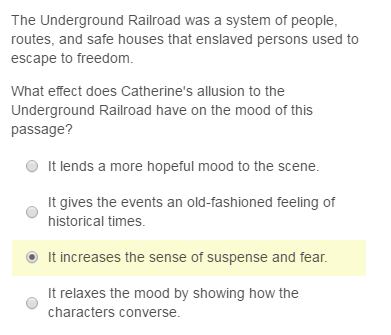
The Shadowland Tunnel Between the wave-whipped headlands of Dredmor and the sun-brightened hills of Valegreen, the unknown hazards of Shadowland Tunnel beckoned. As the self-driven cart hurtled down the track toward the tunnel entrance, its whistle hooting rudely, Jake and Catherine exchanged looks, trying unsuccessfully to reassure each other. "No one has ever returned from this tunnel to describe what it's like," Catherine shivered. “Do you think we should go back?” Jake asked. “No, the tunnel is our only chance for freedom. We have to be daring enough to take the risk.” The angle of the track steepened downward as the cart descended toward the gaping pitch-black cavity that was the tunnel’s entrance. Here, the dark green vegetation took on weird tints of purple and crimson, and from somewhere a wind arose, its moans sounding like warnings. “I feel like we’re heading into the River Styx,” Jake said, his voice trembling. “You know, in Greek mythology, the river of the dead? Like we’re souls who’ve just died and we’re going to meet Charon, the guide, who’s going to ferry us into the underworld.” “Why are you saying that?” Catherine quailed. “Are you trying to scare me? Maybe the tunnel’s like the Underground Railroad, and it’ll take us to a place where we won’t be hunted anymore, and we won’t be outcasts, and we’ll be free.” The final syllables of her reply faded at the exact moment when the cart plummeted into the chute that marked the tunnel entrance.
 Vocaloid:
can we do one passage at a time plz ;_;
pandasurvive:
oki im sorry lol
Vocaloid:
the first question on the Shakespeare passage - it's not really about relationships, it's about aging, so the second answer is better
Vocaloid:
for the third question on the Shakespeare passage, think about the last line: "and whistles in his sound" all of the "s's" sound like whistling so D is the best answer
pandasurvive:
Oh ok thanks :)
Vocaloid:
all your answers on the Shadowland Tunnel passage are good sorry about the FDR passage, all that political stuff went over my head :/
pandasurvive:
Dont be sorry lol. You are helping me so much. And all the formal 18-19 hundreds talk gives me headaches tbh lol.
Vocaloid:
anything else?
pandasurvive:
no thats it, thanks so much :D.
Vocaloid:
ok, gonna go work on some personal stuff but I might be back later tonight
pandasurvive:
Also I am about to turn it in :)
Join our real-time social learning platform and learn together with your friends!
 VERNEISH:
Two objects are moving along separate linear paths where each path is described by position, d, and time, t.
VERNEISH:
Two objects are moving along separate linear paths where each path is described by position, d, and time, t.

 Maci:
what are the best stock apps for people who want to start investing?
Maci:
what are the best stock apps for people who want to start investing?
 Twaylor:
genuienly how do i get better self control i keep watcing youtube and theres this
Twaylor:
genuienly how do i get better self control i keep watcing youtube and theres this
 IzzyCookie:
|dw:1792074056138:dw| Uhm, I don't know where to ask this, but I'm in college welding at my community college, and I need help learning vertical welding for
IzzyCookie:
|dw:1792074056138:dw| Uhm, I don't know where to ask this, but I'm in college welding at my community college, and I need help learning vertical welding for

 thehearken:
not sure if this is considered spam, im sorry if it is, but does anyone have tips
thehearken:
not sure if this is considered spam, im sorry if it is, but does anyone have tips