
 kodakanderson:
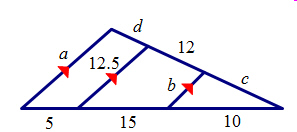
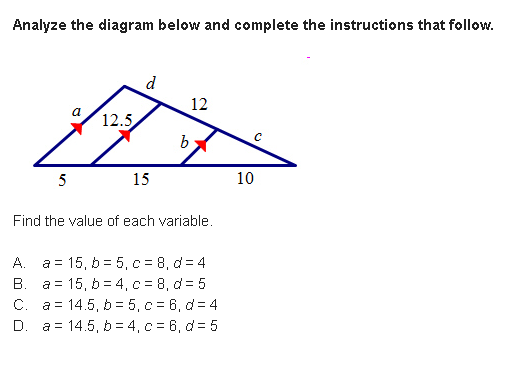
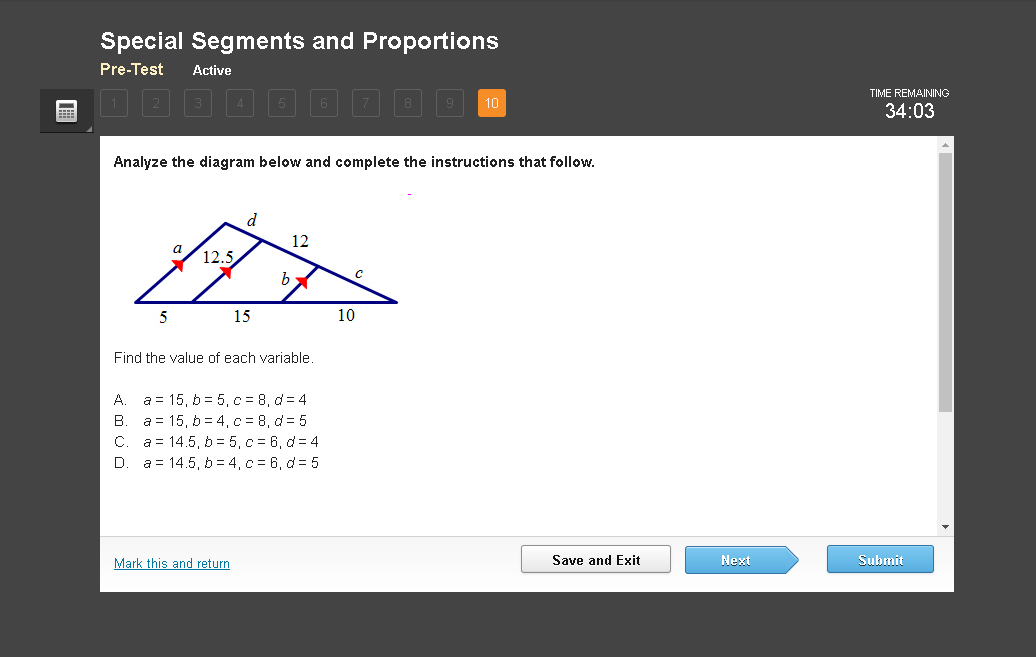
Find the value of each variable. (picture below) WILL MEDAL A. a = 15, b = 5, c = 8, d = 4 B. a = 15, b = 4, c = 8, d = 5 C. a = 14.5, b = 5, c = 6, d = 4 D. a = 14.5, b = 4, c = 6, d = 5
 Hero:
Hero:
Hi @kodakanderson, "(picture below)"... Where's the picture?
Hero:

kodakanderson:
thx i i didnt know
 kodakanderson:
here the picture
Hero:
@Ultrilliam
Hero:
Give me a few to look over this
kodakanderson:
ight you
 kodakanderson:
here
Hero:
Okay, so my question to you is, Have you already attempted to solve this yourself?. If so, what have you done so far? You can either explain here or you can use the draw feature to show the work that you've done so far.
 Hero:
Hero:
Yes, I understand the problem itself, but I'm asking you if you have attempted to solve this on your own yet.
kodakanderson:
i cant solve it thats why i need help
Hero:
@kodakanderson Are you familiar with the concept of similar triangles?
kodakanderson:
no i m trash at math
Hero:
Well, the concept of similar triangles is as follows: If two angles of a triangle have measures equal to the measures of two angles of another triangle, then the triangles are similar. Corresponding sides of similar polygons are in proportion, and corresponding angles of similar polygons have the same measure. In this case we have three triangles: |dw:1497824444118:dw|
Hero:
Triangle G: |dw:1497824474264:dw|
kodakanderson:
thanks you
Hero:
Triangle B: |dw:1497824632966:dw|
Hero:
And Triangle R|dw:1497824726432:dw|
kodakanderson:
thanks you
Hero:
So, in this case, \(\triangle{B} \sim \triangle{R} \sim \triangle{G}\) because their angles all have the same measure: |dw:1497824892239:dw|
Hero:
And thus the corresponding sides of the triangles are proportional
kodakanderson:
you good at this 😭😎🙂😁😁☺☺☺☺☺☺☺
kodakanderson:
thatsks too you
Hero:
For example, we can set up the following proportion to find the length of side b: \(\dfrac{b}{10} = \dfrac{12.5}{15 + 10}\)
Hero:
@kodakanderson would you like to try solving for \(b\) for the proportion above?
kodakanderson:
no
Hero:
@kodakanderson
 Jaynator495:
Bruh. You need to help yourself for others to help you. ._.
Join our real-time social learning platform and learn together with your friends!
 DoltonCarlee:
what are y'all's options on S A T essays because honestly their not that bad
DoltonCarlee:
what are y'all's options on S A T essays because honestly their not that bad

 thereneelg:
Can someone give me a summary of article 231, The war guilt clause?? I need to explain what it is, but I can't find any shortened version of what it is and
thereneelg:
Can someone give me a summary of article 231, The war guilt clause?? I need to explain what it is, but I can't find any shortened version of what it is and
 luisaam2:
What should you do when the person you want to talk to the most is the one making
luisaam2:
What should you do when the person you want to talk to the most is the one making
 Breathless:
https://medal.tv/games/roblox/clips/nAYivIl6oXB6q9QAI?invite=cr-MSxCSk4sMTY4OTA4N
Breathless:
https://medal.tv/games/roblox/clips/nAYivIl6oXB6q9QAI?invite=cr-MSxCSk4sMTY4OTA4N
 Twaylor:
I'm not that good at law can someone fact check this without bias? June 29, 2026, the Supreme Court decided Chatrie v.
Twaylor:
I'm not that good at law can someone fact check this without bias? June 29, 2026, the Supreme Court decided Chatrie v.
 Demon25:
For a hoco proposal with a cheerleader and football player, what else should be a
Demon25:
For a hoco proposal with a cheerleader and football player, what else should be a
