
 smithm29:
A 15-gram sample of a substance that's a by-product of fireworks has a k-value of 0.1405. Find the substance's half-life, in days. Round to the nearest tenth.
 Vocaloid:
"half life" is the amount of time it takes for a substance to lose 50% of it's mass so we use our formula y = a(e^kt) and plug in 7.5 for y, 15 for a, and 0.1405 for k
Vocaloid:
7.5 = 15 * e^(0.1405)t dividing both sides by 7.5 gives us 0.5 = e^(0.1405t) know where to go from here?
smithm29:
no idea lol i suck at this
Vocaloid:
in order to "eliminate" the e^( part we must take the natural log of both sides ln(0.5) = lne^(0.1405t) if we have ln(e^something) we can cross out the ln(e part so we get ln(0.5) = 0.1405t then we simply divide both sides by 0.1405
Vocaloid:
I get 4.9 days
smithm29:
oh... im still so lost lol
smithm29:
that was right tho :D
Vocaloid:
well, let's take a closer look at our formula
Vocaloid:
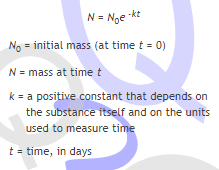
y = a(e^-kt) *I forgot to put the negative sign before
 smithm29:
ooh ok
Vocaloid:
since your problem gives you: the initial mass the final mass and k, you can insert these into the formula and find t
Vocaloid:
|dw:1501390253430:dw|
smithm29:
wait whats the final mass?
Vocaloid:
|dw:1501390271584:dw|
Vocaloid:
since they are asking for "half-life" the final mass = initial mass/2
Vocaloid:
half-life is the amount of time it takes for the final mass to equal half the intial mass
smithm29:
i feel really dumb rn lol
Vocaloid:
don't worry about it, it's just a definition to memorize
smithm29:
wait than whats the 0 for?
Vocaloid:
the "0" is a subscript, it's just to make the N_0 different from the other N
smithm29:
oh ok
Vocaloid:
it's just a fancy label, it doesn't get treated like an actual 0
Vocaloid:
any other questions?
smithm29:
prob
smithm29:
i have another one can u like guide me through it?
Vocaloid:
sure, you can close this question and make a new one
smithm29:
cool
Join our real-time social learning platform and learn together with your friends!
 VERNEISH:
Two objects are moving along separate linear paths where each path is described by position, d, and time, t.
VERNEISH:
Two objects are moving along separate linear paths where each path is described by position, d, and time, t.

 Maci:
what are the best stock apps for people who want to start investing?
Maci:
what are the best stock apps for people who want to start investing?
 Twaylor:
genuienly how do i get better self control i keep watcing youtube and theres this
Twaylor:
genuienly how do i get better self control i keep watcing youtube and theres this
 IzzyCookie:
|dw:1792074056138:dw| Uhm, I don't know where to ask this, but I'm in college welding at my community college, and I need help learning vertical welding for
IzzyCookie:
|dw:1792074056138:dw| Uhm, I don't know where to ask this, but I'm in college welding at my community college, and I need help learning vertical welding for

 thehearken:
not sure if this is considered spam, im sorry if it is, but does anyone have tips
thehearken:
not sure if this is considered spam, im sorry if it is, but does anyone have tips