
 natg2900:
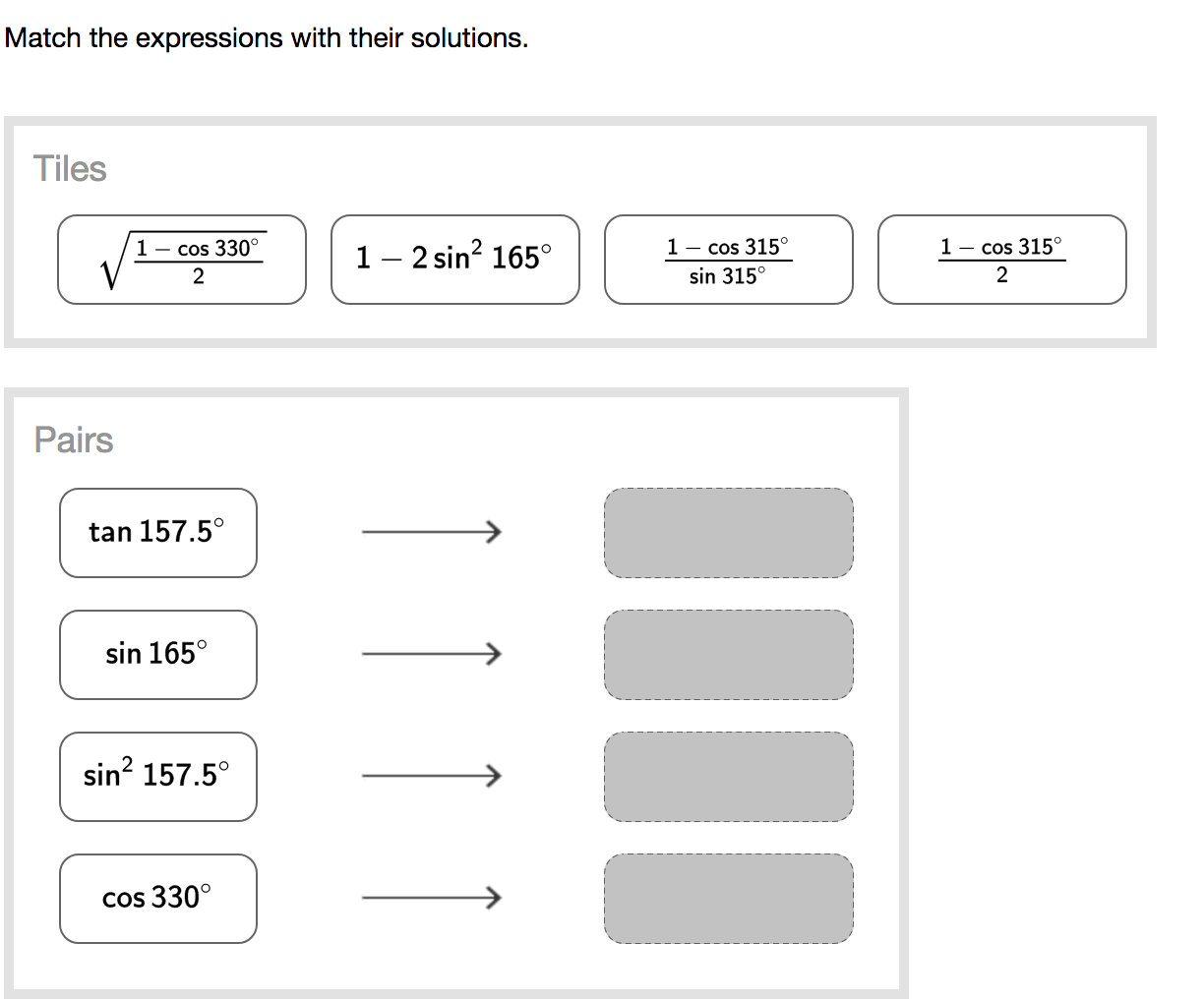
see screenshot below
 SmokeyBrown:
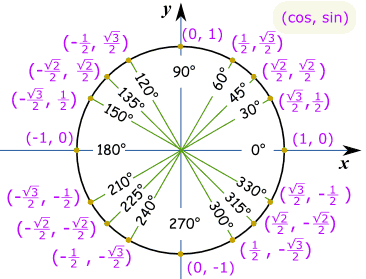
Ah good old trigonometry. I'm sure you're familiar with the Unit Circle? It's this thing right here.
 SmokeyBrown:
Before we examine this in detail, I'd like to review the meaning behind sin, cos, and tan, with the device "SOH CAH TOA". In a right triangle, sin is calculated by the length Opposite the angle/the length of the Hypotenuse; cos by the length Adjacent to the angle/the length of the Hypotenuse; tan by the length Opposite the angle/the length Adjacent to the angle
SmokeyBrown:
Now, we can relate this to the right triangles that appear in the Unit Circle. Using cos(330) as an example, we see that the corresponding coordinates (sqr(3)/2, -1/2) can be used as the Adjacent and Opposite lengths, respectively. This being the Unit Circle, the Hypotenuse is 1. So, cos in this case would be (sqr(3)/2)/1 or simply sqr(3)/2
 Vocaloid:
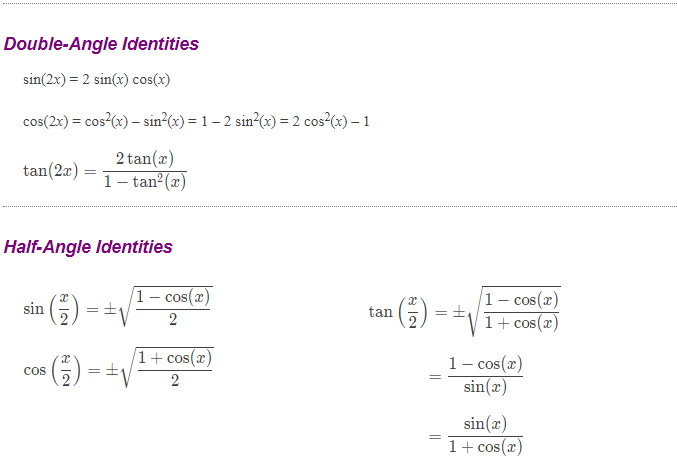
this is all good but it's just double angle/half angle formulas
 SmokeyBrown:
I just googled this and Froppy is correct. Her's is a simpler solution.
Vocaloid:
if tan(157.5) = tan(x) then x = 315 then tan(157.5) = [1 - cos(315) ]/sin(315) = choice c
Vocaloid:
you can do something similar with sin(165)
Vocaloid:
sin(x/2) = +- sqrt(1-cos(2x)/2))
Vocaloid:
for the last one cos(2x) = 1 - sin^2(x)
Vocaloid:
then we use process of elimination to find sin^2(157.5)
Vocaloid:
hope this helps
Vocaloid:
going to bed
Join our real-time social learning platform and learn together with your friends!
VERNEISH:
Two objects are moving along separate linear paths where each path is described by position, d, and time, t.

 Maci:
what are the best stock apps for people who want to start investing?
Maci:
what are the best stock apps for people who want to start investing?
 Twaylor:
genuienly how do i get better self control i keep watcing youtube and theres this
Twaylor:
genuienly how do i get better self control i keep watcing youtube and theres this
 IzzyCookie:
|dw:1792074056138:dw| Uhm, I don't know where to ask this, but I'm in college welding at my community college, and I need help learning vertical welding for
IzzyCookie:
|dw:1792074056138:dw| Uhm, I don't know where to ask this, but I'm in college welding at my community college, and I need help learning vertical welding for

 thehearken:
not sure if this is considered spam, im sorry if it is, but does anyone have tips
thehearken:
not sure if this is considered spam, im sorry if it is, but does anyone have tips