
 princeevee:
A coin is flipped four times. X is the number of times it will land with a head up. Which statement is true about this situation? The variable X has a binomial distribution. P(success)=0.5P(success)=0.5; number trials = 4 The variable X does not have a binomial distribution because P(success) is not constant. The variable X does not have a binomial distribution because there are more than two possible outcomes. The variable X has a binomial distribution. P(success)=0.25; number of trials = 4
 Vocaloid:
hint: what is the probability of heads on ONE coin?
princeevee:
0.5?
Vocaloid:
good so P(success) = 0.5 since there are two outcomes, this is a binomial distribution with number of trials = 4 so option A must be your answer
princeevee:
can you help with more please?
Vocaloid:
ok
princeevee:
For a certain type of hay fever, Medicine H has a 30% probability of working. In which distributions does the variable X have a binomial distribution? Select each correct answer. When the medicine is tried with two patients, X is the number of doses each patient needs to take. When the medicine is tried with six patients, X is the number of patients for whom the medicine does not work. When the medicine is tried with two patients, X is the number of patients for whom the medicine worked. When the medicine is tried with six patients, X is the number of patients for whom the medicine worked.
Vocaloid:
I believe it would be everything except the first option since X = the number of patients (success or fail)
Vocaloid:
if that doesn't work then I would only pick the last two
 Vocaloid:
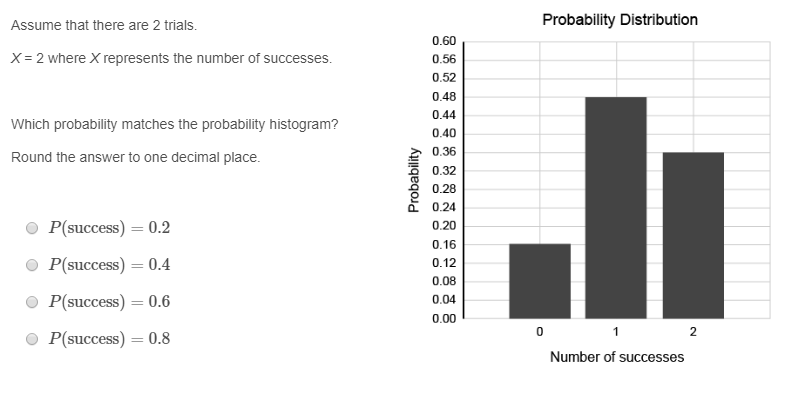
hint: if P(success) * P(success) = 0.36 then what is P(success)?
princeevee:
9?
princeevee:
no wait
Vocaloid:
what is the square root of 0.36?
princeevee:
0.6
Vocaloid:
good, that's your answer
 Vocaloid:
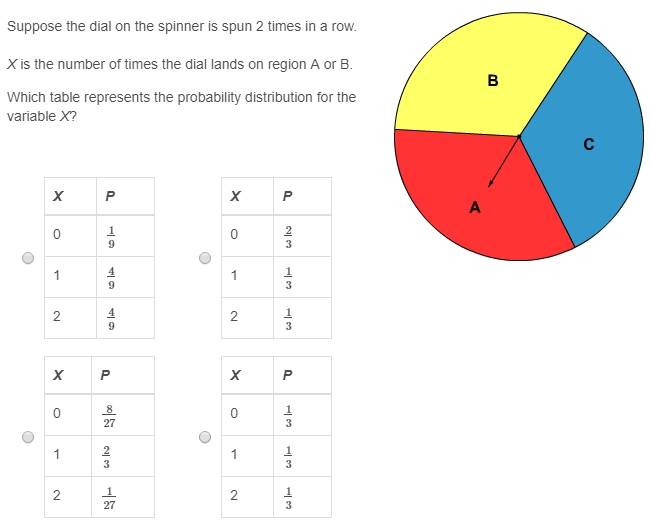
hint: what is the probability of landing on A or B?
princeevee:
1/3
Vocaloid:
in probability "or" implies addition probability of A + probability of B = ?
princeevee:
2/3?
Vocaloid:
good, and if we square that (for X = 2) we get?
princeevee:
B?
Vocaloid:
what is (2/3)*(2/3) ?
princeevee:
1
Vocaloid:
what is 2*2?
princeevee:
4
Vocaloid:
good, what is 3*3?
princeevee:
9
Vocaloid:
good, so (2/3)*(2/3) = 4/9 so if X = 2 gives us a probability of 4/9 that means only option #1 (top left) works
princeevee:
The probability that traffic lights on a certain road will be green is 0.6. When a driver on that road approaches two traffic lights in a row, X is the number of traffic lights that are green. What is P(X=1)? Enter your answer, as a decimal,
Vocaloid:
if 0.6 is the probability of green, what is the probability of NOT green?
princeevee:
0.4?
Vocaloid:
good so we have two possibilities green * not green not green* green so that gives us (0.6)(0.4) + (0.4)(0.6) = ?
princeevee:
0.48
Vocaloid:
good that should be your answer
princeevee:
thanks!
Join our real-time social learning platform and learn together with your friends!
 VERNEISH:
Two objects are moving along separate linear paths where each path is described by position, d, and time, t.
VERNEISH:
Two objects are moving along separate linear paths where each path is described by position, d, and time, t.

 Maci:
what are the best stock apps for people who want to start investing?
Maci:
what are the best stock apps for people who want to start investing?
 Twaylor:
genuienly how do i get better self control i keep watcing youtube and theres this
Twaylor:
genuienly how do i get better self control i keep watcing youtube and theres this
 IzzyCookie:
|dw:1792074056138:dw| Uhm, I don't know where to ask this, but I'm in college welding at my community college, and I need help learning vertical welding for
IzzyCookie:
|dw:1792074056138:dw| Uhm, I don't know where to ask this, but I'm in college welding at my community college, and I need help learning vertical welding for

 thehearken:
not sure if this is considered spam, im sorry if it is, but does anyone have tips
thehearken:
not sure if this is considered spam, im sorry if it is, but does anyone have tips