
 RandomPerson:
...
RandomPerson:
@Vocaloid Gotta metric ton of math I could use assistance with if you can x.x
 Vocaloid:
yeah sure
RandomPerson:
2. Give an example of each of the following: (a) A function whose domain is \([2,\infty]\) (b) An arithmetic sequence (c) A system of equations with no solutions
Vocaloid:
well for the first one we could modify a square root function sqrt(x) gives a domain of [0, infinity) so if we change it to sqrt(x-2) we get a domain of [2,infinity)
Vocaloid:
for an arithmetic sequence we could imagine a scenario like a phone bill where there's a flat fee a1 = $50 for example, and d = 0.01 per minute n, giving us: an = a1 + d(n-1) = 50 + 0.01(n-1)
Vocaloid:
for the last one just write down two parallel lines (same slop, different intercept) y = mx + b where m is the slope and b is the intercept
Vocaloid:
*same slope
RandomPerson:
Alright, for \(f(x)=\frac{1}{x^2-3}\) find: (a) f(3) (b) f(2+h)
Vocaloid:
just plug in x = 3 for a and x = (2+h) for b
RandomPerson:
for \(f(x)=\frac{1}{x-5}\) and \(g(x)=2^2-2\), find: (a) \(f\circ g\) (b) \(g\circ f\)
Vocaloid:
so f dot g means take the result for g(x), and substitute for x in f(x)
Vocaloid:
g(x) = 2, so you would use x = 2 for f(x) and find f(x)
Vocaloid:
for part b, just do it the other way around, look at g(x) and substitute f(x) into it (since g(x) doesn't have x in it, then g dot f would also just be 2
RandomPerson:
Ok, For sequence given by \(a_n=4n+5\), (a) find the first five terms (b) find the sum of the first 25 terms, (c) Is this an arithmetic sequence? If so, how can you tell? If not, why not?
Vocaloid:
for part a: start with n =1 and find 4n + 5. then do n = 2, n = 3, n = 4, and n = 5
Vocaloid:
for part b: sum = n(a1+an)/2 where a1 = the term when n = 1 and an = the term when n = 25
Vocaloid:
for part c: observe your sequence for part a and see if there's a common difference (the terms should increase/decrease by the same amount each time)
 RandomPerson:
what does it mean by "area bounded by"?
Vocaloid:
graph all the inequalities and shade in the area that would satisfy all the inequalities
Vocaloid:
it will help to consider them one at a time (for example, for y < 1/2 x + 6 you would just graph y = (1/2)x + 6 with a dotted line and then shade underneath)
Vocaloid:
repeat this process with all of the inequalities, and then emphasize the area where all of the shaded regions overlap
Vocaloid:
|dw:1504745002332:dw|
RandomPerson:
Ok, For the function defined by: \(f(x)=\left\{\begin{matrix}x^2,x\le1 \\ 2x+1,x\gt1,\end{matrix}\right\}\) Evaluate Graph I suck at sine functions
Vocaloid:
does it just say "evaluate graph"? that's odd
RandomPerson:
No, evaluate and graph, sorry about that
RandomPerson:
2 different parts
Vocaloid:
I would just use software to do this tbh
RandomPerson:
Oh, ok then, I was trying to avoid desmos x'D
Vocaloid:
you would just graph x^2 and then 2x + 1, and then just erase the parts of the graph that go outside the inequality
Vocaloid:
so for x^2 x≤1, just graph x^2 and then erase all the parts where x is greater than 1
Vocaloid:
|dw:1504745773848:dw|
Vocaloid:
^should be more like that since it crosses the origin
RandomPerson:
Ah, Ok... the first part of this one is easy enough, but idk about the second part
 Vocaloid:
if graphing is easier for you just graph and check if the intersection point is the same as the algebraic solution
Vocaloid:
if you know how to do row-reduction, then that will work to if you reduce to: \[\left[\begin{matrix}1 & 0 \\ 0 & 1\end{matrix}\right]\]
Vocaloid:
that will give you the solution matrix on the right hand side
RandomPerson:
Ok, Given matrices A, B, and C below, perform the indicated operations if possible. If the operation is not possible, explain why. \(A=\left[\begin{matrix}2&-1&0\\0&5&0.3\\1&4&10\end{matrix}\right],B=\left[\begin{matrix}5&0&2\\1&-3&9\\2&0&4\end{matrix}\right],C=\left[\begin{matrix}1 & 3&5\end{matrix}\right]\) (a) 3A + B (b) 2B + C (c) CA
Vocaloid:
since A and B have the same dimensions you can add/subtract them for example: for a) 3A + B you would multiply every term in A by 3, and then add the corresponding entries in the matrices
Vocaloid:
for CA since C has dimensions 1 x 3 and A has dimensions 3 * 3 you can multiply them to get a 1 * 3 matrix
Vocaloid:
this is hard to explain but if you're in a hurry just use a matrix calculator
 Vocaloid:
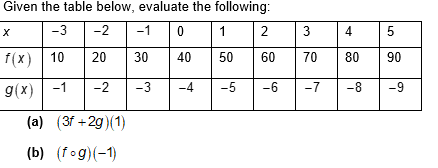
a) isn't too bad, just find f(1) and g(1) from the table and then do 3f + 2g
Vocaloid:
for b) find g(-1) = "some value" then find f at that value (not -1) to get your answer
RandomPerson:
Express the following function, as a composition of two functions f and g. \(h(x)=\frac{x^2}{(x^2+4)}\)
Vocaloid:
idk how to explain this but you could use g(x) = x^2 and f(x) = x/(x+4) since f dot g will give you h(x)
Vocaloid:
basically it's working backwards to find the composition instead of evaluating the composition
 Vocaloid:
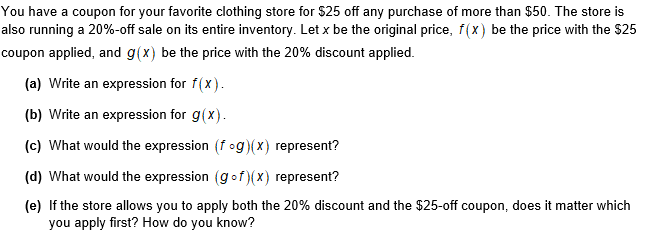
a) f(x) is just x minus the coupon so f(x) = x - 25
Vocaloid:
b) g(x) is (1-0.2)x this is a 20% reduction in x
Vocaloid:
c) and d) f dot g is the price when you apply the sale discount first and g dot f is the price when you apply the coupon first
Vocaloid:
for e) you can calculate f dot g and g dot f yourself and you will see that they're not the same function, thus order matters
RandomPerson:
Ok, thank you. (also if I have any troubles with these when I go back over them and try based off of what you told me, then I'll probably ask for more help ¯\_(ツ)_/¯)
Vocaloid:
np I'm kind of in zombie mode right now so my explanations might not be that great today ;_;
Join our real-time social learning platform and learn together with your friends!
 DoltonCarlee:
what are y'all's options on S A T essays because honestly their not that bad
DoltonCarlee:
what are y'all's options on S A T essays because honestly their not that bad

 thereneelg:
Can someone give me a summary of article 231, The war guilt clause?? I need to explain what it is, but I can't find any shortened version of what it is and
thereneelg:
Can someone give me a summary of article 231, The war guilt clause?? I need to explain what it is, but I can't find any shortened version of what it is and
 luisaam2:
What should you do when the person you want to talk to the most is the one making
luisaam2:
What should you do when the person you want to talk to the most is the one making
 Breathless:
https://medal.tv/games/roblox/clips/nAYivIl6oXB6q9QAI?invite=cr-MSxCSk4sMTY4OTA4N
Breathless:
https://medal.tv/games/roblox/clips/nAYivIl6oXB6q9QAI?invite=cr-MSxCSk4sMTY4OTA4N
 Twaylor:
I'm not that good at law can someone fact check this without bias? June 29, 2026, the Supreme Court decided Chatrie v.
Twaylor:
I'm not that good at law can someone fact check this without bias? June 29, 2026, the Supreme Court decided Chatrie v.
 Demon25:
For a hoco proposal with a cheerleader and football player, what else should be a
Demon25:
For a hoco proposal with a cheerleader and football player, what else should be a
