
 xXMarcelieXx:
can someone help me with calc 3 i dont understand whats going on for this problem. ik it has to do something with scalar or vector projections

 Allison:
Oh girl hold on lemme get help lol
Allison:
@Ultrilliam @Angelica @Warriorz13
xXMarcelieXx:
thanks lol
 Angelica:
I dont even know what Calc 3 is pft XD
 Ultrilliam:
I'm still in precalc @vocaloid
Angelica:
I take Geometry
xXMarcelieXx:
D: i need help with this subject.. im so lost and her study guide looks like another mathematical language too me
Angelica:
I would help if I could but idk how
Ultrilliam:
you know I should know vectors because of the c++ class I was in... but yea... one sec while I look
Ultrilliam:
a) position 1 b) position 2 If I have that right... orthogonal means the product of the 2 positions = 0 I believe
Ultrilliam:
although I don't know the terminology to identify the positions in the vectors... RIP
xXMarcelieXx:
looks right but im like which formula do we use
Ultrilliam:
I just used intuition lol
xXMarcelieXx:
i found this one for number 3 that is similar but idk http://math.arizona.edu/~mgilbert/HW1_Solutions_223_Fall2015.pdf
 loveboy:
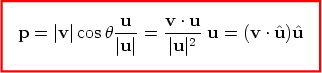
you know the formula for finding one vector component parallel to other vector ?
 xXMarcelieXx:
do i have to draw the diagram ?
loveboy:
its your own choice but why so? you have a formula ,just use it diagram only simplifies your imagination that's all but i recommend you to draw the diagram
xXMarcelieXx:
idk how to draw the diagram. i have a hard time visualizing stuff
loveboy:
umm i'm here ,i'll try to guide you
loveboy:
|dw:1505151450461:dw| now take the component of v along the direction of b that gives you the vector component parallel to b and that is vcos theta
loveboy:
am i right?
xXMarcelieXx:
yeah
loveboy:
okay! so we get |dw:1505151606512:dw| do i write it as well ?
xXMarcelieXx:
that formula is for parallel component right ?
loveboy:
yep
xXMarcelieXx:
\[\theta \cos \theta | <1 ,2 , -1 >/ < 1 , 2 , -1 > \]
xXMarcelieXx:
wait. i think i Salsaed up lol
xXMarcelieXx:
are you there lool
loveboy:
i was wondering that what made you think like that lol
loveboy:
and still its difficult to understand you xD
xXMarcelieXx:
i followed the formula e.e
loveboy:
okay so where we are
xXMarcelieXx:
yes im having a hard time getting it lol
loveboy:
okay so we have a formula |dw:1505152286185:dw|
loveboy:
can you find |dw:1505152397468:dw|
xXMarcelieXx:
we get | b | = sq root 6 right ?
xXMarcelieXx:
aye dont leave me here lol
loveboy:
back
xXMarcelieXx:
wb
loveboy:
thank you :D
loveboy:
yeah modulus of b is correct
loveboy:
|dw:1505153149509:dw|
loveboy:
find unit vector of b
loveboy:
okay! so i gotta go now i'll be back tomorrow see ya
xXMarcelieXx:
no lool
 Nnesha:
B) \[\large\rm Proj_b v =\frac{ v \cdot b }{ \left| v \right|^2 } v=\color{red}{answer}\] \[\large\rm v-\color{red}{answer}= final~ answer\]
Nnesha:
later gtg
xXMarcelieXx:
wait which one is part a and b for that formula?
Nnesha:
for the perpendicular
Nnesha:
B)
Nnesha:
B) \[\large\rm Proj_b v =\frac{ v \cdot b }{ \left| v \right|^2 } v=\color{red}{answer}\] \[\large\rm v-\color{red}{answer}= final~ answer\] \[\large\rm \color{red}{v=<1,0,-1>}~~~~~\color{blue}{b=<1,2,-1>}\] first we need to find the projection of v on b use the above formula\[\large\rm Proj_\color{blue}{b} \color{red}{v}= \frac{ \color{red}{v}\cdot \color{blue}{b} }{ \left| \color{red}{v} \right|^2 } \color{Red}{v}\] \[\large\rm Proj_\color{blue}{b} \color{red}{v}= \frac{ \color{red}{<1,0,1>}\cdot \color{blue}{<1,2,-1>} }{ \left| \color{red}{<1,0,1>} \right|^2 } \color{Red}{<1,0,1>}\] Lets do the denominator first the magnitude of v square but when we take the magnitude it will be square root of v and that will cancel out with the square \[\left| v \right|^2 = (\sqrt{v})^2=v\] so \[\large\rm Proj_\color{blue}{b} \color{red}{v}= \frac{ \color{red}{<1,0,1>}\cdot \color{blue}{<1,2,-1>} }{ \color{red}{ 1^2+0^2+1^2}} \color{Red}{<1,0,1>}\] for numerator apply the dot product <1,0,1> dot <1,2,-1> = ???
Nnesha:
i don't think it asking if its orthogonal or not it just says find the orthogonal vector ?
xXMarcelieXx:
ohhh lol okay so i got < 1 ,0,-1> ?
Nnesha:
yes :=))
xXMarcelieXx:
yayy ^_^ so thats for part b and what about part a ?
 xXMarcelieXx:
nnesha D:
Nnesha:
i see what i did wrong i forgot the negative sign
Nnesha:
but still i didn't get that answer hmmmm le me see...
Nnesha:
ahhh projection of v on `b` so replace all b with v sorry
xXMarcelieXx:
yeah or unless she did a mistake
Nnesha:
okay hmm lets try again..
xXMarcelieXx:
okie
Nnesha:
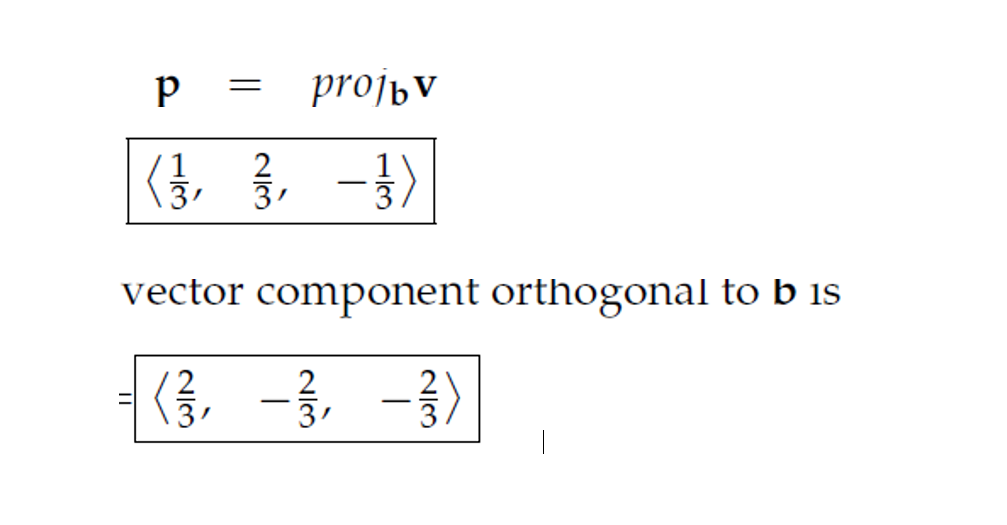
\[\large\rm Proj_\color{blue}{b} \color{red}{v}= \frac{ \color{blue}{b}\cdot \color{red}{v} }{ \left| \color{blue}{b} \right|^2 } \color{blue}{b}\] \[\large\rm Proj_\color{blue}{b} \color{red}{v}= \frac{ \color{blue}{<1,2,-1>}\cdot \color{red}{<1,0,-1>} }{ \left| \color{blue}{<1,2,-1>} \right|^2 } \color{blue}{<1,2,-1>}\] \[=\frac{ 1+0+1 }{ 1^2 +2^2+(-1)^2} \times <1,2,-1>\]\[=\frac{ 2 }{ 6 }<1,2,-1>\]
xXMarcelieXx:
one sec im writing this down lol
xXMarcelieXx:
okay so then
Nnesha:
that's the projection now subtract it from vector v
Nnesha:
\[\frac{1}{3}<1,2,-1>=<\frac{1}{3},\frac{2}{3},-\frac{1}{3}>\]
xXMarcelieXx:
so then i got < 2/3 , -2/3 , -2/3>
Nnesha:
yeah :=))
xXMarcelieXx:
yay :D
xXMarcelieXx:
can you check my work for number 5 , bc her solution says they are parallel , but i think they orthogonal
Nnesha:
can u do 4a ?? parallel one ?
Nnesha:
yeah sure hurry up
xXMarcelieXx:
this is what i did https://docs.google.com/document/d/1Kz1qTwPADPJ5d-75l7Ik0Y7qU_agosgbaqhvTOInGmM/edit
Nnesha:

Nnesha:
if the dot product =0
Join our real-time social learning platform and learn together with your friends!
 VERNEISH:
Two objects are moving along separate linear paths where each path is described by position, d, and time, t.
VERNEISH:
Two objects are moving along separate linear paths where each path is described by position, d, and time, t.

 Maci:
what are the best stock apps for people who want to start investing?
Maci:
what are the best stock apps for people who want to start investing?
 Twaylor:
genuienly how do i get better self control i keep watcing youtube and theres this
Twaylor:
genuienly how do i get better self control i keep watcing youtube and theres this
 IzzyCookie:
|dw:1792074056138:dw| Uhm, I don't know where to ask this, but I'm in college welding at my community college, and I need help learning vertical welding for
IzzyCookie:
|dw:1792074056138:dw| Uhm, I don't know where to ask this, but I'm in college welding at my community college, and I need help learning vertical welding for

 thehearken:
not sure if this is considered spam, im sorry if it is, but does anyone have tips
thehearken:
not sure if this is considered spam, im sorry if it is, but does anyone have tips