
 zarkam21:
Help please
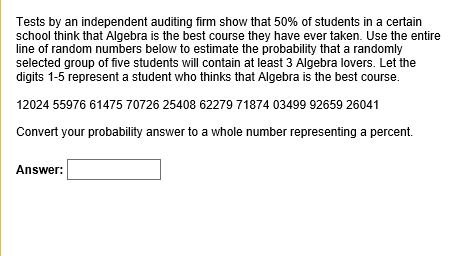
 Vocaloid:
first use the random numbers to generate the first 5 unique digits let me know what you get
zarkam21:
what do you mean can you explain further please :(
Vocaloid:
each digit represents one student read off the first digit then read off the next digit keep going until you have 5 unique digits
zarkam21:
12024
Vocaloid:
the digits must be unique
Vocaloid:
no repeats
zarkam21:
61475
Vocaloid:
no, go back to the begininng
Vocaloid:
12024 discard the second 2 and move to the next digit so you get 12045 make sense?
zarkam21:
Yes A little bit
Vocaloid:
now, starting where the first segment left off, generate 5 new unique digits
zarkam21:
58976?
Vocaloid:
where are you getting 8 from
zarkam21:
didn't you say that you get the number from the next unique
Vocaloid:
next sequentially, not numerically
Vocaloid:
we have 59766 we get rid of the duplicate 6 then we go to the next digit (the next one in the problem) it's a 1 so our next digits are 59761 make sense?
zarkam21:
yes
Vocaloid:
keep going with the next 5 digits
zarkam21:
70526
zarkam21:
62179
zarkam21:
71804
zarkam21:
right?
Vocaloid:
after the 1 the next digit should be a 4
Vocaloid:
47570 remove the duplicate 7's 475 now we use the next 2 available digits
Vocaloid:
72 the 7 is a duplicate from what we had before so we go to the next digit which is a 6
Vocaloid:
so we get 47526
Vocaloid:
this brings us right to the 5th segment (starting with 254) generate the next 5 digits
Vocaloid:
still there?
zarkam21:
Yes I am here trying to understand
zarkam21:
Yes I see
Vocaloid:
I need to start heading home now so let me type out the rest of the instructions
Vocaloid:
once you have finished generating the digits (use up all the available numbers), observe each set of numbers and see how many of the groups have 3 or more digits that are 1-5) and divide that by the total number of groups you obtained
zarkam21:
4 numbers have 3 or more digits that are 1-5
zarkam21:
Is the answer 46%
zarkam21:
@Vocaloid
zarkam21:
@Vocaloid
Vocaloid:
how many total sets of 5 digits did you get
zarkam21:
12024 : 4 - 1224 55976 : 2 - 55 61475 : 3 - 145 70726 : 1 - 2 25408 : 3 - 254 62279 : 2 - 22 71874 : 2 - 14 03499 : 2 - 34 92659 : 2 - 25 26041 : 3 - 241
Vocaloid:
again, for each cluster of digits there should be NO duplicates
zarkam21:
4?
Vocaloid:
re-generate the clusters such that there are NO duplicates in each cluster each set of digits should have 5 unique digits (NO duplicates)
zarkam21:
OKay let me write it all out on scrap paper hold on a sec
Vocaloid:
@sillybilly123 do you know if I'm interpreting this problem correctly? I am treating each digit as 10% of the population (mutually exclusive with each other) so each digit within each of the 5 clusters must be unique
zarkam21:
when you say we use the next two available digits after removing the duplicate, do you mean in the next number or the current number?
Vocaloid:
what do you mean?
Vocaloid:
@sillybilly123 but if we allow duplicates it just ends up being 40% seems closer to what they want
Vocaloid:
|dw:1506526575483:dw|
zarkam21:
and then we would divide right?
Vocaloid:
I end up getting 6/8 (not sure if this is right)
Vocaloid:
I would probably just use your method
zarkam21:
OKay so just to go over this I would start from the beginning and the first number 12024 does have a duplicate. it has 2. So I would emit the second 2 and get 5?
Vocaloid:
right but I don't think my interpretation was correct
Vocaloid:
just use the clusters given in the problem and forget about the duplicate removing
zarkam21:
SO just forget about the removing and focus on the original numbers given
Vocaloid:
right (sorry if that was misleading)
Vocaloid:
I end up getting 4 out of 10 clusters so 40%
zarkam21:
Yeah okay thanks
zarkam21:
No its okay sometimes it is confusing
zarkam21:
I appreciate all your help always
Join our real-time social learning platform and learn together with your friends!
 VERNEISH:
Two objects are moving along separate linear paths where each path is described by position, d, and time, t.
VERNEISH:
Two objects are moving along separate linear paths where each path is described by position, d, and time, t.

 Maci:
what are the best stock apps for people who want to start investing?
Maci:
what are the best stock apps for people who want to start investing?
 Twaylor:
genuienly how do i get better self control i keep watcing youtube and theres this
Twaylor:
genuienly how do i get better self control i keep watcing youtube and theres this
 IzzyCookie:
|dw:1792074056138:dw| Uhm, I don't know where to ask this, but I'm in college welding at my community college, and I need help learning vertical welding for
IzzyCookie:
|dw:1792074056138:dw| Uhm, I don't know where to ask this, but I'm in college welding at my community college, and I need help learning vertical welding for

 thehearken:
not sure if this is considered spam, im sorry if it is, but does anyone have tips
thehearken:
not sure if this is considered spam, im sorry if it is, but does anyone have tips