
 kaylak:
math help
kaylak:
@Vocaloid
 Mehek:
Question?
Mehek:
The ones you selected for 1 are correct I'm not sure if option D is an answer too because \((x^2+x)^2\) = \(x^4+2x^3+x^2\) and the leading is a 4th degree
Mehek:
And for #2 it is option B)
Mehek:
I am not sure about #3 you can ask vocaloid that
kaylak:
@Vocaloid
 Vocaloid:
only look at the graph where x is between -2 and 3 what's the highest value the function obtains?
kaylak:
3?
kaylak:
is mehek correct on the other answers
Vocaloid:
make a tick mark where x = -2 make another tick mark where x = 3 between those two values, what's the highest y-value that the graph touches?
kaylak:
2
kaylak:
is the closest
Vocaloid:
good so 2 is your max I think Mehek is right for the other answers so far
Vocaloid:
kinda stumped on 4 tbh, let me think
kaylak:
i'm getting better at pre cal lol trying to solve some on my own
Vocaloid:
my pre-calc is kind of rusty, but I believe since there are 2 local maxima there are at least 2 "turns" which means a minimum degree of 3 [just considering those roots] then you would consider the complex roots (2+3i and 2 - 3i)
Vocaloid:
Mehek do you remember how do to this? ;_;
Mehek:
I haven't taken this :/ so nope
kaylak:
can y'all check these next few
kaylak:
am i correct and what is 5
Vocaloid:
sorry this is taking so long, but yes, your answers for 6 and 7 are right
Vocaloid:
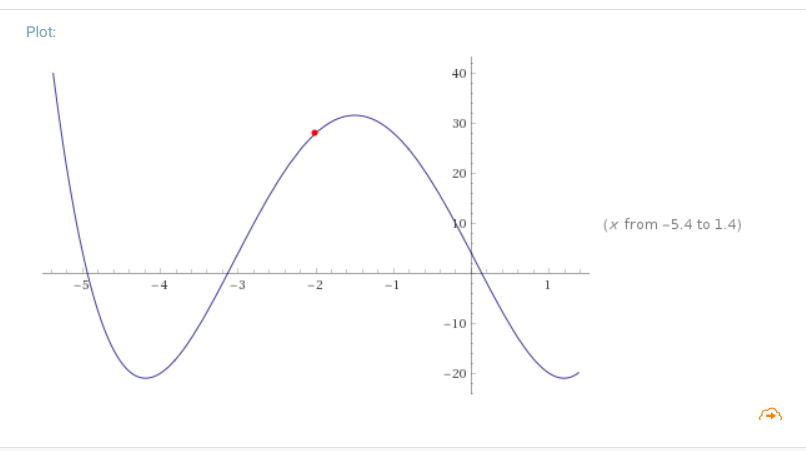
anyway, for the intermediate value theorem, you would evaluate the function the left hand and right hand ends of the interval (for example, evaluate f(-5) and f(-4). now, treat f(-5) to f(-4) as a new interval, and if 0 is within that interval, then the original interval contains a 0
Vocaloid:
I think it's a little easier to explain with math than with English
kaylak:
-3,-2 one?
Vocaloid:
can you show me your work?
Vocaloid:
what did you get for f(-3) and f(-2)?
kaylak:
i'm graphing it honestly
Vocaloid:
you can also do it algebraically
kaylak:
-4,-3 appears to one too
 Vocaloid:
(-3,-2) does not contain a 0 (-4,-3) does
kaylak:
-5,-4 -4,-3 1,2
kaylak:
i'm looking at the graph on mathway probably should try desmos
kaylak:
am i right so far?
Vocaloid:
you're missing [0,1] take a look at the graph I attached
Vocaloid:
other than that I think you're good
Vocaloid:
wolfram alpha is a very powerful mathematical software
kaylak:
i thought it was 0,1
Vocaloid:
I'm talking about the intervals not points
Vocaloid:
[0,1] means the interval x = 0 to x = 1 in between x = 0 and x = 1, there is one zero so [0,1] is an option
Vocaloid:
keep in mind the answer choices are intervals, not points
kaylak:
https://s1.postimg.org/9n9ibnzw9b/Capture.png but 0,1 is still an answer right and check 8 and help with 9?
Vocaloid:
8's good
Vocaloid:
for 9 I am not sure about formatting, but you would just find the possible roots using the p/q formula, and then test each root using synthetic division
Vocaloid:
(the rational root theorem, that is)
kaylak:
how would you do it if there isn't a q for example no x=3
Vocaloid:
hint: what is the coefficient on the highest powered term?
kaylak:
1
kaylak:
so x=1
Vocaloid:
x is not 1, but you would use that 1 to find the possible values of q
Vocaloid:
remember, q is all the possible factors of the coefficient on the highest powered term so what are the factors of 1?
kaylak:
+-2i and -1
Vocaloid:
just consider real numbers for now
Vocaloid:
the only factor of 1 is 1 so your possible values of q are +1 and -1 (or written as +- 1)
Vocaloid:
what about the constant? (4) what are the factors of 4?
kaylak:
2 and -2
Vocaloid:
keep going, you're missing 2 more
kaylak:
2i -2i
Vocaloid:
remember, we are only considering real roots for this (no i)
Vocaloid:
hint: 1 is a factor of every whole number, and if 1 is a factor of 4, what's also a factor of 4?
kaylak:
oh duh i'm going way ahead of myself
kaylak:
1,4
Vocaloid:
good so let's list out all the combinations
Vocaloid:
p = ± 4, ±2, ±1 q = ±1 so every possible combination of p/q can be tested as a root in synthetic division
Vocaloid:
so +4/-2, +1/1, etc.
kaylak:
so i need to divide 4/-2, 1/1 ?
Vocaloid:
yeah, you would divide all the possible combinations of p and q to find possible roots to test
kaylak:
so -2 and 1 ?
Vocaloid:
yes, those were two possible roots I used in the example you would need to divide ALL combinations of p and q to find ALL the roots, though. it's more than just those two
kaylak:
-1/1=-1
Vocaloid:
good keep going, there should be 6 possible roots
kaylak:
4/2=2
Vocaloid:
good
kaylak:
4/1=4 one more right?
Vocaloid:
good
kaylak:
2/1=2?
Vocaloid:
you already said this one ^^"
Vocaloid:
it's -4 to save you some time
kaylak:
oh oops
Vocaloid:
so our roots are +4, -4, +2, -2, +1, -1 so we can pick one root at a time to test -1 is a good choice, so perform synthetic division with x = -1 (or, x + 1 = 0)
kaylak:
ok lol
kaylak:
there shouldn't be a remainder right i get 10
Vocaloid:
that would be for +1 as a root not -1 ^^
Vocaloid:
for x = -1 the number that goes outside the synthetic division symbol is -1 I believe?
Vocaloid:
or is it 1
kaylak:
x=1 i just calculated
Vocaloid:
ah, so x = 1 is not a root try x = -1 as a root
Vocaloid:
awesome! so now we have x^2 +4 do you think x^2 + 4 = 0 has any more roots?
Vocaloid:
that is, does x^2 + 4 = 0 have any real number solutions? (no i)
kaylak:
we said -2
Vocaloid:
hint: does (-2)^2 + 4 = 0?
kaylak:
i just said that lol
Vocaloid:
again, does (-2)^2 + 4 equal 0?
kaylak:
yes
Vocaloid:
hint: (-2)^2 = (-2)*(-2) = ?
kaylak:
-4
Vocaloid:
try one more time
Vocaloid:
negative * negative = positive
kaylak:
4
Vocaloid:
good so (-2)^2+4 = 8, not 0 so -2 is not a root
kaylak:
oh crap duh i'm listening to an ll and doing pre cal
kaylak:
am done now
Vocaloid:
so do you think x^2 + 4 = 0 has any solutions?
Vocaloid:
good, it has no other solutions, so all possible roots have been found, making your problem complete
kaylak:
am almost done yay
kaylak:
10 should be right i need help with 11 mainly
Vocaloid:
I think you could do a piecewise function that excludes x = -2
Vocaloid:
and put (x-3) in the denominator to make that vertical asymptote
kaylak:
so for example i could say 6x^3-2x^2-x-3 for denominator?
Vocaloid:
I guess but you don't need to make it that complex
Vocaloid:
if you just put 1/(x-3) as your function it'll work fine
Vocaloid:
(it's your choice though)
Vocaloid:
anyway, after you have your function, you can write it in piecewise notation { f(x) = ______ from (-infinity,-2) { f(x) = _______ (same function) from (-2,infinity)
kaylak:
oh ok
kaylak:
so pick a function? for the numerator
Vocaloid:
actually come to think of it there's a better way
Vocaloid:
if you put (x+2) in your numerator AND the denominator this should give you a hole at x = -2
kaylak:
so x+2/x+2-x/3?
Vocaloid:
almost
Vocaloid:
(x+2)
(x+2)(x-3) the
is a fraction bar
Vocaloid:
whoops
Vocaloid:
(x+2) fraction bar (x+2)(x-3) should do it
kaylak:
how would i explain how i determined it
Vocaloid:
using the steps I have outlined above
Vocaloid:
\(\color{#0cbb34}{\text{Originally Posted by}}\) @Vocaloid if you put (x+2) in your numerator AND the denominator this should give you a hole at x = -2 \(\color{#0cbb34}{\text{End of Quote}}\)
Vocaloid:
\(\color{#0cbb34}{\text{Originally Posted by}}\) @Vocaloid and put (x-3) in the denominator to make that vertical asymptote \(\color{#0cbb34}{\text{End of Quote}}\)
kaylak:
is 10 right? and 12? i'm about to solve 12
Vocaloid:
yeah I think 10's good
kaylak:
12 is a
kaylak:
1 more after this to check
Vocaloid:
12 is good
kaylak:
13?
Vocaloid:
yes good
Vocaloid:
for 14 find the least common denominator convert both fractions to have the LCD then just add
kaylak:
14 i have to solve
Vocaloid:
hint: to start, try factoring both denominators then the LCD will be a bit more obvious
kaylak:
x x -2 x
Vocaloid:
uh I'm not sure what this means ^^
kaylak:
x x -4 1
Vocaloid:
try using parentheses to be more clear
kaylak:
x^2=(x*x) right
kaylak:
-2x=(-2*x)
Vocaloid:
if you have terms being added and subtracted you cannot factor each term individually, you have to consider the expression as a whole
Vocaloid:
for example, for (x^2-2x) what happens if you factor out x? make sure to keep parentheses in your answer
kaylak:
ypu have (x-2)
kaylak:
?
Vocaloid:
good, so we get (x)(x-2) as the new denominator now try factoring (x^2-4) using difference of squares
kaylak:
x+2 x-2
Vocaloid:
good so let's compare the left denominator and the right denominator left: (x)(x-2) right: (x+2)(x-2) how can we get them both to be the same thing?
kaylak:
x^+2 x-2?
Vocaloid:
uh I'm not sure what you mean by that
kaylak:
x*x=x^2
Vocaloid:
I think you're a little off track ^^ let me help out
Vocaloid:
left: (x)(x-2) right: (x+2)(x-2) if we multiply the "right" by x and the "left" by (x+2) what do we get?
Vocaloid:
*** note: do not distribute any parentheses yet
kaylak:
x^4-2x^3-4x^2+8x
Vocaloid:
please do not distribute any parentheses yet
Vocaloid:
you should have gotten: left: (x)(x-2)(x+2) right: (x+2)(x-2)(x) right?
kaylak:
oh ok so you wanted it exactly literally ok i'm over here trying to combine it
Vocaloid:
yeah, sorry if I wasn't clear ^_^"
kaylak:
piecewise function are not until next unit lol just looked for that other question it's ok
Vocaloid:
anyway, remember that, in order to keep the value of a fraction the same, you would multiply the numerator AND the denominator by the same value
Vocaloid:
so for the left-fraction, multiply the numerator and the denominator by (x+2) and then for the right fraction, multiply the numerator and the denominator by x
Vocaloid:
if you do your math correctly you should have two fractions with the same denominator then you can just add the numerators and put that over the new denominator if that makes sense
Vocaloid:
like: (A/C) + (B/C) = (A+B)/C
kaylak:
so multiply with the x(x-2)(x+2) we have?
Vocaloid:
let me rephrase this ^^
kaylak:
or by the orginal equation
Vocaloid:
your original problem is (x-4)/(x^2-2x) + (4/(x^2 - 4)) apply the multiplications to this ^
Vocaloid:
(you can use the factored form if that's easier)
kaylak:
x-4*(x+2)=-3x+2 x^2-2x*x+2=-x^2+2 4*x=4x x^2-4*x=x^2-4x
Vocaloid:
check your math again
Vocaloid:
your denominators should be equal
Vocaloid:
use the factored form if that's simpler
Vocaloid:
(x-4)/ [x(x-2)] + (4/[x+2][x-2]) ^ apply the multiplications to this
Vocaloid:
you should get x(x-2)(x+2) as your denominator
kaylak:
x+2/x^2+2? answer
kaylak:
mathway says the numerator is x+4?
Vocaloid:
try leaving things in factored form instead of expanding things out
Vocaloid:
at the very end, you can do the expansions
Vocaloid:
I wouldn't trust mathway, their software isn't good for calculations
Vocaloid:
also can we open a new question? this one is lagging a lot
Vocaloid:
I can transfer my work over
kaylak:
so x+2 for numerator is correct and sure
Vocaloid:
I don't think x + 2 is the correct numerator
kaylak:
im confused
Join our real-time social learning platform and learn together with your friends!
 DoltonCarlee:
what are y'all's options on S A T essays because honestly their not that bad
DoltonCarlee:
what are y'all's options on S A T essays because honestly their not that bad

 thereneelg:
Can someone give me a summary of article 231, The war guilt clause?? I need to explain what it is, but I can't find any shortened version of what it is and
thereneelg:
Can someone give me a summary of article 231, The war guilt clause?? I need to explain what it is, but I can't find any shortened version of what it is and
 luisaam2:
What should you do when the person you want to talk to the most is the one making
luisaam2:
What should you do when the person you want to talk to the most is the one making
 Breathless:
https://medal.tv/games/roblox/clips/nAYivIl6oXB6q9QAI?invite=cr-MSxCSk4sMTY4OTA4N
Breathless:
https://medal.tv/games/roblox/clips/nAYivIl6oXB6q9QAI?invite=cr-MSxCSk4sMTY4OTA4N
 Twaylor:
I'm not that good at law can someone fact check this without bias? June 29, 2026, the Supreme Court decided Chatrie v.
Twaylor:
I'm not that good at law can someone fact check this without bias? June 29, 2026, the Supreme Court decided Chatrie v.
 Demon25:
For a hoco proposal with a cheerleader and football player, what else should be a
Demon25:
For a hoco proposal with a cheerleader and football player, what else should be a
