
 Roses:
help me please.
 Roses:
@Vocaloid
Roses:
@JustSaiyan
Roses:
@Falconmaster
 Falconmaster:
@Ultrilliam sorry I cant help
Roses:
it's fine
 563blackghost:
What two angles are equal to each other?
Roses:
umm idk
Roses:
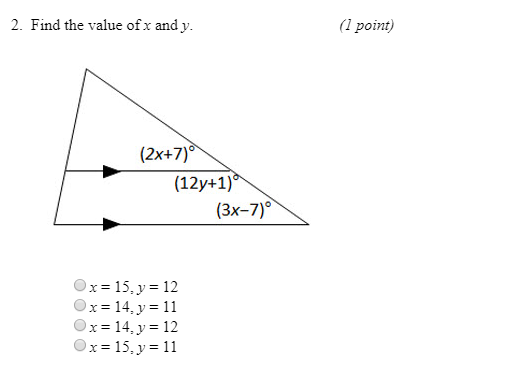
is it 3x-7 and 2x+7
563blackghost:
Well let's look at the triangle. We can assume that the lines (that have arrows) are parallel to each other, meaning that the diagonal line that meet the parallel lines creates 3 angles, two being equal. |dw:1509392421246:dw|
563blackghost:
Yes that is correct.
Roses:
okay
563blackghost:
So we would set it up as this... \(\bf\large{2x+7=3x-7}\) Can you simplify this?
Roses:
hold on
Roses:
5x=7?
563blackghost:
Not quite. |dw:1509392735824:dw|
Roses:
oh
563blackghost:
If you can't see it try disabling the halloween theme...
Roses:
so would it be 14x=11y
563blackghost:
Well let's not jump to answer just yet, since we found x now we can try and find y. We see that \(\bf{2x+7}\) and \(\bf{12y+1}\) lie on a straight line, meaning that they are a linear pair (equal to 180 degrees). So we can find y. We know \(\bf{x=14}\) so we plug this into \(\bf{2x+7}\). \(\bf\large{(2(14)+7)+(12y+1)=180}\) Simplify.
Roses:
i'm so stuck right now
563blackghost:
With what? How we got to this equation or the equation itself?
Roses:
the equation itself
563blackghost:
Ah. Well let's work out the first part. We follow by PEMDAS. So we first work with the paranthesis (we see we have two) so we work with the one with paranthesis inside being \(\bf{(2(14)+7)}\). |dw:1509393451334:dw| So we get \(\bf\large{35+12y+1=180}\) Now combine like terms. \(\large\bf{12y+36=180}\) Can you do from here?
Roses:
48y=180?
563blackghost:
You need to subtract 36 from both sides. \(\large\bf{12y=144}\) Now divide by 12 from both sides. \(\large\bf{y=\frac{144}{12}}\)
Roses:
so it is 12y
Roses:
so the answer is c
Roses:
is that the correct answer?
563blackghost:
Yea it is C.
Roses:
thank you
563blackghost:
np :) though when saying a variable is equal to a number don't put it as \(\bf{12y}\) but as \(\bf{12=y}\), cause that will get your answer wrong.
Roses:
oh okay thank you
563blackghost:
you welcome :)
Join our real-time social learning platform and learn together with your friends!
 VERNEISH:
Two objects are moving along separate linear paths where each path is described by position, d, and time, t.
VERNEISH:
Two objects are moving along separate linear paths where each path is described by position, d, and time, t.

 Maci:
what are the best stock apps for people who want to start investing?
Maci:
what are the best stock apps for people who want to start investing?
 Twaylor:
genuienly how do i get better self control i keep watcing youtube and theres this
Twaylor:
genuienly how do i get better self control i keep watcing youtube and theres this
 IzzyCookie:
|dw:1792074056138:dw| Uhm, I don't know where to ask this, but I'm in college welding at my community college, and I need help learning vertical welding for
IzzyCookie:
|dw:1792074056138:dw| Uhm, I don't know where to ask this, but I'm in college welding at my community college, and I need help learning vertical welding for

 thehearken:
not sure if this is considered spam, im sorry if it is, but does anyone have tips
thehearken:
not sure if this is considered spam, im sorry if it is, but does anyone have tips