
 kaylak:
math help
kaylak:
@Vocaloid
 kaylak:
help?
kaylak:
you there
 Vocaloid:
I'm going through the calculations
Vocaloid:
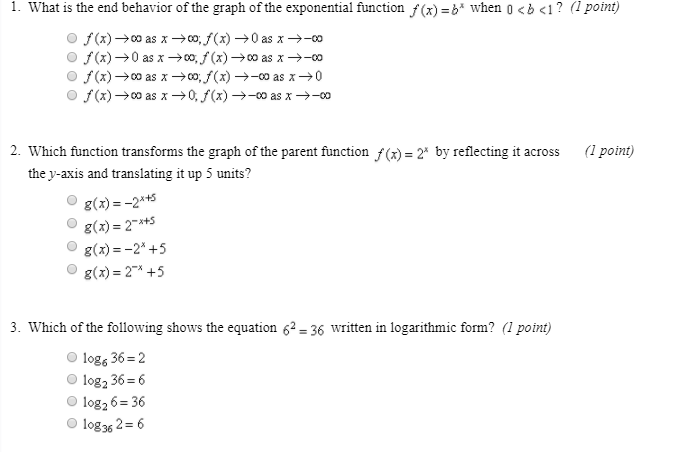
for the first problem pick a value of b (let's just say b = 0.5) and see what happens when x becomes very large or very negative
Vocaloid:
for example, if we have something like y = (0.5)^(-1000) what kind of number do we get? is it close to 0? infinity? negative infinity?
kaylak:
its 1.071 etc
kaylak:
so 0
Vocaloid:
don't forget the exponent
Vocaloid:
it ends up being 10^(31) so this is a very very large positive number which means it approaches + infinity as x ---> -infinity
Vocaloid:
now try seeing what happens if you calculate x to be a very large positive number say, y = (0.5)^(1000)?
kaylak:
i know 3 is a
kaylak:
the opposite
Vocaloid:
what does the function approach when x is very large?
kaylak:
-infinity? as x infinity
Vocaloid:
try calculating (0.5)^(100) and let me know what you get
kaylak:
i got 9.332 etc
Vocaloid:
make sure you are including the exponential part too
Vocaloid:
what does the exponent look like?
kaylak:
9.332636e
Vocaloid:
what is the part after the e?
kaylak:
-302
Vocaloid:
good, so if the exponent is very very negative that means this term is close to 0
Vocaloid:
so end behavior: x --> -infinity, function --> infinity x ---> infinity, function --> 0 pick the answer choice that matches
kaylak:
b?
Vocaloid:
awesome, good
Vocaloid:
so for the second problem, a reflection over y puts a negative sign right in front of x
kaylak:
is 2 d
Vocaloid:
awesome good
Vocaloid:
and 3 was a) like you said
kaylak:
4
kaylak:
use exponential form to evaluate logsub poenent 8 2
Vocaloid:
\[\log_{8} 2 \]
Vocaloid:
this?
kaylak:
yes
Vocaloid:
|dw:1509472605005:dw|
Vocaloid:
so 2 is your y-value and 8 is your b value
Vocaloid:
2 = 8^x solve for x
kaylak:
1/3
Vocaloid:
good
 Vocaloid:
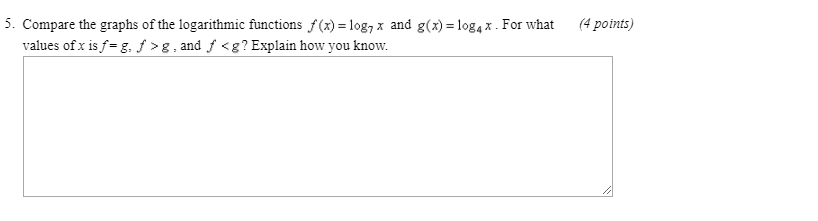
oh lordy I would honestly just graph these and compare the graphs
kaylak:
oh lord
 Vocaloid:
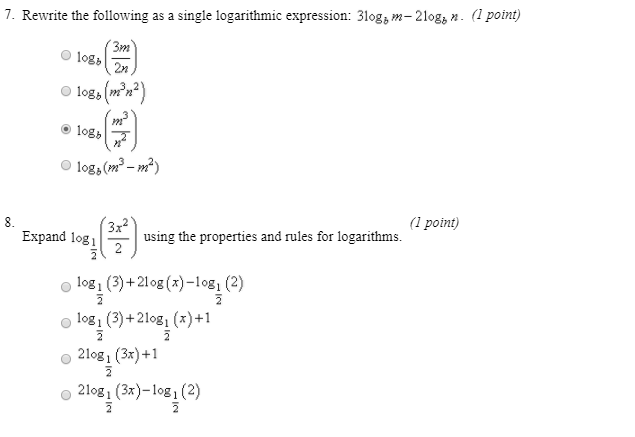
7 is good
Vocaloid:
so for 8 you want to split the quotient into a difference (basically the opposite of what you did for 7)
Vocaloid:
and then you can move the 2 on the x^2 to the front of the log let me know what you get
kaylak:
b the answer?
kaylak:
I remember studying this over the summer
kaylak:
b correct?
Vocaloid:
I think that's right yeah
 kaylak:
@Vocaloid
kaylak:
@Vocaloid
Vocaloid:
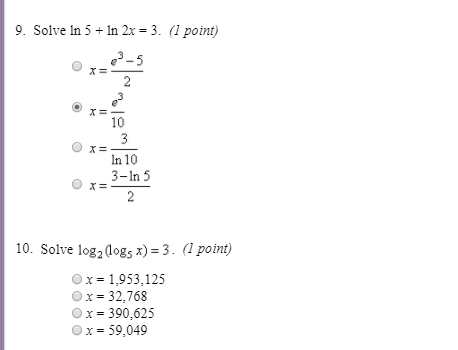
9 is right
Vocaloid:
still working on 10
Vocaloid:
for 10, first re-write both sides in base 2 to eliminate the log(2)
Vocaloid:
and then write both sides in base 5 to eliminate log_5
kaylak:
so c ?
kaylak:
?????
Vocaloid:
nvm c is right
kaylak:
it is yay
Join our real-time social learning platform and learn together with your friends!
VERNEISH:
Two objects are moving along separate linear paths where each path is described by position, d, and time, t.

 Maci:
what are the best stock apps for people who want to start investing?
Maci:
what are the best stock apps for people who want to start investing?
 Twaylor:
genuienly how do i get better self control i keep watcing youtube and theres this
Twaylor:
genuienly how do i get better self control i keep watcing youtube and theres this
 IzzyCookie:
|dw:1792074056138:dw| Uhm, I don't know where to ask this, but I'm in college welding at my community college, and I need help learning vertical welding for
IzzyCookie:
|dw:1792074056138:dw| Uhm, I don't know where to ask this, but I'm in college welding at my community college, and I need help learning vertical welding for

 thehearken:
not sure if this is considered spam, im sorry if it is, but does anyone have tips
thehearken:
not sure if this is considered spam, im sorry if it is, but does anyone have tips