
 kaylak:
help
kaylak:
@Vocaloid
 kaylak:
@Vocaloid
 Vocaloid:
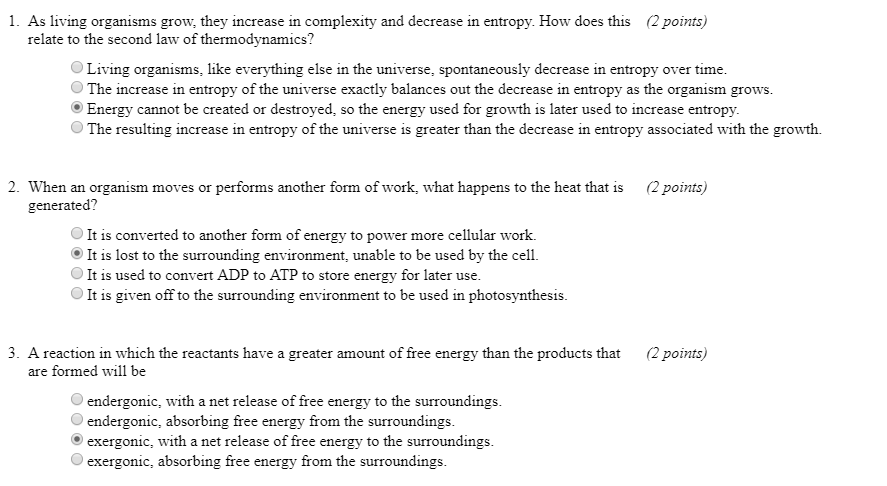
check #1 again energy cannot be created or destroyed would be the first law not the second
Vocaloid:
note: the net entropy of the universe must increase so what must be true about the organisms' entropy?
kaylak:
d?
Vocaloid:
good #2+3 look good to me
 Vocaloid:
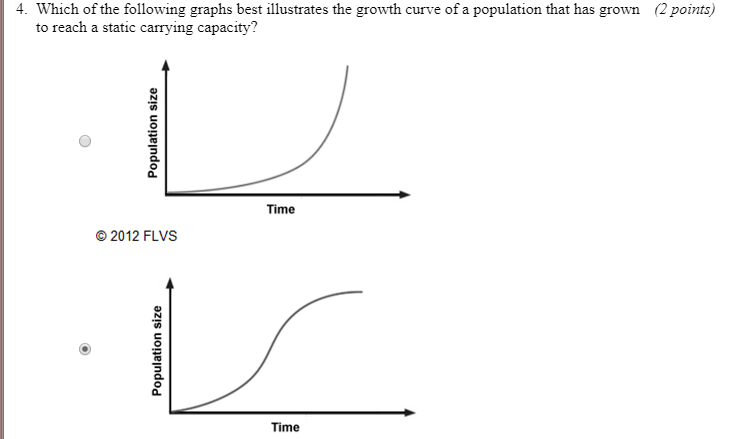
good
kaylak:
yay
 Vocaloid:
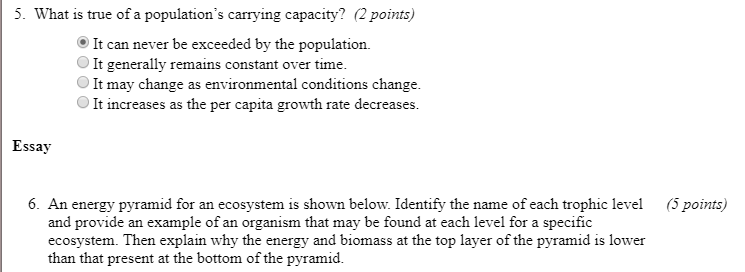
actually, that's not true, remember that carrying capacity is a theoretical number set by humans, there's nothing stopping nature from temporary exceeding capacity temporarily
Vocaloid:
hint: carrying capacity can change
kaylak:
so c
Vocaloid:
good, c
kaylak:
6 is because of 10% of oxygen decreasig as layerrs go up
Vocaloid:
hm, I think you have the right idea but I don't think it's oxygen that decreases by 10%, it's available energy that is only 10% of the previous trophich level
Vocaloid:
|dw:1509912481759:dw|
kaylak:
so from 90% it decreases 10% of energy from what is consumes or producers get from sun
Vocaloid:
yeah, you have the right idea
Vocaloid:
I think we typically treat the bottom level as 100% though
kaylak:
ok and i need an example animal like producer is a plant
Vocaloid:
pick a specific ecosystem, like a forest, and start with an organism like a tree producing seeds/nuts think about what animals eat nuts and think about what sort of animals eat those animals
kaylak:
ok so forest
kaylak:
so squirrel is primary consumer
Vocaloid:
good, keep going
kaylak:
a bear eats a squirrel?
Vocaloid:
that's a good example, but since bears are tertiary consumers (at the top) it might be best to pick another one for secondary consumer
Vocaloid:
ex. snakes eat squirrels so snakes are secondary consumers what animals eat snakes?
kaylak:
wolf
Vocaloid:
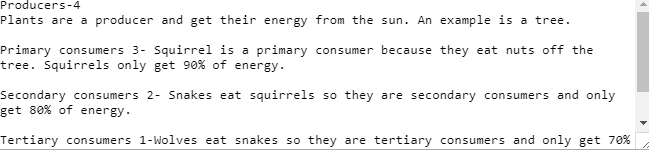
good so wolf (tertiary) --> snake (secondary) --> squirrel (primary) --> tree (nuts, producer)
 Vocaloid:
your calculations are incorrect
Vocaloid:
treat the tree as 100% squirrel gets 10% of the tree snakes get 10% of the squirrel's energy (10% of 10%) wolf gets 10% of snake's energy (10% of 10% of 10%)
kaylak:
so 100 90 9 .09 ?
Vocaloid:
10% of 100% is not 90
kaylak:
10 1 .01
Vocaloid:
good
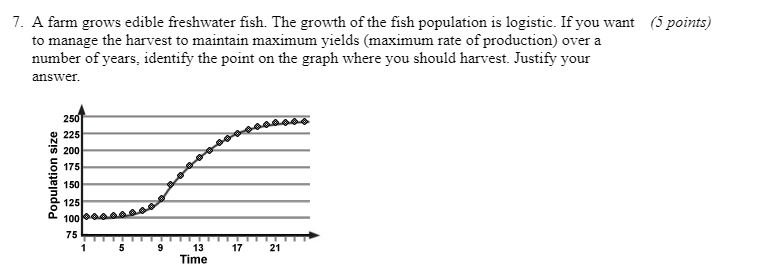 Vocaloid:
I'm not 100% sure but I would guess near carrying capacity
Vocaloid:
harvesting too early would halt growth and waiting until carrying capacity is reached would be detrimental to the population (overcrowding)
kaylak:
point 10 maybe
Vocaloid:
what do you mean?
kaylak:
you hvae to identify a point and justify
Vocaloid:
right, and I said pick a time near the carrying capacity
Vocaloid:
t = 10 is not near the carrying capacity
kaylak:
13
Vocaloid:
good, t = 13 seems to have the greatest slope
Vocaloid:
[still not 100% sure on this one though]
kaylak:
so how should i explain this
Vocaloid:
at t = 13 the growth rate is the largest so it would be beneficial to keep the population around that size
kaylak:
why not higher or lower just trying to completely explain my teacher is picky
Vocaloid:
come to think of it the slope is actually highest at t = 10 not 13 whoops
Vocaloid:
anyway, since we are asking for maximum production rate, we want the point where the slope of the graph is the highest
kaylak:
i was right lol
Vocaloid:
when t < 10 or t > 10 the slope starts to decrease which is why I would pick 10
kaylak:
that's all lol
Join our real-time social learning platform and learn together with your friends!
 DoltonCarlee:
what are y'all's options on S A T essays because honestly their not that bad
DoltonCarlee:
what are y'all's options on S A T essays because honestly their not that bad

 thereneelg:
Can someone give me a summary of article 231, The war guilt clause?? I need to explain what it is, but I can't find any shortened version of what it is and
thereneelg:
Can someone give me a summary of article 231, The war guilt clause?? I need to explain what it is, but I can't find any shortened version of what it is and
 luisaam2:
What should you do when the person you want to talk to the most is the one making
luisaam2:
What should you do when the person you want to talk to the most is the one making
 Breathless:
https://medal.tv/games/roblox/clips/nAYivIl6oXB6q9QAI?invite=cr-MSxCSk4sMTY4OTA4N
Breathless:
https://medal.tv/games/roblox/clips/nAYivIl6oXB6q9QAI?invite=cr-MSxCSk4sMTY4OTA4N
 Twaylor:
I'm not that good at law can someone fact check this without bias? June 29, 2026, the Supreme Court decided Chatrie v.
Twaylor:
I'm not that good at law can someone fact check this without bias? June 29, 2026, the Supreme Court decided Chatrie v.
 Demon25:
For a hoco proposal with a cheerleader and football player, what else should be a
Demon25:
For a hoco proposal with a cheerleader and football player, what else should be a
