
 kaylak:
help
kaylak:
@Vocaloid
kaylak:
@Ultrilliam
 Vocaloid:
@hero @angle I've been having really bad migraines today can you assist with some math?
 kaylak:
help
 Angle:
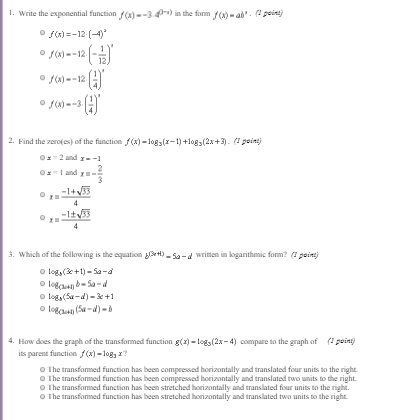
@kaylak the picture is really blurry for me (or maybe I need new glasses) could you upload a clearer one? ... or post one question at a time?
kaylak:
sure
 Angle:
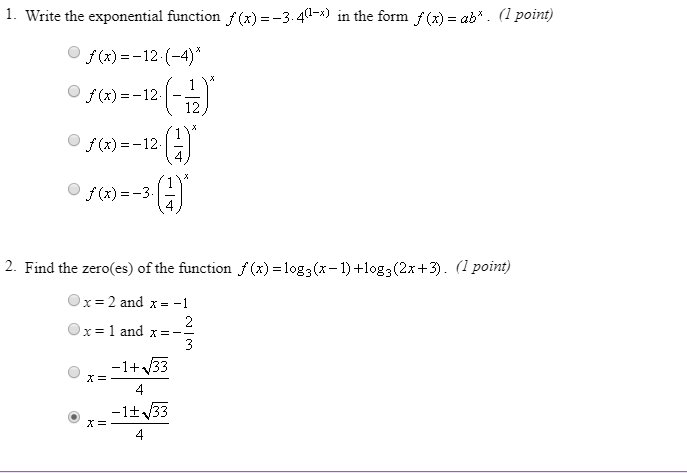
ooo much better now... Have you seen this exponent rule before? \[\huge a^{b - c} = \frac{a^b}{a^c}\]
kaylak:
no lol
kaylak:
typing a lot lol
Angle:
ok, for example \(\huge \frac{2^6}{2^2} = \frac{2*2*2*2*2*2}{2*2}\) \(\large = 2*2*2*2 = 2^4\) yes?
kaylak:
yes
Angle:
which means that \(\huge \frac{2^6}{2^2} \large = 2^{6-2} = 2^4\) which is basically the rule I stated above does that make sense?
kaylak:
yes
kaylak:
d then?
Angle:
so \(\large a^{b-c} = \huge \frac{a^b}{a^c}\)
kaylak:
if -3 stays -3 and 4^(1-x) turns into 1/4^x
kaylak:
right
kaylak:
?
Angle:
That's the think I was trying to say by starting with stating that rule I was talking about... \(\large 4^{1-x} = \huge \frac{4^1}{4^x}\)
kaylak:
so is d the answer
Angle:
no because 4^(1-x) is *not* 1/(4^x)
kaylak:
oh ok it's a then so you have to multiply 3*4
kaylak:
oh ok it's a then so you have to multiply 3*4
Angle:
yup!
kaylak:
is 2 correct
kaylak:
2 being d
kaylak:
?
kaylak:
\(\color{#0cbb34}{\text{Originally Posted by}}\) @kaylak \(\color{#0cbb34}{\text{End of Quote}}\)
kaylak:
can't quote a file
Angle:
hmmm that's not what I got... you basically want to solve for (x -1)(2x + 3) = 1
kaylak:
that's what mathway got?
Angle:
nope... wolframalpha... but the idea is that for logs of the same base: \(\large ~log_a x\ + log_a y = log_a (x*y) \) which is how you end up with trying to solve for (x - 1)(2x + 3) = 1
Angle:
ohhh wait you did get the right idea BUT you cannot have the log(negative number)
kaylak:
so c then?
Angle:
yeah ^_^
kaylak:
lol next 2
Angle:
I need to go to class now feel free to ask your next two questions as a new post for someone else to help you ^_^
Join our real-time social learning platform and learn together with your friends!
VERNEISH:
Two objects are moving along separate linear paths where each path is described by position, d, and time, t.

 Maci:
what are the best stock apps for people who want to start investing?
Maci:
what are the best stock apps for people who want to start investing?
 Twaylor:
genuienly how do i get better self control i keep watcing youtube and theres this
Twaylor:
genuienly how do i get better self control i keep watcing youtube and theres this
 IzzyCookie:
|dw:1792074056138:dw| Uhm, I don't know where to ask this, but I'm in college welding at my community college, and I need help learning vertical welding for
IzzyCookie:
|dw:1792074056138:dw| Uhm, I don't know where to ask this, but I'm in college welding at my community college, and I need help learning vertical welding for

 thehearken:
not sure if this is considered spam, im sorry if it is, but does anyone have tips
thehearken:
not sure if this is considered spam, im sorry if it is, but does anyone have tips