
 zarkam21:
Help
 Vocaloid:
oh wait
Vocaloid:
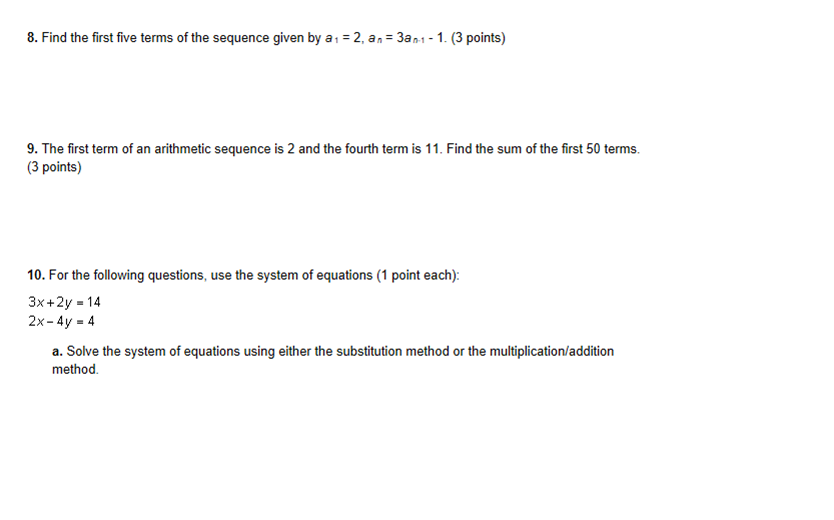
it's recursive, so you would start with a1 = 2 then apply the rule, which tells you to multiply the term by 3 and subtract 1 to get the next term
Vocaloid:
then take the result from that operation and then find the next term using the same rule
Vocaloid:
recursive formulas stink but thankfully we don't use these very often
zarkam21:
a1=2 a2=5 a3=14 a4=41 a5=122
Vocaloid:
good
Vocaloid:
so for 9 you want to write an arithmetic equation to solve for d
Vocaloid:
an = a1 + (n-1)d an = 11 a1 = 2 n = 4 solve for d
zarkam21:
d=3
Vocaloid:
awesome, now we use the sum formula
zarkam21:
okay
Vocaloid:
|dw:1510377993846:dw|
Vocaloid:
since we want n = 50 we will need to find a50 first
Vocaloid:
use this: an = a1 + (n-1)d to find an when n = 50, keeping the same a1 and d value as before
zarkam21:
149/50
Vocaloid:
a50 = 2 + (50-1)3 = ?
zarkam21:
297
Vocaloid:
ah think I see what the misunderstanding is the 50 in a50 is not treated like a number, it's just a label
zarkam21:
149
Vocaloid:
good, 149
Vocaloid:
now we go back to our sum formula
Vocaloid:
|dw:1510378518379:dw|
Vocaloid:
then find sn using these values
zarkam21:
3775
Vocaloid:
awesome, that's the final answer
Vocaloid:
for 10, this is what we are given: 3x + 2y = 14 2x - 4y = 4 start by doubling the first eqution
zarkam21:
okay
Vocaloid:
then, you should be able to eliminate y by adding the equations together
zarkam21:
wait by doubling do you mean 6x+4y=28
Vocaloid:
yes
Vocaloid:
since there's +4y on the top and -4y on the bottom these cancel when you add the equations
zarkam21:
12x=112
Vocaloid:
6x+4y=28 2x - 4y = 4 start by adding the x terms. 6x + 2x = ?
zarkam21:
oh we are adding I thought we were multiplying
zarkam21:
x=4
Vocaloid:
as a general rule you can multiply equations by a constant, but not multiply the equations together
Vocaloid:
yes, x = 4
Vocaloid:
now solve for y 2x - 4y = 4 when x = 4
zarkam21:
y=1
Vocaloid:
good so (4,1) = your ans
Join our real-time social learning platform and learn together with your friends!
 DoltonCarlee:
what are y'all's options on S A T essays because honestly their not that bad
DoltonCarlee:
what are y'all's options on S A T essays because honestly their not that bad

 thereneelg:
Can someone give me a summary of article 231, The war guilt clause?? I need to explain what it is, but I can't find any shortened version of what it is and
thereneelg:
Can someone give me a summary of article 231, The war guilt clause?? I need to explain what it is, but I can't find any shortened version of what it is and
 luisaam2:
What should you do when the person you want to talk to the most is the one making
luisaam2:
What should you do when the person you want to talk to the most is the one making
 Breathless:
https://medal.tv/games/roblox/clips/nAYivIl6oXB6q9QAI?invite=cr-MSxCSk4sMTY4OTA4N
Breathless:
https://medal.tv/games/roblox/clips/nAYivIl6oXB6q9QAI?invite=cr-MSxCSk4sMTY4OTA4N
 Twaylor:
I'm not that good at law can someone fact check this without bias? June 29, 2026, the Supreme Court decided Chatrie v.
Twaylor:
I'm not that good at law can someone fact check this without bias? June 29, 2026, the Supreme Court decided Chatrie v.
 Demon25:
For a hoco proposal with a cheerleader and football player, what else should be a
Demon25:
For a hoco proposal with a cheerleader and football player, what else should be a
