
 zarkam21:
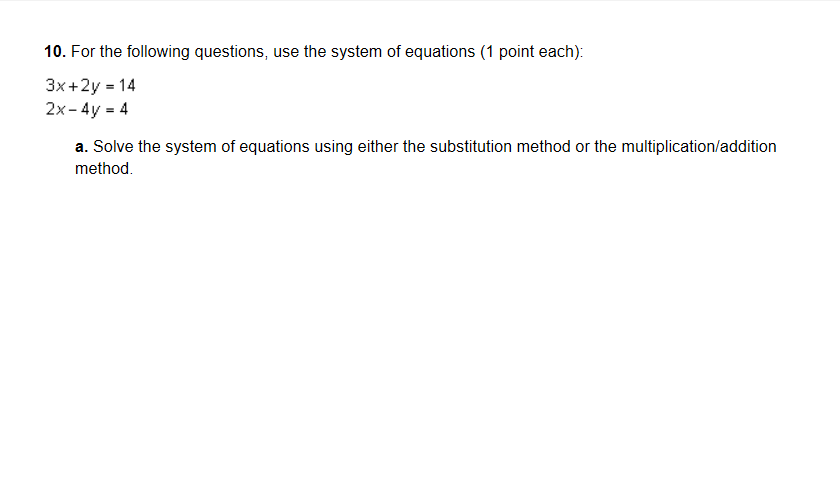
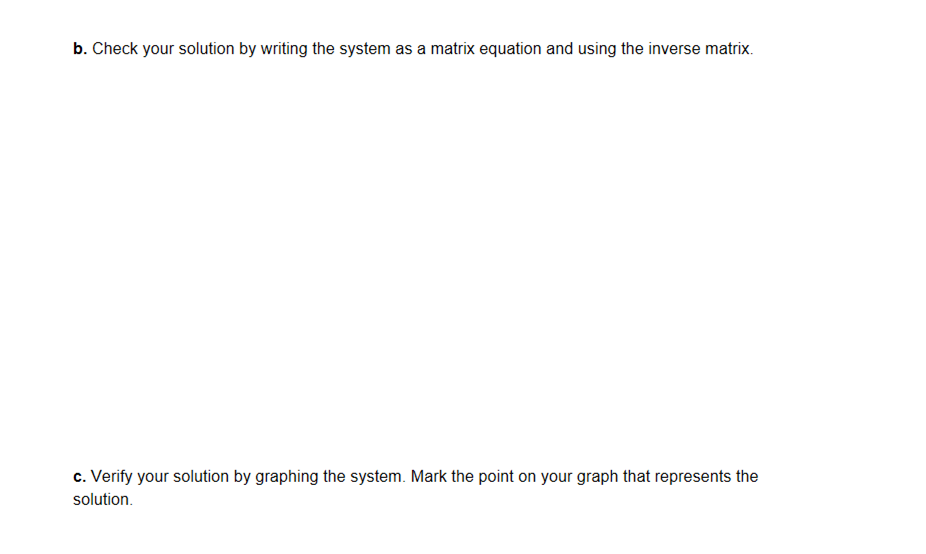
OKay so already solved for a with @vocaloid now for part b and c
zarkam21:
@Vocaloid
 Vocaloid:
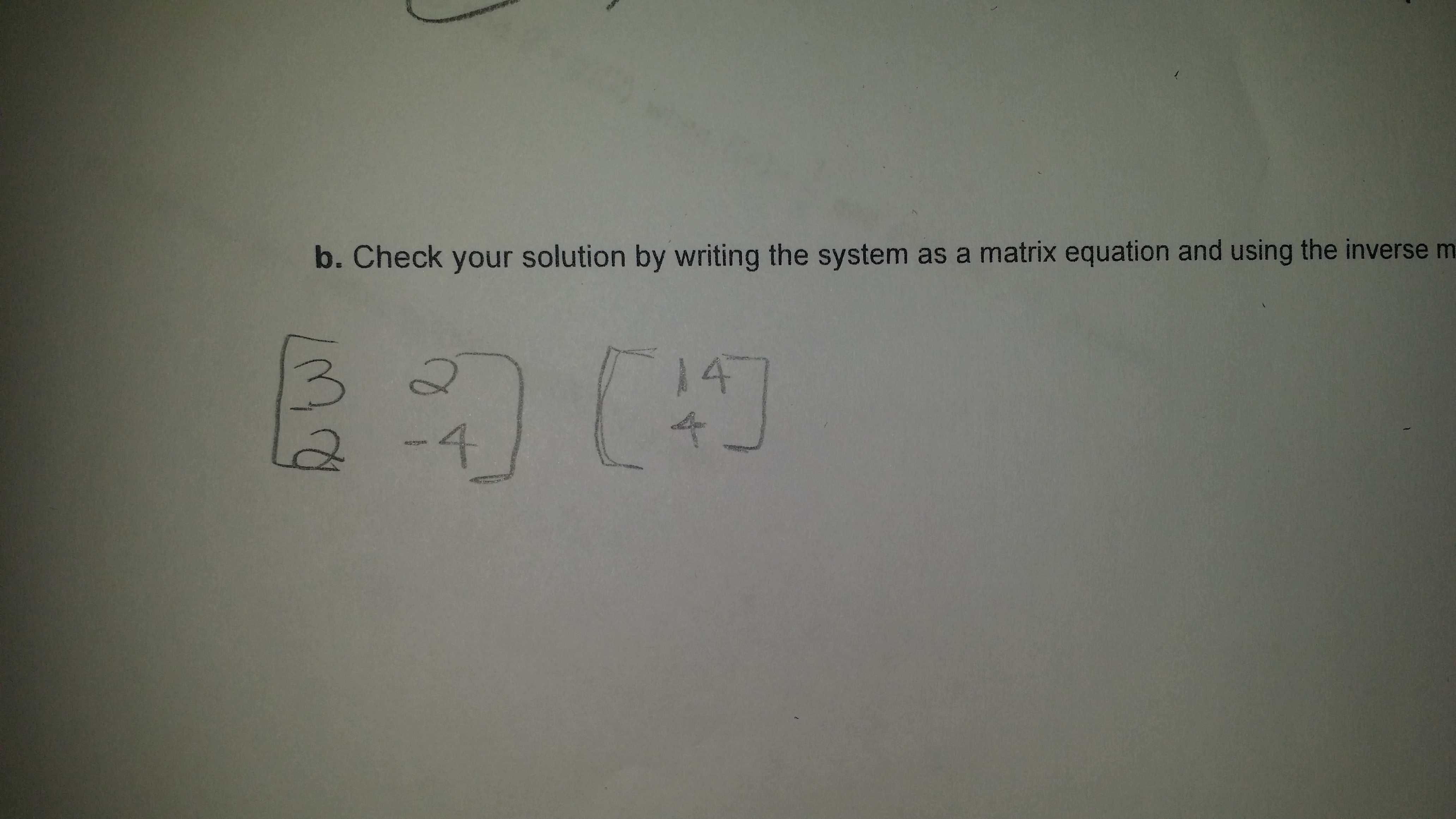
first we take the coefficients and put them into a matrix
Vocaloid:
|dw:1510525940717:dw|
Vocaloid:
|dw:1510525947639:dw|
Vocaloid:
make sure to keep all signs (+ or -)
Vocaloid:
\[\left[\begin{matrix}3 & 2 \\ 2 & -4\end{matrix}\right]\]
Vocaloid:
\[\left(\begin{matrix}x \\ y\end{matrix}\right)\]
zarkam21:
okay so would that be 14,4
Vocaloid:
good, so \[\left(\begin{matrix}14 \\ ?\end{matrix}\right)\]
zarkam21:
4
Vocaloid:
should be 14,4
Vocaloid:
good, so now we write these in order
Vocaloid:
|dw:1510526371314:dw|
 Vocaloid:
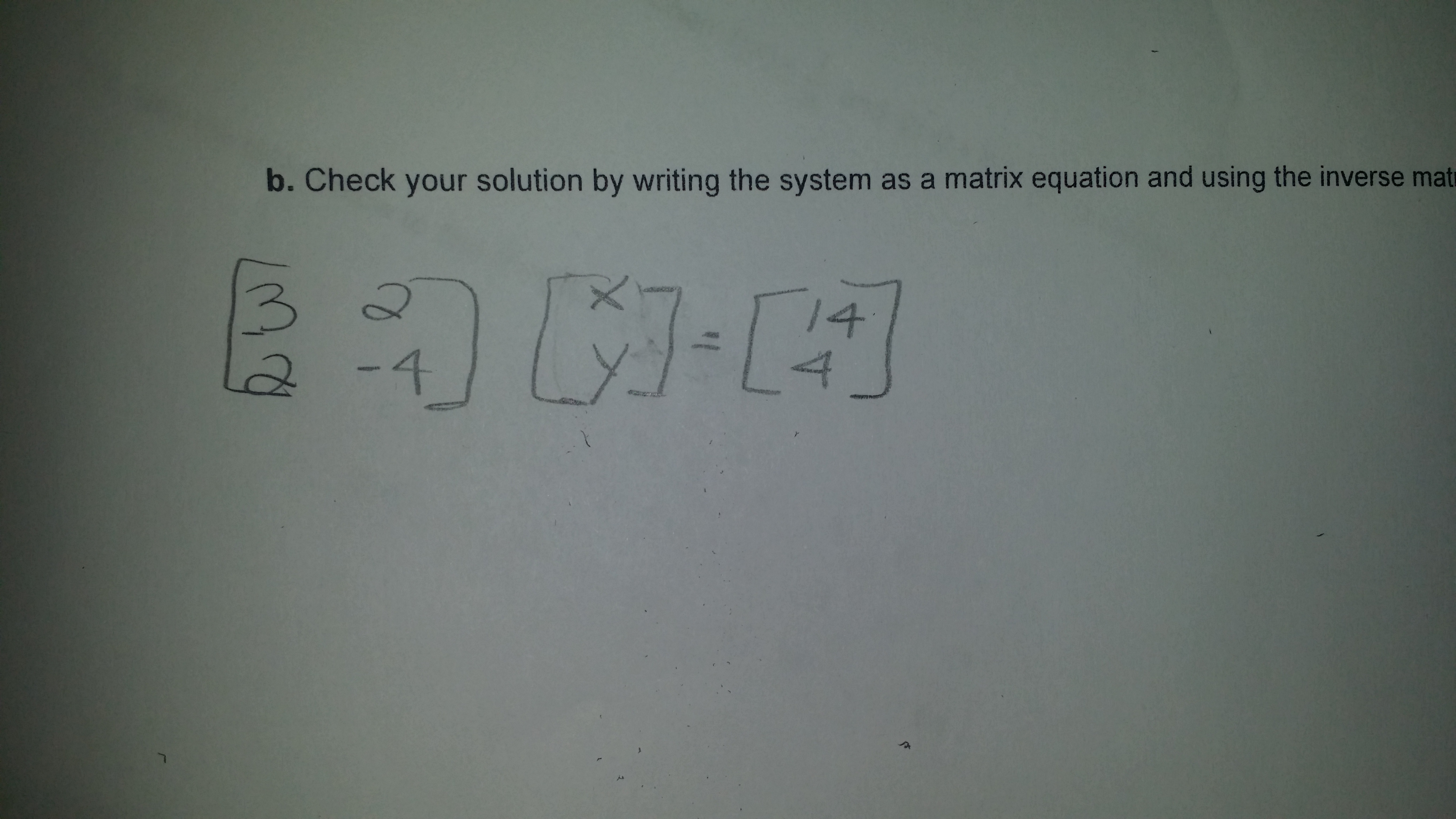
now, in order to isolate the x,y matrix we multiply both sides by the inverse of the coefficient matrix
Vocaloid:
need to have the x, y, matrix too
Vocaloid:
^it should look like what I drew up there
 Vocaloid:
good, now we find the inverse of the coefficient matrix (the 3,2,2,-4)
zarkam21:
okay
Vocaloid:
|dw:1510526537348:dw|
zarkam21:
so we subtract 1 from each value
Vocaloid:
\(\color{#0cbb34}{\text{Originally Posted by}}\) @Vocaloid \[\left[\begin{matrix}3 & 2 \\ 2 & -4\end{matrix}\right]\] \(\color{#0cbb34}{\text{End of Quote}}\) apply this logic to this matrix to find the determinant
zarkam21:
2,1,1,-5
Vocaloid:
a = 3, b = 2, c = 2, d = -4
Vocaloid:
the -1 in the top right corner does not mean -1, this is the notation that means inverse
zarkam21:
-16
Vocaloid:
good, the determinant is 16, now we find this part:
Vocaloid:
|dw:1510526677187:dw|
Vocaloid:
switch the a and d values then multiply the c and b values by -1 to find this new matrix
zarkam21:
a = -4, b = 2, c = 2, d = 3
zarkam21:
like that right?
zarkam21:
I switched the values and now I apply the formula
zarkam21:
?
Vocaloid:
almost, we also need to multiply b and c by -1
zarkam21:
-6
Vocaloid:
\[\left[\begin{matrix}-4 & -2 \\ -2 & 3\end{matrix}\right]\]
zarkam21:
6
Vocaloid:
our work so far should be a 2x2 matrix
Vocaloid:
so now we apply the inverse formula by taking this new matrix and multiplying it by 1/the determinant which is 1/(-16)
Vocaloid:
\(\color{#0cbb34}{\text{Originally Posted by}}\) @Vocaloid \[\frac{ 1 }{ -16 }\[\left[\begin{matrix}-4 & -2 \\ -2 & 3\end{matrix}\right]\]\] \(\color{#0cbb34}{\text{End of Quote}}\)
Vocaloid:
then we left-multiply this matrix * each side of the original equation
Vocaloid:
|dw:1510527100023:dw|
Vocaloid:
the left side cancels out (thankfully)
Vocaloid:
|dw:1510527170983:dw|
Vocaloid:
|dw:1510527183968:dw|
Vocaloid:
when you multiply the black parts out you should get x = 4 and y = 1 which agrees with the solution we obtained by solving the system
Vocaloid:
[make sure you are applying the matrix multiplication method not just multiplying across the rows]
zarkam21:
Yes I applied that and it checked to be the correct answer
Vocaloid:
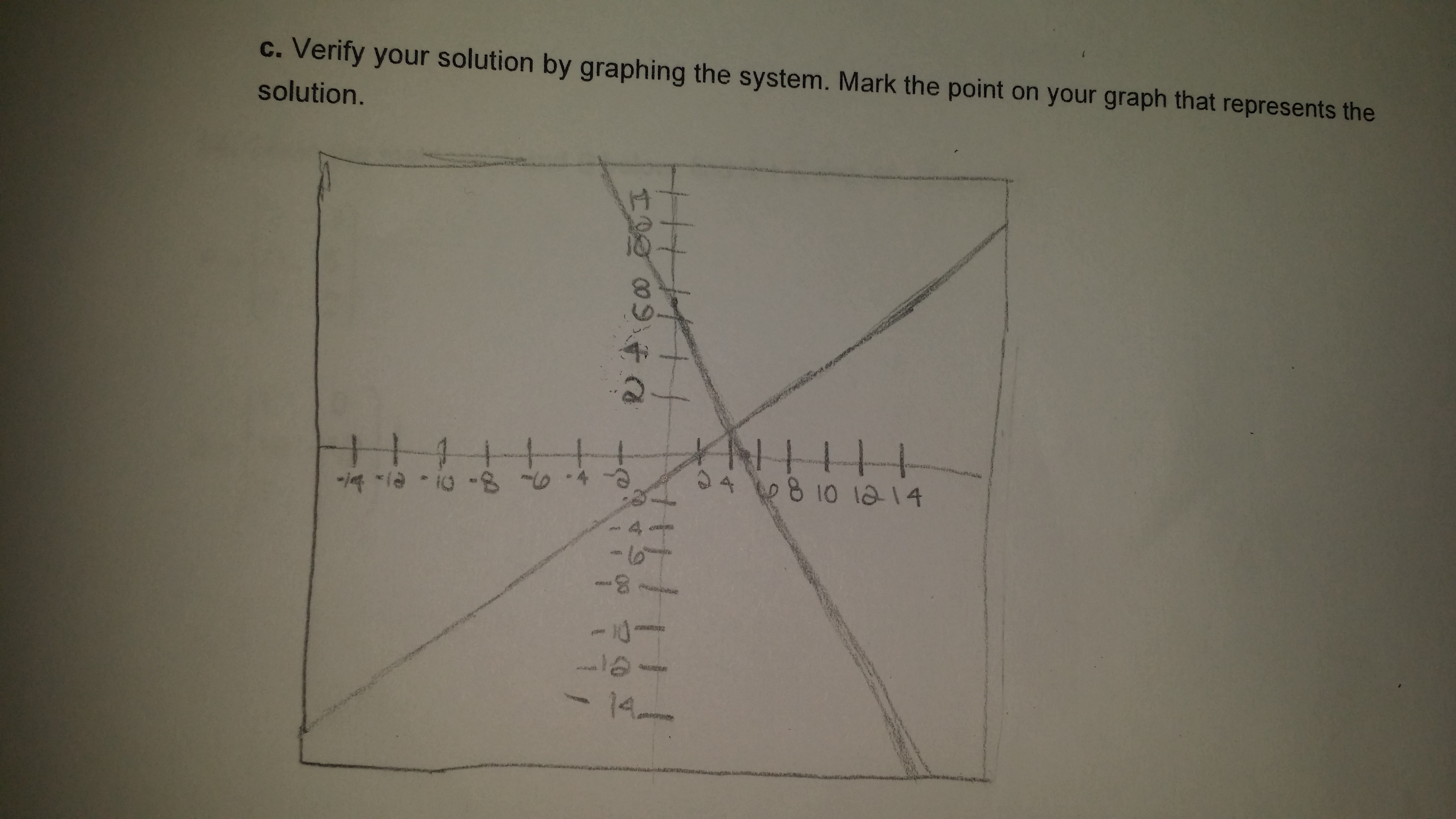
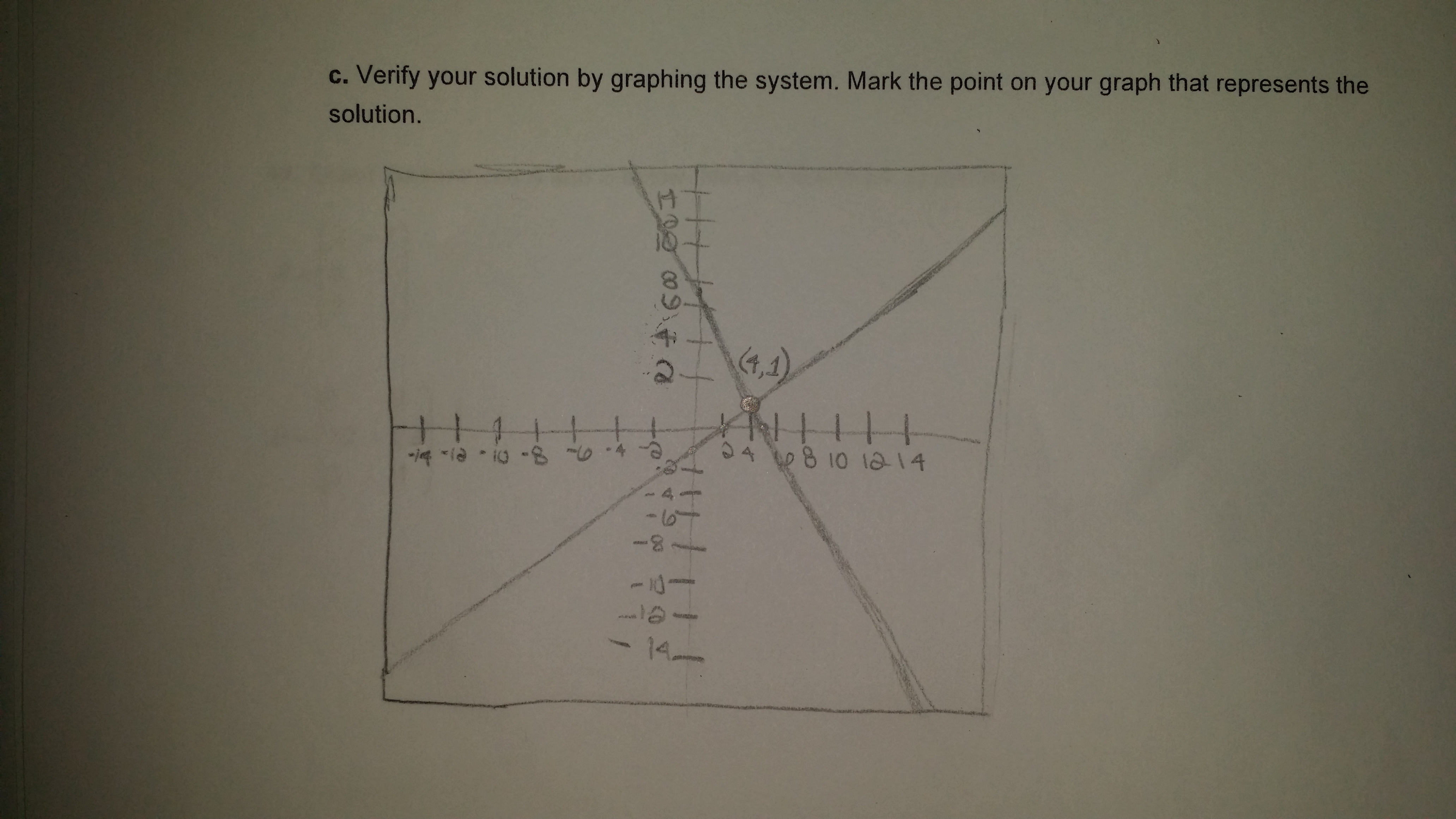
awesome, and then for part c you would just graph them and confirm that they intersect at (4,1)
zarkam21:
SO just graph the two systems of equations given
Vocaloid:
yes
 Vocaloid:
good, now be sure to mark the intersection as (4,1)
Vocaloid:
just make a point at (4,1) and write (4,1) besides it
 Vocaloid:
awesome, that's it for c
Join our real-time social learning platform and learn together with your friends!
 VERNEISH:
Two objects are moving along separate linear paths where each path is described by position, d, and time, t.
VERNEISH:
Two objects are moving along separate linear paths where each path is described by position, d, and time, t.

 Maci:
what are the best stock apps for people who want to start investing?
Maci:
what are the best stock apps for people who want to start investing?
 Twaylor:
genuienly how do i get better self control i keep watcing youtube and theres this
Twaylor:
genuienly how do i get better self control i keep watcing youtube and theres this
 IzzyCookie:
|dw:1792074056138:dw| Uhm, I don't know where to ask this, but I'm in college welding at my community college, and I need help learning vertical welding for
IzzyCookie:
|dw:1792074056138:dw| Uhm, I don't know where to ask this, but I'm in college welding at my community college, and I need help learning vertical welding for

 thehearken:
not sure if this is considered spam, im sorry if it is, but does anyone have tips
thehearken:
not sure if this is considered spam, im sorry if it is, but does anyone have tips