
 Ultrilliam:
Math LaTeX
 Elsa213:
\(\frac{2}{1}\) = `\frak`
Elsa213:
Wait.. nerp... `\frac`
Ultrilliam:
\( \sf\Large1.~~Not~Sure\\ \sf\Large2.~~Domain~(-\infty,4)\bigcup(4,\infty), Range~(-\infty,5)\bigcup(5,\infty)\\ \sf\Large3.~~4x^2-9x+7+\frac{x-2}{x^2+x+1}\\ \sf\Large4.~~16x^2+1\\ \sf\Large5.~~x=-3,y=2x-6\\ \sf\Large6.~~Not~Sure\\ \sf\Large7.~~(x=7),~(x=-1),~(x=1)\\ \sf\Large8.~~(x=3),~(x=-2),~(x=-1+i),~(x=-1-i)\\ \sf\Large9.~~x^9-12x^2+55x^2-114x+90x\\ \sf\Large10.~~f(x)=\frac{1}{x-5}+\frac{1}{2}=\frac{x-3}{2(y-5)}\\ \sf\Large11.~~Can't~Factor \)
Ultrilliam:
shoo elsa
Elsa213:
Okay. >.>
Ultrilliam:
@Vocaloid Can you check my answers?
Ultrilliam:
and help me on the ones I'm not sure of?
 Vocaloid:
am I checking your math or am I checking your coding?
Ultrilliam:
Math
Vocaloid:
where are the original problems
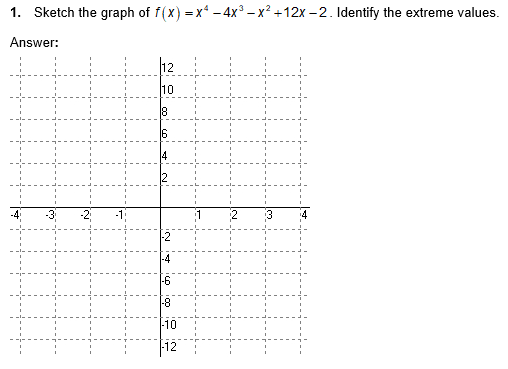
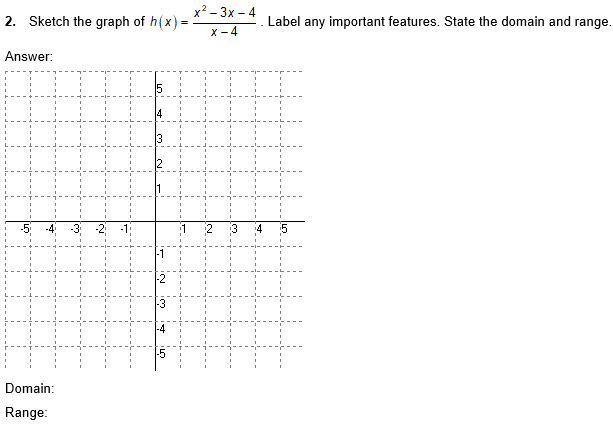








 Ultrilliam:
There they are, in number order
Vocaloid:
I'm a little stressed out right now but I'm going to see if one of my friends can help you ;_;
 methethpropbut:
\(\color{#0cbb34}{\text{Originally Posted by}}\) @Ultrilliam \( \sf\Large1.~~Not~Sure\\ \sf\Large2.~~Domain~(-\infty,4)\bigcup(4,\infty), Range~(-\infty,5)\bigcup(5,\infty)\\ \sf\Large3.~~4x^2-9x+7+\frac{x-2}{x^2+x+1}\\ \sf\Large4.~~16x^2+1\\ \sf\Large5.~~x=-3,y=2x-6\\ \sf\Large6.~~Not~Sure\\ \sf\Large7.~~(x=7),~(x=-1),~(x=1)\\ \sf\Large8.~~(x=3),~(x=-2),~(x=-1+i),~(x=-1-i)\\ \sf\Large9.~~x^9-12x^2+55x^2-114x+90x\\ \sf\Large10.~~f(x)=\frac{1}{x-5}+\frac{1}{2}=\frac{x-3}{2(y-5)}\\ \sf\Large11.~~Can't~Factor \) \(\color{#0cbb34}{\text{End of Quote}}\) 2, 3, 4, 5, 7, 8, 11 are correct. For 10 I assume you mean \[f(x)=\frac{ x-3 }{ 2(x-5) }\] and made a small typo there, but otherwise it's right
Ultrilliam:
For number 1, (2.795,-2.583) and (-0939,-10.061)?
methethpropbut:
\(\color{#0cbb34}{\text{Originally Posted by}}\) @Ultrilliam For number 1, (2.795,-2.583) and (-0939,-10.061)? \(\color{#0cbb34}{\text{End of Quote}}\) Those are the two minima yes, not too easy to find though! There should be a turning point that's a maxima as well between them, if you're looking for that point as well. Also in question 6, there are 4 sign changes and hence the rule tells us that all roots are positive..
Ultrilliam:
For number 6 are the roots, \(\large1,\frac{1}{2},\frac{1}{4},5,\frac{5}{2},\frac{5}{4}\)?
Ultrilliam:
I will be right back
Join our real-time social learning platform and learn together with your friends!
VERNEISH:
Two objects are moving along separate linear paths where each path is described by position, d, and time, t.

 Maci:
what are the best stock apps for people who want to start investing?
Maci:
what are the best stock apps for people who want to start investing?
 Twaylor:
genuienly how do i get better self control i keep watcing youtube and theres this
Twaylor:
genuienly how do i get better self control i keep watcing youtube and theres this
 IzzyCookie:
|dw:1792074056138:dw| Uhm, I don't know where to ask this, but I'm in college welding at my community college, and I need help learning vertical welding for
IzzyCookie:
|dw:1792074056138:dw| Uhm, I don't know where to ask this, but I'm in college welding at my community college, and I need help learning vertical welding for

 thehearken:
not sure if this is considered spam, im sorry if it is, but does anyone have tips
thehearken:
not sure if this is considered spam, im sorry if it is, but does anyone have tips