
 Vocaloid:
Matrix Diagonalization (cont.)
 Vocaloid:
I am honestly lost on this one @sillybilly123
 sillybilly123:
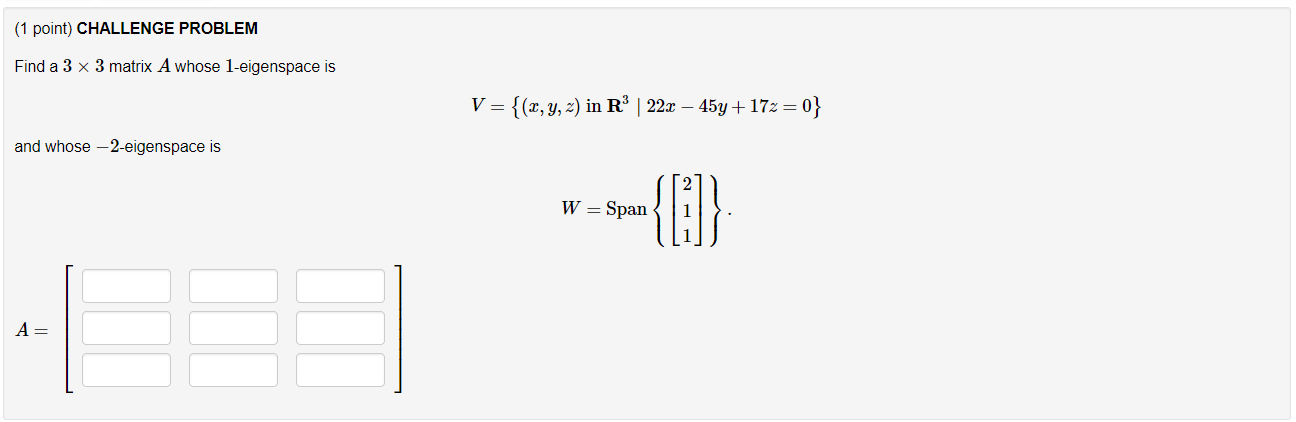
V: For \(\lambda = 1\), generate a few vectors on that \(\pi ~ : ~ 22x - 45 y + 17 z = 0 \) plane. Eg: - if x,y = 1,0 then \(\mathbf v_1 = <1, 0, - 22/17>\) - if x,y = 0,1 then \(\mathbf v_2 = <0, 1, 45/17>\) For \(\lambda = -2\) which lies along the line pointing \(\mathbf v_3 = <2,1,1>\) from O, that's its eigen-direction So we can now [reverse(!)-]diagonalise: \(A = S \Lambda S^{-1}\) \(= \begin{bmatrix} 1 & 0 & 2 \\ 0 & 1 & 1 \\ -22/17 & 45/17 & 1 \end{bmatrix} \begin{bmatrix} 1 & 0 & 0 \\ 0 & 1 & 0 \\ 0 & 0 & -2 \end{bmatrix} \begin{bmatrix} 1 & 0 & 2 \\ 0 & 1 & 1 \\ -22/17 & 45/17 & 1 \end{bmatrix}^{-1}\) \(= \begin{bmatrix} -29/4 & 135/8 & -51/8 \\ -33/8 & 151/16 & -51/16 \\ -33/8 & 135/16 & -35/16 \end{bmatrix}\) Next try out A on the eigenvectors to see that it works. Lot easier starting here: https://www.wolframalpha.com/input/?i=((1,0,2),(0,1,1),(-22%2F17,+45%2F17,1))+*+((1,0,0),(0,1,0),(0,0,-2))+*++inverse+((1,0,2),(0,1,1),(-22%2F17,+45%2F17,1)) Not yet convinced this is the most efficient way to go about this
Join our real-time social learning platform and learn together with your friends!
 DoltonCarlee:
what are y'all's options on S A T essays because honestly their not that bad
DoltonCarlee:
what are y'all's options on S A T essays because honestly their not that bad

 thereneelg:
Can someone give me a summary of article 231, The war guilt clause?? I need to explain what it is, but I can't find any shortened version of what it is and
thereneelg:
Can someone give me a summary of article 231, The war guilt clause?? I need to explain what it is, but I can't find any shortened version of what it is and
 luisaam2:
What should you do when the person you want to talk to the most is the one making
luisaam2:
What should you do when the person you want to talk to the most is the one making
 Breathless:
https://medal.tv/games/roblox/clips/nAYivIl6oXB6q9QAI?invite=cr-MSxCSk4sMTY4OTA4N
Breathless:
https://medal.tv/games/roblox/clips/nAYivIl6oXB6q9QAI?invite=cr-MSxCSk4sMTY4OTA4N
 Twaylor:
I'm not that good at law can someone fact check this without bias? June 29, 2026, the Supreme Court decided Chatrie v.
Twaylor:
I'm not that good at law can someone fact check this without bias? June 29, 2026, the Supreme Court decided Chatrie v.
 Demon25:
For a hoco proposal with a cheerleader and football player, what else should be a
Demon25:
For a hoco proposal with a cheerleader and football player, what else should be a
