
 xXMarcelieXx:
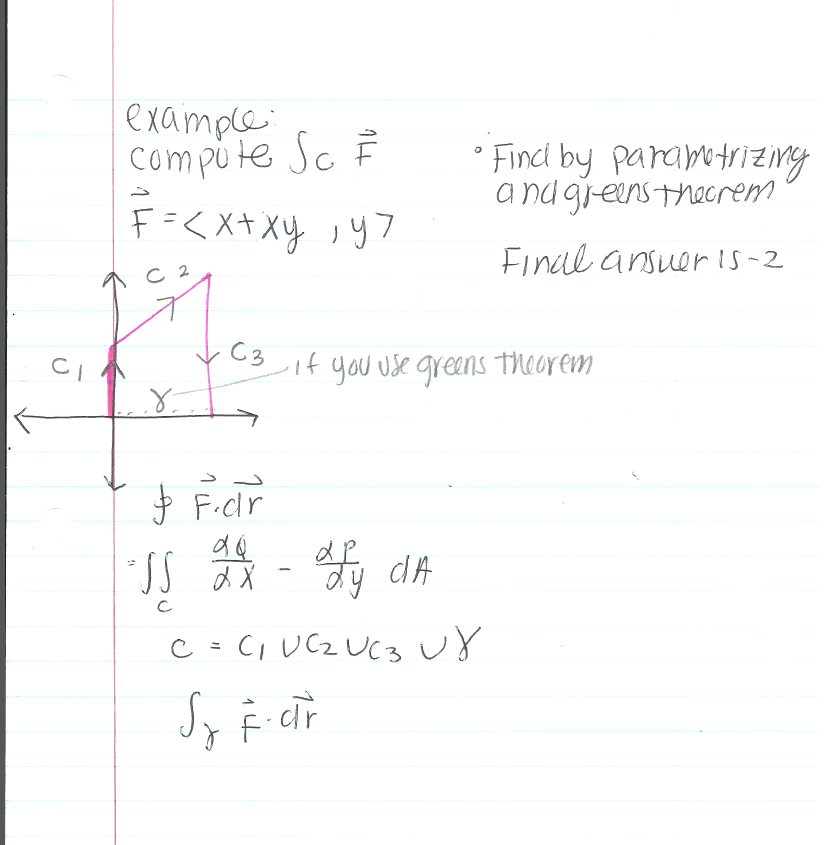
example find by using greens theorem and parametrization
 xXMarcelieXx:
@Zepdrix
 Zepdrix:
What does the thing at the bottom of the contour say? Gamma ... if you use Greene's Theorem? 0_o Sec I gotta go read Paul's Notes a sec x'D
Zepdrix:
Oh it has to be a closed loop in order to apply this theorem, right?
xXMarcelieXx:
yes thats gamma for greens theorem but she said if u were to parametrize it u dont need gamma
Zepdrix:
Hmm :\ thinking...
Zepdrix:
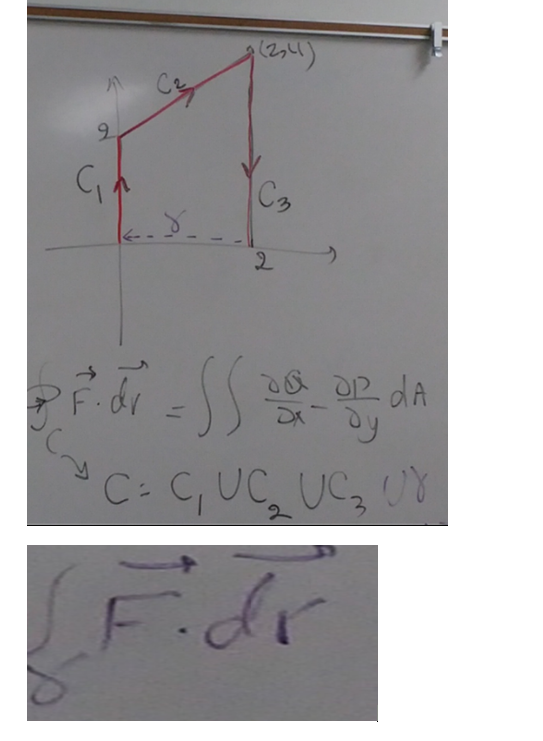
I don't see any values labeled on the graph. How high does c1 go? Does it end at y=1 or something?
Zepdrix:
Do you have points for the c's?
xXMarcelieXx:
oh wait there are points leh me upload the one she wrote on the board
 Zepdrix:
k lemm figure this out :x
Zepdrix:
And the final answer is supposed to be -2? Darn, I came up with -4 ;c Back to the drawing board.
xXMarcelieXx:
hmm yeh
Zepdrix:
Ohh I made an Algebra mistake... I see it now. Ok lemme fix my mistake and see if that tidies things up ;p Then we'll go over it.
xXMarcelieXx:
okie;p
Zepdrix:
Hmm that's even more wrong ;c lol Thinkinggg
Zepdrix:
|dw:1510880920716:dw|
Zepdrix:
We could get some boundaries for the region if we label the sides like that: 0 <= x <= 2 0 <= y <= x+2 I'm not sure how, or why, we would parameterize that.. hmm
xXMarcelieXx:
yeah
 sillybilly123:
Nah :( There is an **unlimited** number of ways to param this (\(\gamma\)) path integral ** Neat 'n' simple one: \(x(t) = 2-t, y(t) = 0 \implies \mathbf r_{\gamma}(t) = <2-t,0>_{t \in [0,2]}\) \(\mathbf r'_{\gamma}(t) = <-1,0>\) \(\int_{\gamma} \mathbf F \cdot d \mathbf r = \int\limits_{0}^{2} <(2 - t) + (2 - t) \cdot 0, 0> \cdot <-1,0> dt = -2\) ** More Contrived, yet Simple One: \( \mathbf r_{\gamma}(t) = <2- 2 \sin t,0>_{t \in [0,\frac{\pi}{2}]}\) \(\mathbf r'_{\gamma}(t) = <- 2 \cos t,0>\) \(\int_{\gamma} \mathbf F \cdot d \mathbf r = \int\limits_{0}^{\frac{\pi}{2}} <(2 - 2 \sin t) + (2 - 2 \sin t) \cdot 0, 0> \cdot <- 2 \cos t,0> dt\) \(= \int\limits_{0}^{\frac{\pi}{2}} - 4 \cos t + 2 \sin 2t ~ d t = -2\) ** Obvious One: \(x(t) = t, y(t) = 0 \implies \mathbf r_{\gamma}(t) = <t,0>_{t \in [2,0]}\) Do that yourself, that's maybe the best place to start if you are lost; but careful as the interval is \(t = 2 \to 0\). Thinking of parameter t as a proxy for time is so helpful as physics is where all this stuff originally came from, and that intuition drives a real practical understanding of what it really adds up to ASIDE: Green's Theorem: the CW path you have drawn/been given will give you the negative answer. Green's (and Stokes') and the whole of vector calculus are driven by the right hand/thumb rule....etc...so the algebra itself is asymmetric. If you do all the other line integrals, you need to watch out for the -ve sign you will inevitably get from Green if you work it correctly
Join our real-time social learning platform and learn together with your friends!
 VERNEISH:
Two objects are moving along separate linear paths where each path is described by position, d, and time, t.
VERNEISH:
Two objects are moving along separate linear paths where each path is described by position, d, and time, t.

 Maci:
what are the best stock apps for people who want to start investing?
Maci:
what are the best stock apps for people who want to start investing?
 Twaylor:
genuienly how do i get better self control i keep watcing youtube and theres this
Twaylor:
genuienly how do i get better self control i keep watcing youtube and theres this
 IzzyCookie:
|dw:1792074056138:dw| Uhm, I don't know where to ask this, but I'm in college welding at my community college, and I need help learning vertical welding for
IzzyCookie:
|dw:1792074056138:dw| Uhm, I don't know where to ask this, but I'm in college welding at my community college, and I need help learning vertical welding for

 thehearken:
not sure if this is considered spam, im sorry if it is, but does anyone have tips
thehearken:
not sure if this is considered spam, im sorry if it is, but does anyone have tips