
 zarkam21:
Help please
 Vocaloid:
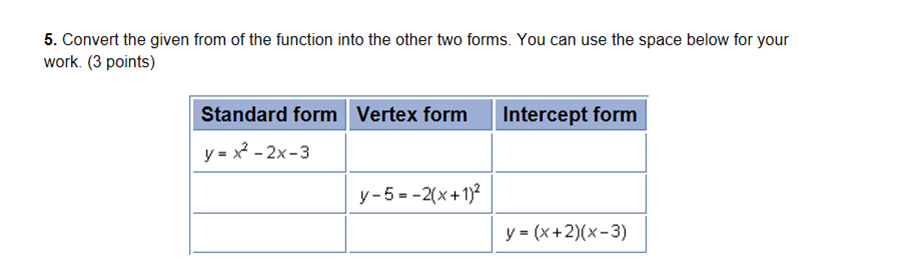
going from standard to vertex form is the most difficult so let's start with that y = x^2 - 2x - 3 first we add 3 to both sides to isolate the x^2 and x terms y + 3 = x^2 - 2x now, we need to add/subtract some number (c) to make the right side a perfect square
Vocaloid:
if a is the coefficient on the x^2 term (1) and b is the coefficient on the x term (-2) we can use the formula c = (-b/2a)^2 to find that value of c
Vocaloid:
b = -2 a = 1 c = (-b/2a)^2 = ?
zarkam21:
4
Vocaloid:
check your calculations again ^^ the denominator should be 2a not a
zarkam21:
-2/2
zarkam21:
-1
zarkam21:
1?
Vocaloid:
good ^^ so we add 1 to each side to get y + 3 + 1 = x^2 - 2x + 1 factor the right hand side
zarkam21:
would it be y=(x-1)^2-4
Vocaloid:
good, but judging by their format they want you to write it as y + k = (x-h)^2 so it would be y + 4 = (x-1)^2
zarkam21:
and this would be vertex form for the first one right?
Vocaloid:
yes
Vocaloid:
to go from standard to intercept, simply factor y = x^2 - 2x - 3
zarkam21:
x-3,,, x+1?
Vocaloid:
good so y = (x-3)(x+1) = intercept form and that's it for row 1
Vocaloid:
for row 2, start with vertex form and convert to standard by expanding y - 5 = -2(x+1)^2 using foil
zarkam21:
would it be \[y=-2x^2-4x+3\]
Vocaloid:
good now to go from that to vertex form, simply factor it
Vocaloid:
hm it looks like it doesn't factor evenly let me check my calculations again
zarkam21:
Yes that's what i concluded as well
Vocaloid:
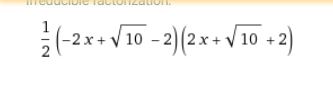
we could use the quadratic formula
zarkam21:
OKay
 cheatingchild:
Here's a tip, use socratic. lmao. It's an app, i don't think they have it for android but they do have it for IPhones. You just scan the equation and it shows you how to do it along with giving you the answer in case you need to check. It works for science and history too.
zarkam21:
I actually like knowing how to solve it by myself :(
cheatingchild:
Ah, well good luck. :)
Vocaloid:
|dw:1512698913051:dw| ngl I kinda forgot what to do from here to turn it into an eqn
zarkam21:
(x + 3)(2x − 1) = 0
zarkam21:
@AngeI
Vocaloid:
I don't think that's quite right ^^
zarkam21:
OH okay :/
 Vocaloid:
we can go back to it i guess
zarkam21:
Yeah that's what I got but i don't think that isright i got the same on mathway
Vocaloid:
anyhoo, for row 3, to go from vertex to standard you just expand (x+2)(x-3) using foil
zarkam21:
\[y=(x-\frac{ 1 }{ 2 })^2-\frac{ 25 }{ 4 }\]
Vocaloid:
oh uh are you still working on that row 2 equation?
zarkam21:
no this is the vertex form for the third row
Vocaloid:
oh, well it's easier to go from intercept to standard first ^_^ so just expand (x+2)(x-3)
zarkam21:
I'm not getting it quite right
Vocaloid:
foil, first outer inner last (x+2)(x-3) = x^2 - 3x + 2x - 6 = x^2 -x - 6 *** sorry, typo
Vocaloid:
then to go from standard (x^2 -x - 6) to vertex we just need to use the method we did at the beginning (completing the square) y = x^2 - x - 6 y + 6 = x^2 - x using the same method we did earlier, find c = (b/2a)^2
 wo1f0mon:
@Vocaloid dont we have latex witch would make this easier to read?
Join our real-time social learning platform and learn together with your friends!
 VERNEISH:
Two objects are moving along separate linear paths where each path is described by position, d, and time, t.
VERNEISH:
Two objects are moving along separate linear paths where each path is described by position, d, and time, t.

 Maci:
what are the best stock apps for people who want to start investing?
Maci:
what are the best stock apps for people who want to start investing?
 Twaylor:
genuienly how do i get better self control i keep watcing youtube and theres this
Twaylor:
genuienly how do i get better self control i keep watcing youtube and theres this
 IzzyCookie:
|dw:1792074056138:dw| Uhm, I don't know where to ask this, but I'm in college welding at my community college, and I need help learning vertical welding for
IzzyCookie:
|dw:1792074056138:dw| Uhm, I don't know where to ask this, but I'm in college welding at my community college, and I need help learning vertical welding for

 thehearken:
not sure if this is considered spam, im sorry if it is, but does anyone have tips
thehearken:
not sure if this is considered spam, im sorry if it is, but does anyone have tips